
01
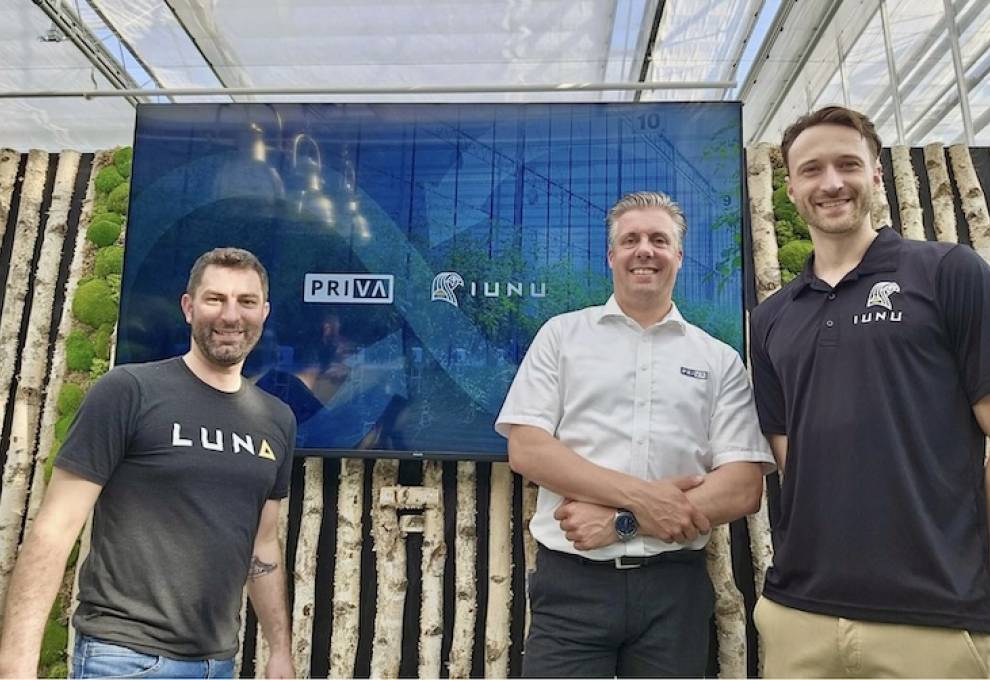
Priva and IUNU team working together at the PROOF Research & Development Centre at HortiTech. Photo courtesy of IUNU.
IUNU and Priva have announced a partnership that combines climate execution data from the Priva One platform with continuous plant-level insights from IUNU’s LUNA AI system to deliver reliable yield forecasting and prognosis capabilities to commercial greenhouse growers. The integration, available now to joint customers globally, addresses one of the industry’s longest-standing operational challenges: achieving reliable, week-over-week yield forecasts.
“What truly impacts profitability is not whether a forecast is off by a small percentage. Growers can manage small deviations,” said Adam Greenberg, CEO of IUNU. “What causes real damage are the big swings. Unexpected peaks or gaps in harvest volume arrive too late to adjust labour, logistics, or commercial commitments. This partnership gives growers evidence-based forecasts that evolve as their crop responds to real conditions.”
The approach is already delivering results in commercial operations. In one multi-hectare, high-wire vine operation, the grower entered the season confident in the climate strategy and historical yield models. Early in the crop cycle, subtle acceleration in the fruit set began to emerge in specific zones. Because the system continuously monitored plant-level data and tied it directly to executed climate conditions, it flagged a future harvest peak nearly three weeks before it would have been visible in harvest data. That early signal gave the operations team time to adjust labor plans, smooth commercial volumes, and align logistics before the swing arrived.
“The value was not knowing the final number earlier,” the grower said. “The value was having time to adjust before the swing hit.”
Growers cannot build reliable yield forecasts from a single source of data. Constantly shifting interactions between climate execution, plant behaviour, labour decisions, and timing shape yield outcomes. The variation of outside radiation has an influence on plant development. Inside the greenhouse, climate control operates dynamically. Growers adjust setpoints based on energy prices, weather forecasts and crop stage. At the plant level, individual plants grow at different rates, and different sections respond differently to the same conditions.
The Priva One platform provides deep visibility into climate execution. Not what was planned, but what actually happened inside the greenhouse. IUNU’s LUNA AI system adds continuous plant-level insight at scale, capturing real variability across plants, zones, and conditions. Because this learning is automated and continuous, it scales across entire commercial operations without increasing labour or relying on manual crop registration. Unlike forecasting systems that rely on historical variety performance, average conditions, or manually gathered data, this approach learns continuously from the specific facility, genetics, and executed climate strategy.
“When climate execution data and plant-level learning are combined, prognosis shifts from experience-based to evidence-based,” said Meiny Prins, CEO of Priva. “The model adapts as the crop responds. If plant development accelerates or slows, if climate strategies shift, or if labour actions alter plant balance, the system incorporates those effects before they turn into costly volume swings.”
The integrated system enables rolling one-to-eight-week yield forecasts that update as conditions evolve, reducing uncertainty and giving growers time to act. Decisions around climate strategy, labour planning, and harvest timing can be made with confidence rather than reaction. Yield forecasting shifts from a report that explains what has already occurred to a decision-support tool that helps prevent those moments from occurring in the first place.
Priva will showcase Priva One and discuss the IUNU integration at the following upcoming events:
• - Fruit Logistica in Berlin from February 4–6, Priva booth A40
•
- Indoor Agcon in Las Vegas from February 11-12, Priva booth 625, IUNU booth 732
•
- HortiContact in Gorinchem from February 25-26, Priva: booth A20
Source: IUNU and Priva January 28, 2026 news release
Standard (Image)
If latest news
Check if it is latest news (for "Latest News" page)
1 (Go to top of list)

