
01
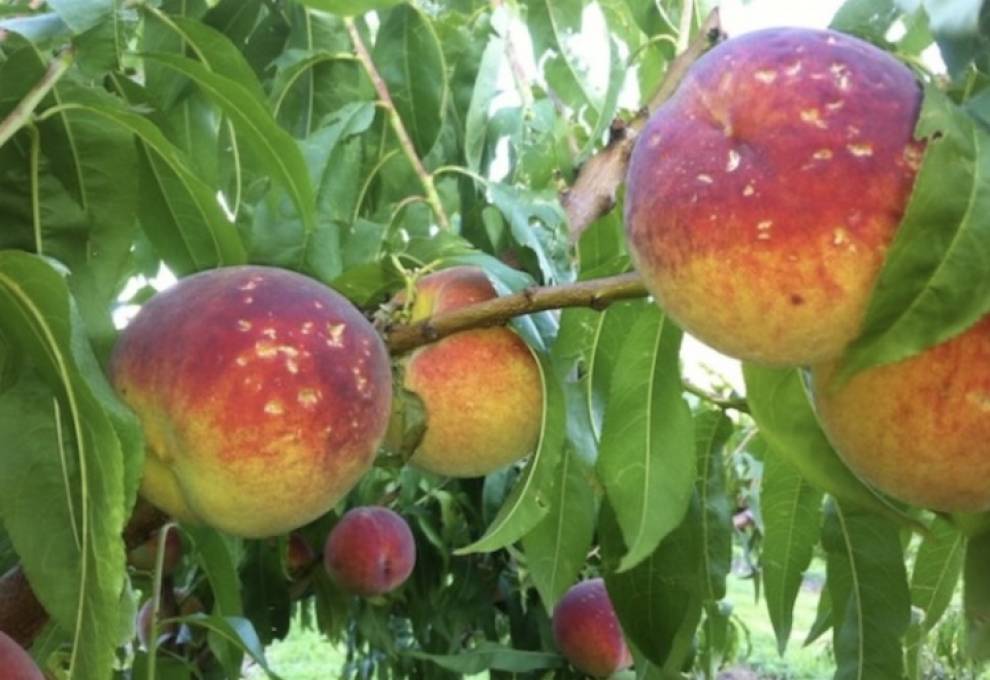
Peaches wasting in Okanagan orchards.
KATHY MICHAELS
Thousands of pounds of fruit are going to waste in Summerland, British Columbia as farms on the frontlines of a firefight sit empty just as the window for harvest opens, offering a devastating blow in what has already been a difficult year.
“It’s almost as though being a farmer has become a hostile experience,” said Adrian Arts, executive director of the BC Fruit Growers’ Association, adding that growers have been hit by heat, drought and now wildfire this year alone.
Peaches that were to be harvested last week will likely rot on the tree and the remaining fruits that aren’t quite ready for harvest will likely be ruined by ash, Arts said. Early-season Sunrise apples were also supposed to be harvested last Saturday.
“They don't have a long window, so I'm guessing a lot of that crop is going to be abandoned along with the peaches, plums, and all the rest of the stuff that was immediately coming ripening in Summerland this week,” he said.
Arts said the repeated crises aren’t just devastating farmers in the Okanagan. They’re also exposing weaknesses in existing government support programs that are no longer meeting their needs.
“We’ve been in crisis now for five, six years,” he said.
Financial supports are often based on five- to 10-year averages of profits. Arts said that after years of repeated losses, the formula is no longer working for farmers.
He said governments need to move beyond discussions and provide concrete support, along with a more holistic approach to managing and protecting the agricultural industry.
Among other things, local governments have been seeking updated funding programs for agricultural water infrastructure, while there are more than $300 million in projects ready to proceed between Oliver, Summerland, Kelowna, Lake Country and Vernon, he said.
Arts also wants governments to invest heavily in wildfire mitigation, saying that would better serve farmers and residents in agricultural zones than many other endeavours.
In addition to tree fruit farmers, the wildfire is threatening Summerland’s wine industry at the height of the tourism season.
Ron Kubek, owner of Lightning Rock Winery, said there will be no red wine this year because of concerns about smoke exposure. Sparkling wines are also likely to not make the cut.
Other wineries may take a different approach, he said, with many awaiting laboratory analysis to determine the extent of smoke exposure and which grapes can safely be used.
Kubek said winemakers have options for dealing with smoke-affected grapes, but those processes can be costly.
He’s spoken to some who used reverse osmosis following the 2021 wildfire season to save their grape crop, though the process is costly and not entirely as effective as one might hope.
Ultimately, however, Kubek said the priority is making sure staff are safe and, if possible, protecting the vines so they can produce again in the years to come.
“We’ve been through this before and we will come out the other side,” he said.
That resolve has been bolstered by an outpouring of support.
Arts said the agricultural community has similarly been buoyed by the generosity and support of people around the region who have rallied around those affected by the fires.
“It’s been beautiful,” Arts said.
He said people have offered places for animals, storage and accommodation for agricultural workers displaced by the evacuations.
Going forward, once the crisis has abated, Arts said he hopes the public support translates into pressure on elected officials at all levels of government.
“We're heading into local government elections. We are seeing some local governments that are actively difficult with agriculture and others that are very supportive in agricultural communities,” he said.
“Residents need to tell politicians that agriculture is worth protecting.”
He urged residents to be vocal and become allies of the agricultural sector.
Kubek said in the days, weeks and months ahead, consumers can support producers hit by this fire by buying local products, including wine, cider, beer and distilled products.
Source: Castanet August 13, 2026 reprinted with permission
Standard (Image)
If latest news
Check if it is latest news (for "Latest News" page)
