
01
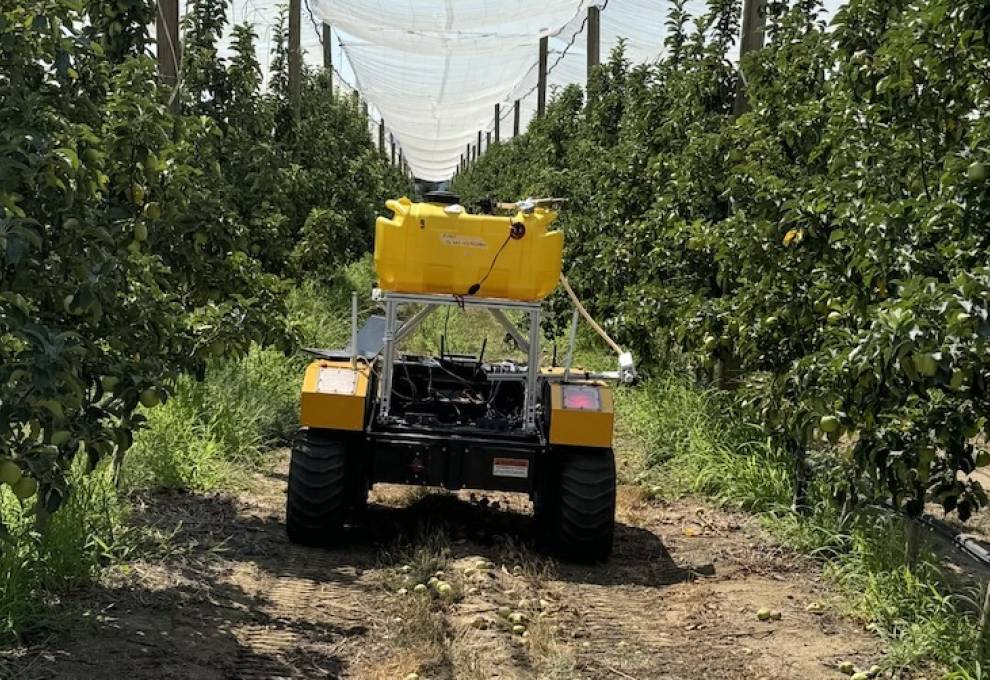
Autonomous sprayer is being tested by WA Tree Fruit Research Commission in partnership with WSU Smart Farm. Similar prototypes will be shown at FIRA-USA in Yakima, Washington.
Concerns over automation and new technology have skyrocketed this fall, since a high-profile AI researcher warned that artificial intelligence is on the brink of causing widespread harm. Some pundits called the doomsday warning alarmist, but few dismissed it…including such luminaries as former U.S. president Barack Obama, who’s joined those wanting an AI slowdown and tighter guardrails on such technology.
The full effect of the anti-AI movement remains to be seen. But it’s bound to put the technology-friendly agriculture and sector food under the microscope.
Here’s why. Growers and suppliers are already active in incorporating AI technology and AI-generated information into some of their operations and management plans, for efficiency. Food production from field to table has always relied on technology, even though the public perceives farming as a very traditional, downhome pursuit. That stoic image has made farmers among society’s most trusted individuals.
And that trust is why agri-food may be the ideal example for how AI, robotics and other new technologies used in practical ways complement conventional wisdom, rather than threaten it. This convergence offers a road map for growers and the public alike.
Later this month in Yakima, Washington, the industry will come together for a unique look at hi-tech, practical field applications at the fifth International Forum for Agricultural Robotics. Organizers call this year’s forum a “travelling tailored event” and promote it as “Where Ag Tech and Robotics Meet Growers.”
Among the items of interest at the forum include what the industry calls technology road maps. In Washington, a two-year apple technology roadmap will be highlighted at the field level, by the Washington Tree Fruit Research Commission and the Washington State University Smart Orchard.
Dr. Ines Hanrahan, the commission’s executive director and a key presenter at the forum, says the apple technology road map shows new technology methodically and practically fits into a well-defined management system, while providing a return on investment.
The apple technology road map is informed by three priority areas, with different times to impact: irrigation in the near term, crop load management as the season progresses, and finally by harvest automation as a long-term goal. Within each area, the existing technology landscape is described, and three-year strategies and activities are identified and prioritized for focus and action.
The strategies all involve new technology, in an integrated way. For example, for irrigation, a local evidence base is being developed to determine how technology can be used to optimize sensing the soil-plant-atmosphere continuum. Researchers are also looking into technology to support climate modeling-driven decisions, and for practically operating automated line control to improve fruit yield and quality.
For crop load management, a strategy is being pursued to advance the availability and effectiveness of production modeling tools, with special emphasis on early-season prediction. The end goal is to give producers access to high-quality data around crop load management as early in the season as possible.
And for harvest labour, the technology road map is helping apple growers get what organizers call “robot ready” by lowering the costs of developing commercially viable mechanical and autonomous apple harvesting solutions.
All this knowledge is adding up, and will ultimately be available to extension personnel working with farmers and others. Hanrahan believes that in three to five years, sensor technology coming out of the Smart Farm will support what she calls individual “prescriptions” for managing and maintaining orchard trees. Research in Washington has enabled irrigation water uptake to decrease by 50 per cent. And as weather extremes grow, water conservation will be an increasing priority for producers and consumers, regardless of where they farm or live.
Hanrahan invites Canadian growers interested in new technology to join this year’s forum. “Having the event in the Pacific Northwest makes it ideal for Canadians to participate,” she says. “You can expect [to hear] a lot of questions that are pertinent to Canadian growers.”
Standard (Image)
If latest news
Check if it is latest news (for "Latest News" page)
1 (Go to top of list)