
01
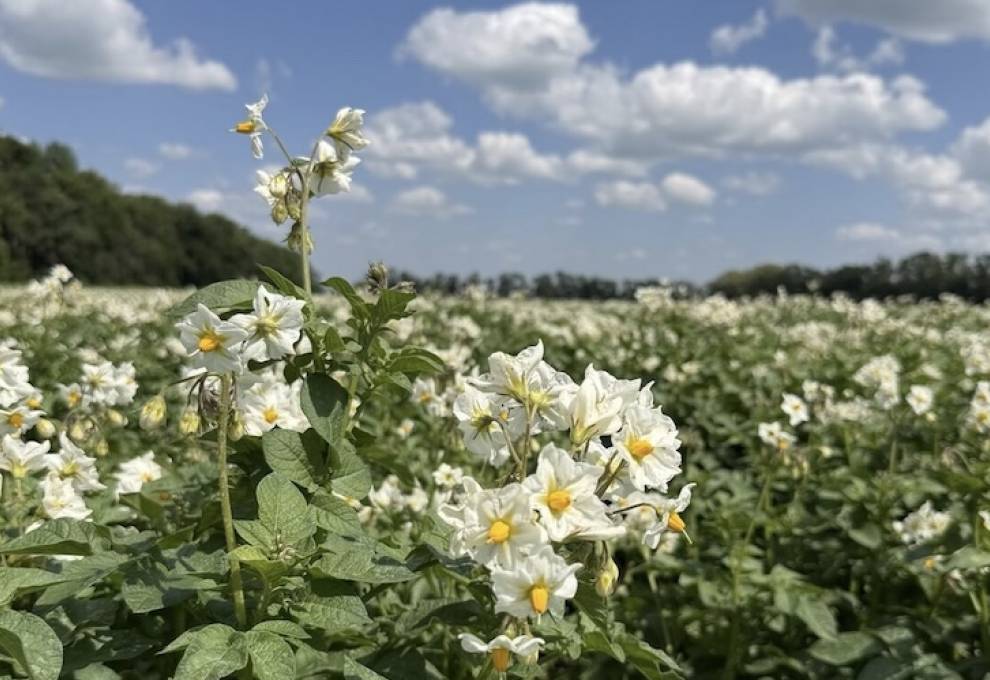
Photo courtesy of Peak of the Market
Statistics Canada released the 2026 seeded potato acreage report on July 17, showing that Alberta continues to expand once again, up five per cent from 80,000 acres to an historic 86,000 acres in 2026. Due to crop rotations and access to irrigation in southern Alberta, growers also produce large volumes with averages that range from 380 to 425 cwt/acre.
Victoria Stamper, general manager, United Potato Growers of Canada, provides insight to the statistics. She says that McCain Foods did not utilize as much Alberta crop as planned from the 2025-2026 season, but the company is now reported to be running at capacity at its new Coaldale plant with expectations that more processing crop will be required for the upcoming season.
In North America overall, supply has outstripped processing demand. Contracts were down in dollars and volumes for the 2026-2027 season. There is added pressure on profitability due to rising costs for fertilizer and diesel. That means the 2026 potato crop is the most expensive ever planted.
Each Canadian province has their own reasons for reduced plantings. British Columbia recorded amazing yields in 2025, so due to oversupply, growers trimmed plantings. Seed acres declined as well.
Stamper is puzzled by the Statistics Canada numbers for Saskatchewan. “I am surprised their acres are down that much as I believe the fresh sector continues to grow, especially with Monette Farms planting anywhere from 800 to 1,000 acres.”
Manitoba planting in the fresh sector is down. “They were long in reds this year and I heard some have reduced their early red acres,” says Stamper. “Processing did get volume back, but it would seem growers were very cautious and did not overplant this year.
Ontario’s acreage is stable, with good processing and chip demand.
Québec’s numbers seem to fluctuate depending on the source of information. While Statistics Canada reports 2.5 per cent increase to 50,086 acres, the growers’ association estimates 47,500 acres, just a bit under the previous year’s numbers. Stamper says all indications are that processing acreage will be down at least in frozen product. Fresh and seed sectors are stable.
Heading east, New Brunswick growers had a reduction in volume from McCain Foods. Prince Edward Island also experienced reductions in Cavendish Farms’ contracts, down almost 10 per cent.
“There is some cautious optimism as stocks, including russets, have declined overall, leaving the pipeline emptier heading into new crop for the first time in a couple of years in Canada but more importantly in the U.S.” says Stamper. “I am not sure the processing sector will correct completely. From what I understand processors are sitting on more frozen inventory compared to last year and exports have continued to soften in the U.S.”
Stamper observes, “We are turning a corner on the oversupply of russets out of the U.S. for the fresh market and the complete erosion of pricing on russets south of the border. As Idaho has moved from the Norkatoh to Burbank variety, crop quality and size profile have changed and we have seen a good improvement in pricing in the carton market for the last two to three weeks. Consumer bags (5 lb poly in the U.S.) are still suffering but have improved from earlier in the year.”
The U.S. acreage is down just over three per cent -- 15,000 acres in Idaho alone-- likely due to cuts in contracts for dehydrated potatoes as well as lower seed acreage. Some acreage may have moved out of fresh russets as well.
Source: United Potato Growers of Canada
Standard (Image)
If latest news
Check if it is latest news (for "Latest News" page)
1 (Go to top of list)

