
01
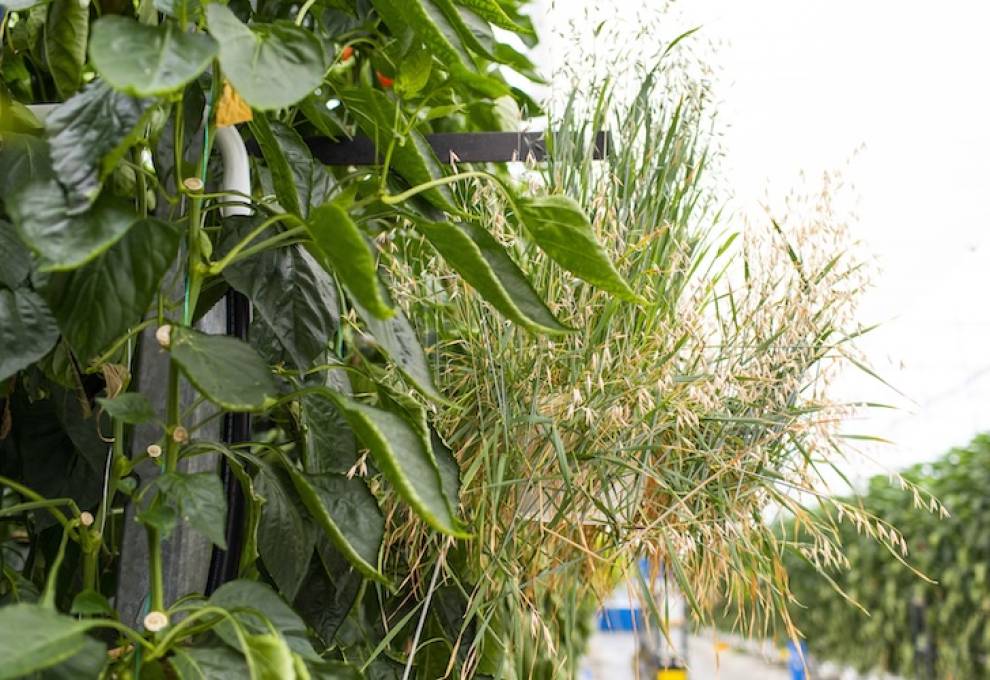
A banker plant that hosts beneficial insects is shown in this pepper greenhouse in Leamington, Ontario.
GREENHOUSE PRODUCE ALLIANCE OF CANADA
Managing pests and diseases is a constant challenge for commercial greenhouse vegetable growers. As pests and plant diseases change, growers need approaches that support a safe food supply, protect people and the environment, and maintain healthy crops while reducing reliance on conventional pest control.
Researchers and companies are evaluating crop protection products, including biological tools and methods that strengthen plant defences, as possible additions to existing greenhouse pest-management practices.
Common greenhouse pests are harder to manage
Spider mites, whiteflies, and thrips reproduce very quickly inside a greenhouse environment. They are notoriously tough to control unless growers start early and take action right away.
No pest control products with entirely new modes of action have been registered for these pests in at least 10 years. With fewer choices, growers repeatedly rotate the same products, which can accelerate resistance and reduce the effectiveness of older treatments. This has increased interest in additional control methods.
Two emerging technologies under review
Two approaches are being studied as potential options for managing greenhouse pests that have developed resistance to existing treatments:
- - Spear T: Spear T is a new product made from a natural spider-venom molecule. Pests such as spider mites, thrips, and whiteflies are paralyzed or killed after contact with it. Because the active ingredient is a protein that breaks down quickly, the product is designed to leave little residue and limit effects on birds, mammals, fish, frogs, and beneficial insects.
- - RNAi: RNAi is a targeted treatment applied to crops to temporarily disrupt an essential biological process in specific pests. It does not genetically modify the plant. The approach is intended to control pests that resist older chemicals while limiting effects on beneficial insects and other non-target organisms. Dr. Vojislava Grbić at Western University, supported by Ontario Greenhouse Vegetable Growers and others, helped develop the technology for two-spotted spider mites. Greenlight Biopesticides is preparing a submission to the Pest Management Regulatory Agency.
Tomato bug emerges as a new threat
The tomato bug (Nesidiocoris tenuis) is a type of omnivorous insect that usually preys on pests such as whiteflies, mites, and thrips. But when those food sources are hard to find, it starts feeding on the crop instead.
Tomato bugs lived in Ontario greenhouses for more than a decade without major problems but recently began damaging commercial tomato and cucumber crops. By 2025, estimated grower losses ranged from $90 million to $288 million. The cause is unknown, but the shift coincides with year-round production under lights, putting major investments at risk.
Research on tomato bug management
Researchers and companies are assessing ways to control this emerging pest. Agriculture and Agri-Food Canada scientist Dr. Labbé and her team found that Pyganic, an insecticide made from pyrethrins extracted from chrysanthemum flowers, was effective against tomato bugs in their research.
Growers gained access to Pyganic through a three-year emergency permit for greenhouse tomatoes and cucumbers running from April 17, 2026, to April 16, 2029. Work toward permanent registration is continuing during the permit period.
Viral diseases affecting tomatoes and cucumbers
Growers are also dealing with serious plant viruses, specifically the Tomato Brown Rugose Fruit Virus (Rugose) and Cucumber Green Mottle Mosaic Virus (CGMMV).
- - Tomato Brown Rugose Fruit Virus (Rugose): This aggressive virus hits tomatoes hard. When it first arrived in Canada in 2020, it wiped out 30 to 70 per cent of crops and cost the sector more than $150 million in lost money across 2020 and 2021. Things got even harder when the United States declared Rugose a quarantine disease, leading to delayed and rejected truck shipments at the border.
- - Cucumber Green Mottle Mosaic Virus (CGMMV): This virus targets cucumbers and is nearly impossible to stop once it takes hold, with some outbreaks wiping out up to half of a crop.
Preventive products for plant viruses
Because plant viruses are difficult to treat after infection, companies are developing preventive products commonly described as plant vaccines. These products are applied to plants and use mild virus strains to activate a plant’s natural defences against more damaging strains. Dutch company Valto has developed a Rugose vaccine and is seeking Canadian approval, while Canadian company A & L Biologicals offers Cuc-Guard for CGMMV.
An aggressive Fusarium wilt on peppers
Back in 2021 and 2022, a new and aggressive root disease called Fusarium wilt showed up in Ontario pepper crops. Confirmed cases ticked up across Ontario and British Columbia by 2023, and by 2024 the disease destroyed more than 150 hectares of crops in Ontario alone.
To prevent Fusarium, growers are testing products such as Trichoderma, a beneficial fungus added to soil or growing media early in the season. It colonizes the root zone and helps keep Fusarium from becoming established. Once peppers are infected, however, few curative options exist, underscoring the need for new treatments.
What does the future hold?
Pest and disease management is part of everyday greenhouse production. Because pests can develop resistance when farms rely too heavily on the same products, growers use a combination of preventive practices, biological controls, monitoring, and selected treatments. Using multiple approaches can slow resistance and reduce dependence on any one control method.
Approaches under consideration include Spear T, plant-based insecticides, preventive products for plant viruses, beneficial fungi, and RNAi technology. Each addresses a different pest or disease issue and remains subject to evidence, regulatory review, and appropriate use within a broader pest-management program.
Standard (Image)
If latest news
Check if it is latest news (for "Latest News" page)
1 (Go to top of list)
