
01
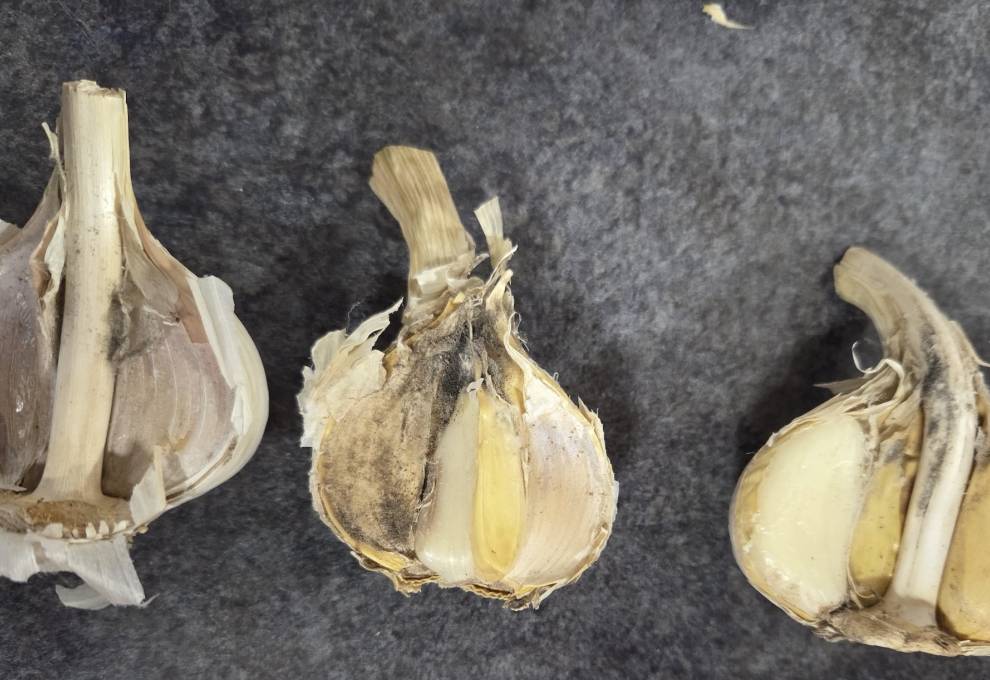
Garlic bulb with a small number of spores and mycelium.
Rhizopus soft rot has been confirmed in Ontario-grown garlic for the first time. Travis Cranmer, vegetable crop specialist and Katie Goldenhar, horticulture pathologist, OMAFA, are reporting the discovery in an ONVegetables.com posting.
The disease is caused by the fungal pathogen, Rhizopus arrhizus, (syn. Rhizopus oryzae) which has been found to infect many other crops including apples, banana, beets, cucumbers, strawberry, sweet potato, tobacco, and watermelon. (Khadiri et al., 2024).
Rhizopus soft rot can be found growing on the inside of the bulb between the clove wrappers in storage. It initially appears as small back dots and has loose, hairy fungal growth. Over time, the fungi cause water-soaked lesions to develop on the clove that eventually turn the clove yellow to dark brown. This disease has been observed in garlic in other countries including India and China. In the summer of 2026, bulbs were split open to reveal fuzzy fungal growth developing along the neck and cloves of garlic bulbs.
Rhizopus arrhizus spores can be found in the soil, decaying organic matter as well as indoor environments, such as storage facilities. Spores are spread through wind, insects and by equipment. They overwinter in the soil and crop debris between seasons and produce thick-walled resting spores (zygospores), which are the long-term survival structure for the fungus. While the ideal temperature range for R. arrhizus development on garlic is not known, studies indicate that it grows well at temperatures above 25°C (77°F). Wet weather at harvest and extended periods of time between harvest and curing creates ideal conditions for Rhizopus arrhizus. Curing facilities that use higher temperatures used to improve the water-holding capacity of the air during curing may subsequently create optimal conditions for R. arrhizus development since it appears to grow well at higher temperatures. (Zhang et al., 2023). Rhizopus spp. are not active below 5°C (41°F).
Special care should be taken as inhalation of Rhizopus arrhizus spores can cause mucormycosis, a serious fungal infection that primarily occurs in immunocompromised individuals or diabetic patients. Wear a mask when handling garlic suspected to have Rhizopus.
While management strategies are still to be explored and no chemical strategies are registered for this disease on this crop, it is expected that cultural management strategies such as avoiding long periods between harvest and cure will help reduce the risk. Consider using dehumidifiers or air conditioners to remove moisture from the air and keep temperatures lower in the curing facility since higher temperatures can improve Rhizopus arrhizus development. For long-term storage, keep garlic in a cool (-1°C – 2°C), and low-humidity environment. Remove and bury any bulbs with mycelial growth and sanitize the storage and curing area after use. Do not plant cloves with any symptoms of disease, including Rhizopus.
If you have concerns about Rhizopus soft rot in garlic, please contact Travis Cranmer travis.cranmer@ontario.ca;519-835-3382 or Katie Goldenhar katie.goldenhar@ontario.ca; 519-835-5792.
Source: ONVegetables September 14, 2026 posting
Standard (Image)
If latest news
Check if it is latest news (for "Latest News" page)
1 (Go to top of list)

