
01
.
After confirming an established population of spotted lanternfly (SLF) in Essex County on October 13th, the Canadian Food Inspection Agency (CFIA) has announced a regulated area for spotted lanternfly (SLF) in the county of Essex, the city of Windsor, the township of Pelee, and the municipality of Chatham-Kent, Ontario, in accordance with the SLF response framework. Under these regulations, all things moving out of the regulated area to non-regulated areas must be free of all life stages of SLF prior to being moved (see below for what this means for growers).
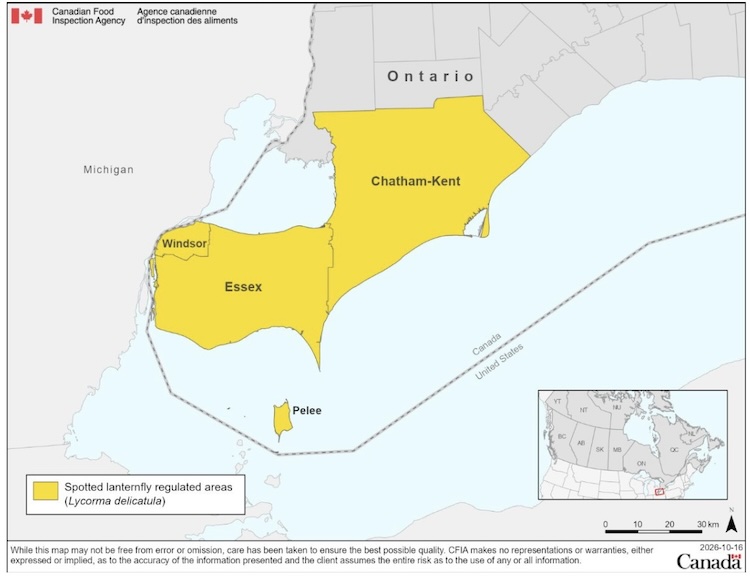
These movement restrictions are intended to help slow the spread of this pest and protect non-infested areas in Canada. The CFIA will continue initiatives to slow the spread to reduce the risk of human-assisted spread of the SLF including raising awareness, education and outreach. Surveillance outside of the regulated area is ongoing.
If you live and/or operate within the regulated area:
- - Check your vehicles and items before leaving the regulated area to confirm they are free from the pest – SLF can “hitchhike” and lay eggs on a variety of items. This travel checklist outlines how to check a vehicle and outdoor items for spotted lanternfly.
- - Make sure SLF is not hitching a ride by:
-
- Killing them on sight – stomp or squish adults immediately
- Scraping the egg masses – into a sealable container and soak with soapy water or crush the egg masses completely ensuring nothing falls to the ground, as untouched eggs can still hatch
-
- - Scout your vineyard for adults and egg masses, particularly on the lower vine trunk and the protected, underside of the trellis end posts.
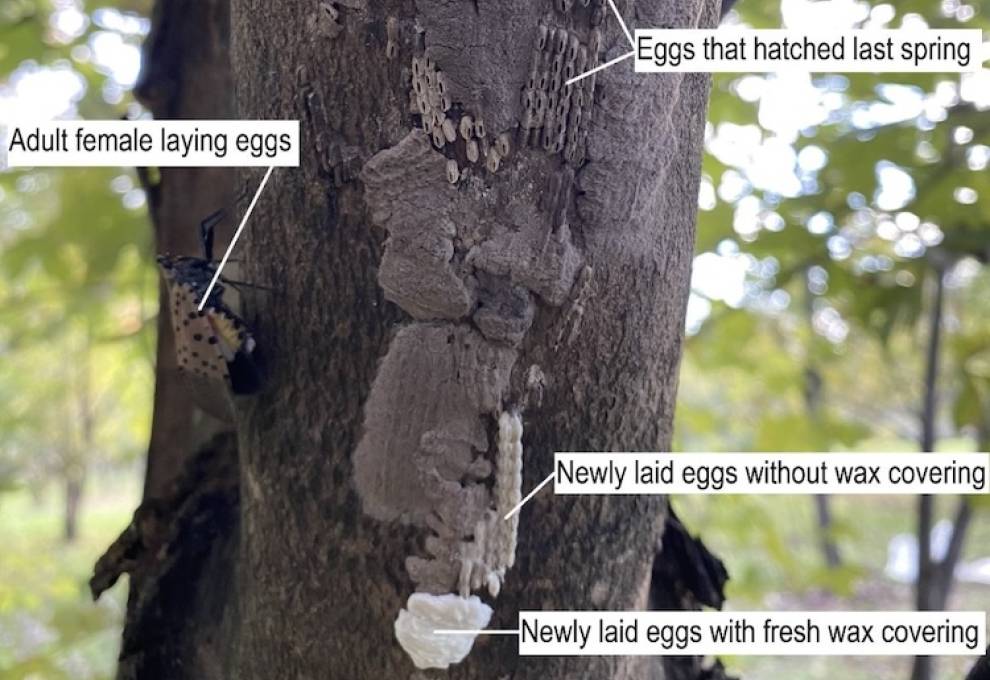
At this time of year, be on the lookout for the adult phase of SLF; about 2-3 cm long, they have pinkish-grey wings with black spots and black veins at the tips. When the forewings are open, the bright red underwings become visible (for example in flight). Egg masses can be found year-round – look for 2.5 cm-long greyish, dried mud-looking secretions on natural and artificial surfaces outdoors.
If you find SLF in or near your vineyard contact Dr. Wendy McFadden-Smith, Grape IPM Specialist, OMAFA, for management consultation at 905-932-8965 or wendy.mcfadden-smith@ontario.ca.
Report this pest to the CFIA on their SLF webpage IF:
- - it is outside of the regulated area of the county of Essex, city of Windsor, township of Pelee
- - it is within the regulated area of the municipality of Chatham-Kent (area adjacent to an established population)
- - in other areas of Canada
Viticultural Resources:
- - "Spotted lanternfly prevention practices for grape producers", Ontario Ministry of Agriculture, Food and Agribusiness' (OMAFA)
- - "Impacts and Management of SLF", Dr. Wendy McFadden-Smith's 2026 OFVC Presentation
Educational Resources:
- - Invasive Species SLF webpage for identification resources, such as posters and a 'spotted lanternfly course' can be found on the These can be shared with staff, contract workers and the public.
Grape Growers of Ontario is working with provincial and federal governments to stress the impact this invasive insect could have on the grape and wine industry and economy. GGO is emphasizing the importance of early detection and access to the necessary crop protection tools. Emergency use and label expansion applications have been submitted for products that support SLF management in vineyards. GGO remains vigilant and committed to advocating for growers needs and will continue to provide up-to-date information to help protect their vineyard.
Please contact Keara White at kwhite@grapegrowersofontario.com or 289-929-7384 if you have any questions.
Source: Grape Growers of Ontario October 23, 2026 newsletter
Standard (Image)
If latest news
Check if it is latest news (for "Latest News" page)
1 (Go to top of list)

