
01
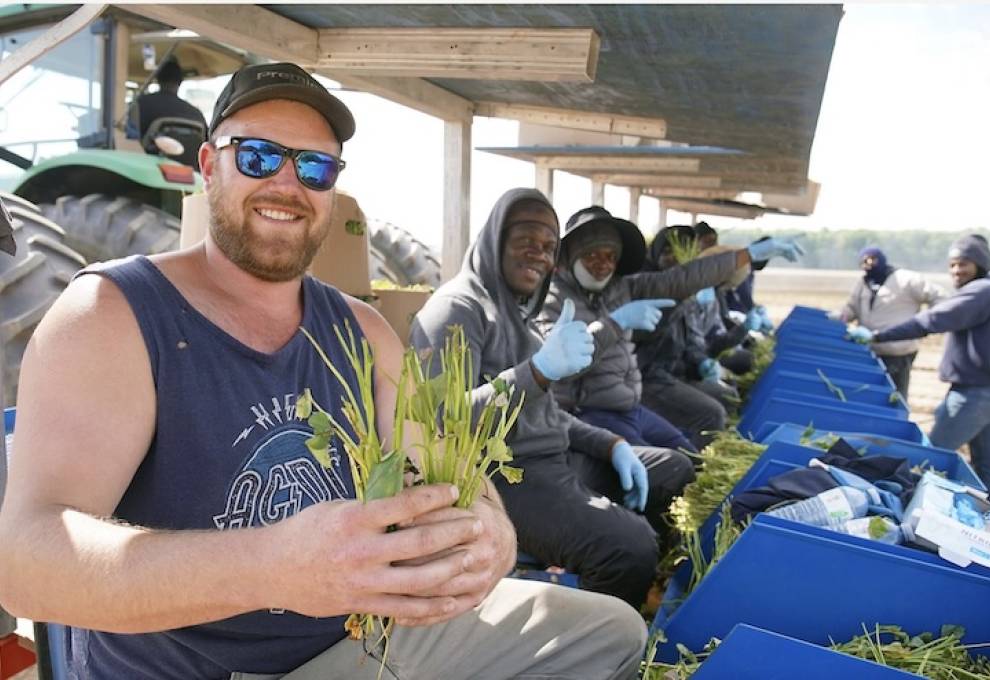
As Dylan Streef attests, Streef Produce Ltd. could not grow 3,000 acres of vegetables and cash crops without the devotion of its Jamaican crew. Here, they are planting sweet potato slips near Princeton, Ontario. Photo by Jeff Tribe.
Last year, 70,000 temporary foreign workers (TFWs) voted, with skilled hands, two thumbs up for farming jobs in Canada. Alfred Campbell, who retired in 2025 after 30 years at Streef Produce Ltd, is one such example. His work here contributed to his six children going to university back home in Jamaica.
“Streef Produce was never just a workplace – it was family!” he said. “I loved watching the next generation grow into taking over the operation.”
Brothers Dylan and Nathan Streef, part of that generational change, today support 32 Jamaican TFWs tending to 3,000 acres of potatoes, sweet potatoes, asparagus, green beans and cash crops grown on the family farm near Princeton, Ontario. The operation routinely uses big iron to plant and harvest, but as Dylan Streef points out, TFWs work hand in hand with this equipment.
“We have invested in an optical potato grader, an optical asparagus grader and roboticized palletizing equipment,” says Streef. “This new technology improves product consistency and operational efficiency while also enhancing workplace safety by reducing physical strain and the risk of injury to our staff.”
Looking to comment on the current state of farm automation, the Royal Bank of Canada (RBC) recently published “The Next Generation of Growth: cultivating a new crop of agricultural talent and innovators.” In discussing the report, Lorna McKercher, RBC director, national agriculture noted that “we predict that one in three jobs in agriculture could be automated in the next decade.”
Dylan Streef agrees, but with a caveat: agriculture relies on a balanced approach to labour and equipment. Asparagus and sweet potatoes, for example, need a lot of manual labour from planting to harvesting. Technology may be well-suited for repetitive, physically demanding tasks, and improving consistency and worker safety, but people remain essential for oversight, decision-making, problem-solving and quality control. Human judgment is still critically needed.
“Once technology is more advanced and goes through a series of bug fixes, I definitely see some farm operations going fully robotic in the future, especially with rising labour and operating costs,” says Streef. “In regards to our own operation, I can say we value our staff and will always need human beings despite automation.”
Leadership
RBC’s assessment concludes that innovation in the Canadian agriculture sector will benefit from accessing a more diverse, highly qualified talent pool. It highlights that many in the engineering, business and computer science fields are not yet aware of how their skills apply to robotic farming automation, operating multi-million dollar farming businesses, or soil-health monitoring applications.
The report goes on to say that “Agriculture grads are not landing in increasingly influential professions such as policy, data, trade and finance. These occupation fields have an important role in managing risks for agriculture but less than 1.5 per cent in each field have some form of agriculture-focused post-secondary training.”
RBC’s meta-analysis also includes some sobering statistics on current research and development investment. Despite Agriculture and Agri-Food Canada’s Sustainable Canadian Agriculture Partnership funding, currently projected at $3.5 billion for years 2023-2028, the country’s public investment in R & D is in decline. As a standalone, federal investment in Canadian agricultural science and innovation is in even further decline, projected to be down 12 per cent by 2027.
McKercher says that RBC’s thought leadership paper is intended to be “a mechanism to speak to policy makers, beyond the echo chambers of agriculture.” The goal is to broaden the conversation about skills, innovation and competitiveness – a critical conversation that needs to not only strengthen the resilience and competitiveness of Canadian agriculture but also to advance the country’s broader pro-growth ambitions.
Entrepreneurship
All that said, horticulture’s $6 billion plus in annual farmgate sales in 2025 is not an insignificant contribution to Canada’s economy. The sector can lay claim to numerous examples of innovative entrepreneurship as well. Among them, and as featured in recent issues of The Grower, four STEM women – Karli Barton, Azimove Sulthana, Isabella Nardone and Avery Johnson – have shared their individual career trajectories doing greenhouse vegetable research at Agriculture and Agri-Food Canada’s Harrow station. There’s also Dr. Amir Khajepour, director of the Waterloo Centre for Automotive Research, who thought outside the box to design and build robots that enhance controlled environment crop storage.
Looking forward, University of Waterloo engineering grad Matt Stevens represents a work in progress when it comes to agricultural innovation. Stevens, a grower and an entrepreneur, is on the 80th re-design of a straw-shaped, robotic finger to thin apple fruitlets. Following two years of trials in his own hobby orchard and in a commercial orchard, his perseverance might soon be rewarded as his team gears up for next summer’s commercialization trials.
“We’re at that confluence of technology that gets me jazzed for the next five years,” says Stevens. “With the cameras available now, for instance, we can build faster.”
Finite Robotics, founded in 2024 by Stevens, his wife Amanda and friend Mike Giannikouris, arose from practical experience acquired on their farm near Simcoe, Ontario, and the realization that farm labour needed to become more efficient. Since both time and money are finite, Stevens decided, why wait.
To be successful, Finite’s robot needed to master four steps: safely navigate through high-density rows, count and size fruitlets on the tree using machine vision, balance crop load by determining the fruitlets that need to be removed, and lastly, remove targeted fruitlets without damaging others in the cluster. Robotic harvesting requires similar learning but with the added step of binning mature apples without bruising.
“It’s a graveyard of global research companies which have tried to develop a robotic apple harvester,” says Stevens. “We think it’s more doable to try thinning before advancing to harvesting. Because these steps have to be done flawlessly.”
Apple growers currently use both chemical and manual thinning to manage crop load, but Stevens believes robotic thinning has a strategic role. Proficient robot thinning can be deployed in any type of weather. When robots are used, re-entry intervals designed to protect human workers during chemical spraying no longer apply. Manual thinning, as a third pass after chemical and robotic thinning, has the potential to significantly reduce the man hours dedicated to this orchard task.
Partnership
Piloting such robotic innovation along side a grower is key. The prototype “showed all the skills” but successful performance in a large, commercial scale orchard was the next step. Enter Gerbe Botden, Blue Mountain Fruit Company, Thornbury, Ontario, who provided a high-density orchard for further trials.
Botden had previously worked with Jenny Lemieux, co-founder and CEO of Vivid Machines, to develop a visioning system capable of scanning each tree and accurately recording fruitlet placement on every tree in an orchard. This data is then available to prioritize deployment of the Finite Robot within an orchard, where it can thin fruitlets as small as seven millimetres.
Having followed robotic harvester R&D for several years, Botden has yet to see a viable product come to market, noting that it’s tough to duplicate the dexterity of a human hand. Industry data estimates that a human worker can pick an apple using a twist-and-lift motion in three seconds, or about 20 apples per minute. A seemingly high bar for a harvester, but perhaps commercially viable thinning is a good place to start.
Back in Simcoe, Matt Stevens is pushing toward the expected arrival of his yet to be named robot thinner. Should 2026 trials go as planned, commercialization will soon follow. No doubt there’s a need, but as every grower knows, technology you can’t buy is technology you can’t use. Over to you, RBC.
Standard (Image)
If latest news
Check if it is latest news (for "Latest News" page)
1 (Go to top of list)

