
01
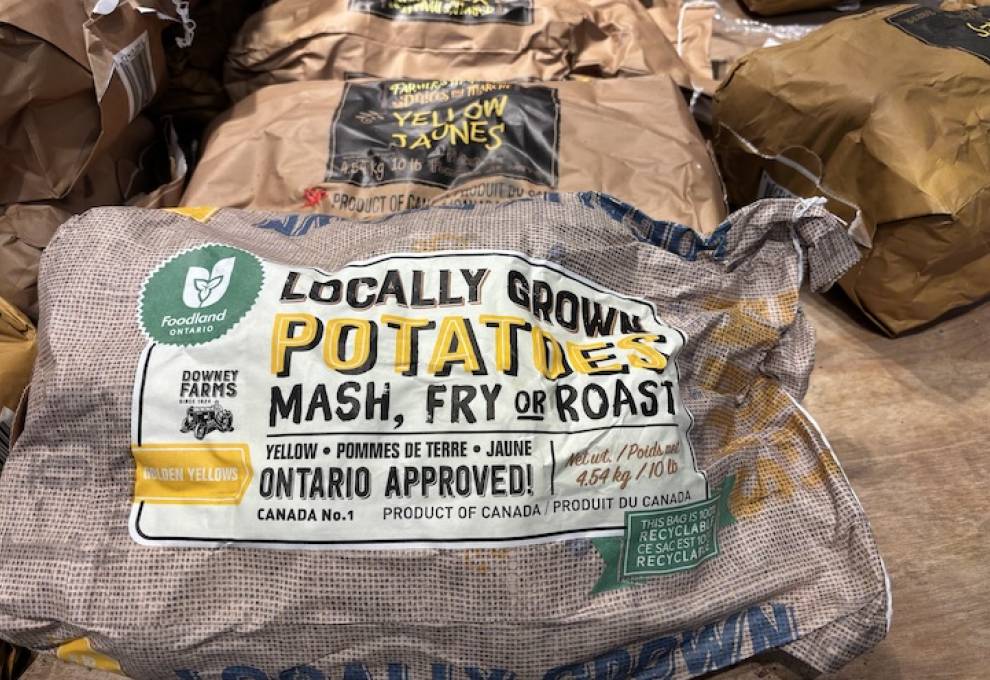
Paper packaging is common for potatoes because light causes greening.
Fibre is good. Plastic is bad. Not so fast.
For growers and packers, packaging decisions have become more complex now that Extended Producer Responsibility (EPR) legislation is rolling out in key markets in Canada. Ontario legislation, for example, went into force as of January 1, 2026.
The EPR goal is to incentivize users to move to recyclable and sustainable packaging. But the diversity of Canadian-grown commodities means that growers must answer several questions for their individual operations. What factors beyond the EPR fee should be considered in calculating the true cost of packaging? Should you be materials-agnostic? And what to make of the recent federal appeals court decision that supports the government’s position of plastic manufactured items as toxic?
Here’s where the packaging file stands according to Daniel Duguay, senior director, sustainability for the Canadian Produce Marketing Association (CPMA). He points out that regulatory actions are yet to be confirmed as a result of the Court of Appeal decision
Regulatory environment is unsettled
Let’s go back to the recent legislative history. In 2023, the Canadian government proposed recycled content regulations that designated plastic manufactured items as “toxic” under the Canadian Environment Protection Act. An umbrella group, Responsible Plastic Use Coalition, objected, citing that the proposed law was unconstitutional and scientifically inaccurate. The Federal Court of Appeal heard the case in June 2024. It took 19 months, an unusual length of time, for the court to rule in January 2026, in favour of the Canadian government’s stance to do away with single-use plastics.
“The fresh produce industry was surprised at this ruling,” explains Duguay, “because of the length of time it took and the relatively straightforward response from the Federal Court of Appeal.”
In the near term, will the Responsible Plastic Use Coalition appeal the decision by end of March 2026? Question two: What will the Carney government do with this renewed authority on banning single-use plastic or will it take a different approach from what was proposed in 2023? Question three: How will the federal government interact with provincial governments on recycling initiatives and ongoing deployment of EPR policies and programs?
The ruling is clearly not helpful for anyone involved in the upcoming CUSMA negotiations. It’s well known that the U.S. government has flagged the zero plastic waste agenda as a potential barrier to trade, jeopardizing food safety, increasing food waste and hindering U.S. agricultural exports.
Mexico has been relatively silent, although the recent January 2026 adoption of the federal Circular Economy Law in Mexico has clarified EPR messaging. Producer responsibility is no longer just about waste management but about full product-lifecycle accountability. The government is emphasizing gradual, sector-by-sector implementation, flexibility in compliance pathways, and strong alignment with design for circularity, while industry and legal commentators stress regulatory uncertainty, data readiness challenges, and the risk of uneven sub-national implementation. Overall, the Mexican government is positioning EPR as a competitiveness and modernization tool, not just an environmental obligation.
The Canadian situation
“Given the current North American and global trade environment, it is critical that the court’s decision does not contribute to trade disruptions or result in negative impacts on food availability, affordability and the reliability of fresh produce supply chains,” wrote Ron Lemaire, president, CPMA, at the time of the court decision in January 2026.
“Ongoing uncertainty has already hindered investments in innovative packaging solutions, waste mitigation strategies and other essential infrastructure, largely due to concerns that future federal plastics regulations could become overly restrictive or harmful to the fresh produce industry.”
The key here is that whatever the EPR regulations are, producers must continue to consider the critical functional role that fresh produce packaging plays to enable sustainable fresh produce supply chains. Thanks to foundational work by the Sustainable Produce Packaging Alignment, a roadmap is published that characterizes packaging needs for numerous fruits and vegetables. Link and scroll to page 24: https://wga.s3.us-west-1.amazonaws.com/science/2025/SPPA%20Report%20.pdf
Notable is the emphasis of varied produce packaging needs based on various groups of commodities: robust produce (e.g. beets, celery, squash); resilient produce (e.g. apples, asparagus, carrots); delicate produce (e.g. peaches, beans, tomatoes); highly perishable (berries); fresh-cut, highly perishable (e.g. leafy greens, bagged salad). When this diversity is analyzed, it’s clear that solutions are mixed. Cut lettuce, for example, needs more than a polybag – it needs modified atmosphere packaging. Berries, for another example, needs more than a fibre punnet – they need a barrier to moisture and some structural integrity to the box.
Functional sustainability
The Sustainable Produce Packaging Alignment, an umbrella partnership organized by the CPMA and U.S.-based Western Growers’ Association concluded that functional sustainability should be the goal. In other words, let’s look at the entire life of the commodity from farmer’s field to consumer’s fork. That view of sustainability is much more holistic than end-of-life sustainability, whether the container is recyclable, reusable or compostable.
Duguay points out that functional sustainability considers a number of factors. If a packaging choice requires more space on a transport and therefore more trucking to get the same amount of product to market, then the tally of greenhouse gas emissions will be higher. If the packaging results in fewer days of shelf life and the retailer can sell only 90 units out of 100 delivered, then those food waste costs need to be part of the equation. If the consumer can’t inspect the produce in packaging, then fewer units may be sold regardless of how sustainable the packaging is.
“Anecdotal evidence of consumer behaviour shows that sales can plummet by up to 50 per cent if consumers can’t inspect the product for freshness and integrity,” says Duguay.
The packaging decision is often in the hands of the procurement manager who may account for material costs and the new EPR fee. But the reality is that packaging decisions are not just about cost, but rather return on investment across the totality of the supply chain – from field to fork. The total cost-of-ownership perspective is increasingly being recognized as a key consideration when looking at the best packaging decision.
As 2026 unfolds, the CPMA will be working with members to develop tools to help better account for the total cost of ownership. This will help further balance upfront material costs against shelf life and food loss rates, as well as EPR fees.
Standard (Image)
If latest news
Check if it is latest news (for "Latest News" page)
1 (Go to top of list)

