
01
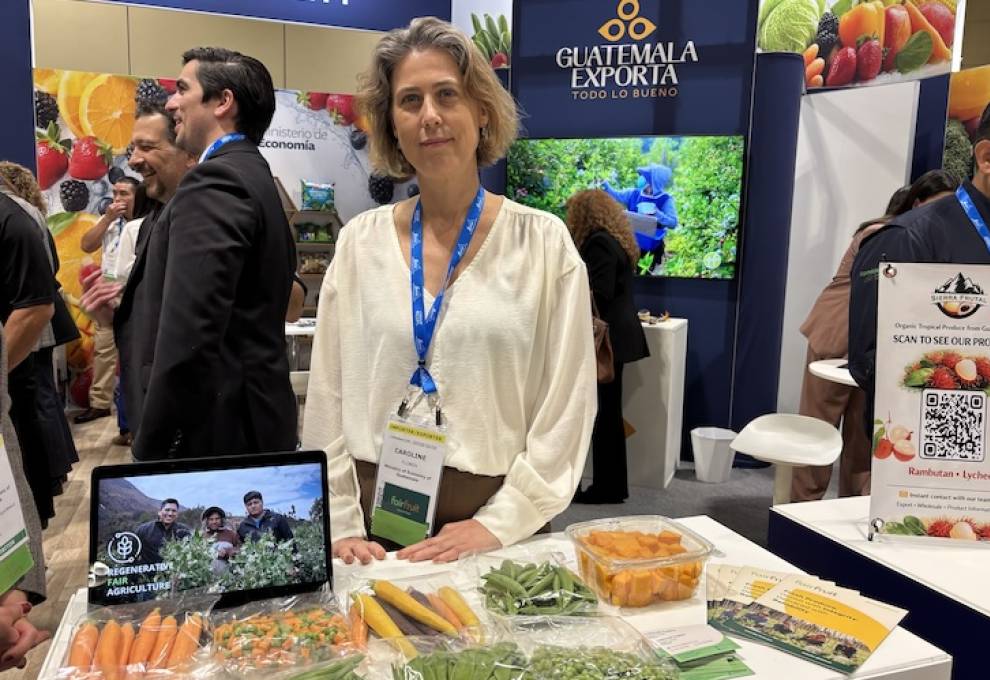
Caroline Floren posed in the Guatemala booth, a first-time exhibitor at the Canadian Produce Marketing Association trade show in April 2026.
Canadian trade negotiators may feel their backs are against the wall when they begin negotiations with their U.S. and Mexico counterparts this month. After all, these countries – particularly the U.S. \ -- are our traditional trading partners. There’s a lot to lose by less trade and less market access.
But in the background, a new scenario has developed. Prime Minister Mark Carney says the days of relying on the U.S. are over and that Canada is much better served by diversifying its trading partners.
Those are encouraging words to other countries who believe they have fruit and vegetables to offer Canada, and activity is starting to stir. Take Brazil, for example. In 2025, it exported almost $54 million worth of fruit – mainly mangoes, watermelon and grapes – to Canada. As well, officials at the Ontario Food Terminal report increased citrus shipments, especially lemons and oranges, arriving from Turkey.
And then there’s Guatemala.
Like Canada, Guatemala relies heavily on trade with the U.S. It’s interested in market diversification and sees potential in upping its game here.
Many natural advantages
Guatemala, a Central American country of 18 million people located just south of Mexico and west of Belize, is blessed with many natural advantages, including fertile soil, a favourable climate, access to both the Pacific Ocean and to the Caribbean Sea, as well as a friendly trade environment.
And it’s no stranger to Canada. Guatemala already exports almost $400 million a year in goods to Canada. Exports to Canada increased by about 57 per cent between 2024 and 2025. But it’s not a one-way street -- imports from Canada grew by approximately 51 per cent during the same period. Agriculture and agri-food products have played an important role in this growth, alongside manufacturing and industrial trade.
Guatemala has maintained an embassy in Canada since 1976. In April, Minister of Foreign Affairs of Guatemala, Ambassador Carlos Ramiro Martínez, paid an official visit to Canada for bilateral meetings with Minister Anita Anand and MP Yasir Naqvi, Parliamentary Secretary to the Minister of International Trade. Discussions included the possibility of a future partial-scope agreement that could eventually serve as the foundation for a free trade agreement between Guatemala and Canada.
The same month, the Canadian Produce Marketing Association (CPMA) organized a trade mission to Guatemala with a delegation of Canadian importers and industry representatives, to explore business opportunities and strengthen commercial ties with Guatemalan exporters. Improved connectivity through direct flights between Montreal and Guatemala City operated by Air Canada has furthered trade potential.
And finally, this year, Guatemala was a first-time exhibitor at the CPMA annual trade show in Toronto in April, displaying homegrown specialty vegetables to a record 4,800 attendees.
Eight Guatemalan companies exhibit here
Eight Guatemalan fresh produce companies took part in the show, including FairFruit, which owns and operates production facilities in Guatemala and Peru. The two countries are some 3,200 kilometres apart and sportcomplementary primary growing seasons (Guatemala - November to April, and Peru - May to November). So, there’s always something coming off the fields and ready for export.
FairFruit’s portfolio includes both conventional and fair trade-certified French beans, peas, brassicas and mini- and coloured carrots, which were featured at its CPMA trade booth.
Evert Wulfrank, CEO of FairFruit USA, was effusive about the Canadian market potential, especially Ontario. He called the province a “priority market” because of the concentration of foodservice, retail, wholesale, and produce import activity. Toronto and Montréal also represent major commercial hubs, he said, with eastern Canada overall providing the most direct and commercially viable route for introducing FairFruit’s produce to Canada.
“Building on a positive track record in the U.S. and Europe, we think the Canadian market offers [us] a large and growing urban consumer base of 40 million people and a thriving food retail market,” he said.
Addressing market gaps
To Wulfrank, FairFruit’s year-round French beans and peas “present a direct, dependable solution that addresses gaps in the Canadian market, backed by values that resonate with Canadian consumers. Our aim is become a recognized, trusted supplier to the eastern Canadian fresh produce trade.”
Adds Caroline Floren, sales and operations manager at FairFruit USA: “We are not just offering products – we are offering a fair partnership. Our goal is to become a trusted, consistent supplier for Canadian buyers and a long-term partner in their growth. The quality of our relationships matters more to us than volume at the outset.”
You may sense a bit of hyperbole in these statements. But measure the country’s enthusiasm for bilateral trade and market access here against the U.S. government’s hostility and disdain for Canada, and it’s clear why opening the door further to Guatemala is worth considering.
Standard (Image)
If latest news
Check if it is latest news (for "Latest News" page)
1 (Go to top of list)