
01
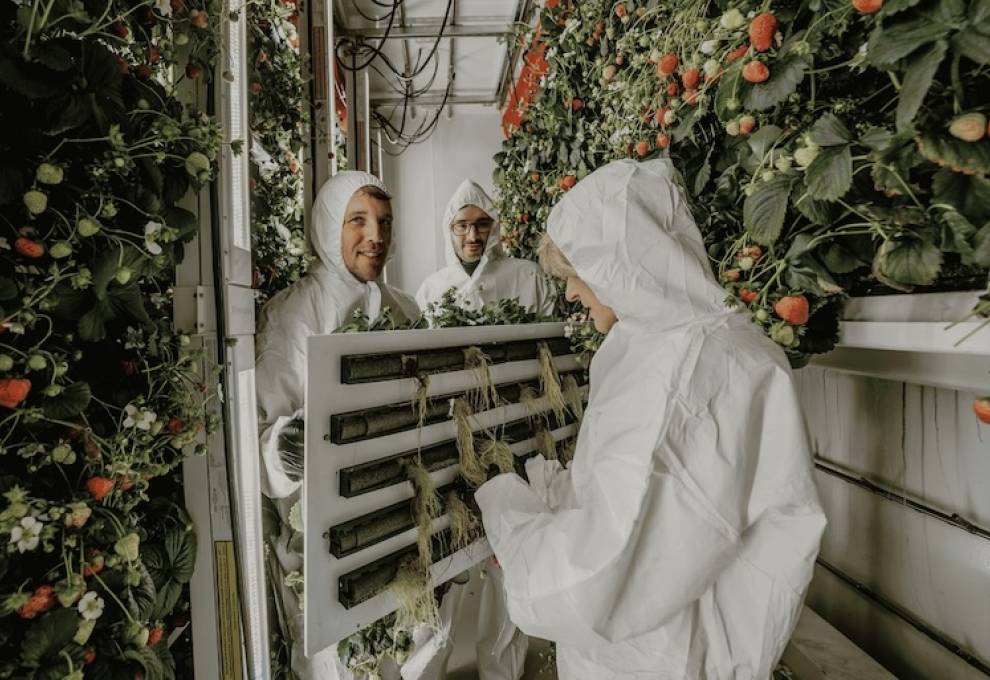
Université Laval team
Launched in 2022, the Weston Family Foundation’s $33 million Homegrown Innovation Challenge set out to answer a deceptively simple question: What would it take to grow berries at scale, year-round in Canada?
Released in September 2026, Homegrown Dispatch Issue 1 highlights the progress made by four teams: University of Guelph, Toronto Metropolitan University, Université Laval and Simon Fraser University.
The University of Guelph, in collaboration with Agriculture and Agri-Food Canada, are looking at AI+lighting+fertigation+greenhouse optimization. Three automated AI systems are at the center of this team’s approach to year-round greenhouse strawberry production. One optimizes LED lighting in response to electricity prices, sunlight and plants needs, another manages climate control for multi-layer growing and a third balances nutrients and reuses water through intelligent rootzone fertigation. Together, the systems aim to increase yields while reducing input costs.
Toronto Metropolitan University, in collaboration with Montel, are looking at airflow+bee-free pollination+microclimate control. Can raspberries be pollinated without bees? Where natural pollinators can struggle under artificial lighting and indoor growing conditions, TMU’s MoFarm system uses guided airflow to support bee-free pollination and create consistent microclimates. The goal is to improve fruit set and reduce yield variability.
Université Laval, in collaboration with Cultivar, are looking at clean transplants + microbiome science. Healthy strawberry crops begin with healthy plants. The Université Laval-Cultivar team is developing disease-free strawberry transplants by combining microbial products that stimulate growth and help prevent disease with the selection and testing of high-quality varieties for indoor production. The result is a reliable supply of clean, consistent, high-quality yielding transplants for growers.
Simon Fraser University, in collaboration with Beritech, are looking at multi-berry production + horticulture+genetics. Rather than focusing on a single crop, SFU and Beritech are developing a lower-infrastructure greenhouse system for off-season blueberries, raspberries and blackberries. The approach combines intercropping, advanced horticultural methods, high-performing varieties, and gene-edited super plants to reduce costs, shorten time to fruit and support continuous harvests.
For an in-depth read, link here: https://homegrownchallenge.ca/the-homegrown-dispatch-issue-1/?utm_source=eblast&utm_id=greenhouseconference
Source: Weston Family Foundation September 28, 2026 newsletter
Standard (Image)
If latest news
Check if it is latest news (for "Latest News" page)
1 (Go to top of list)

