
01
.
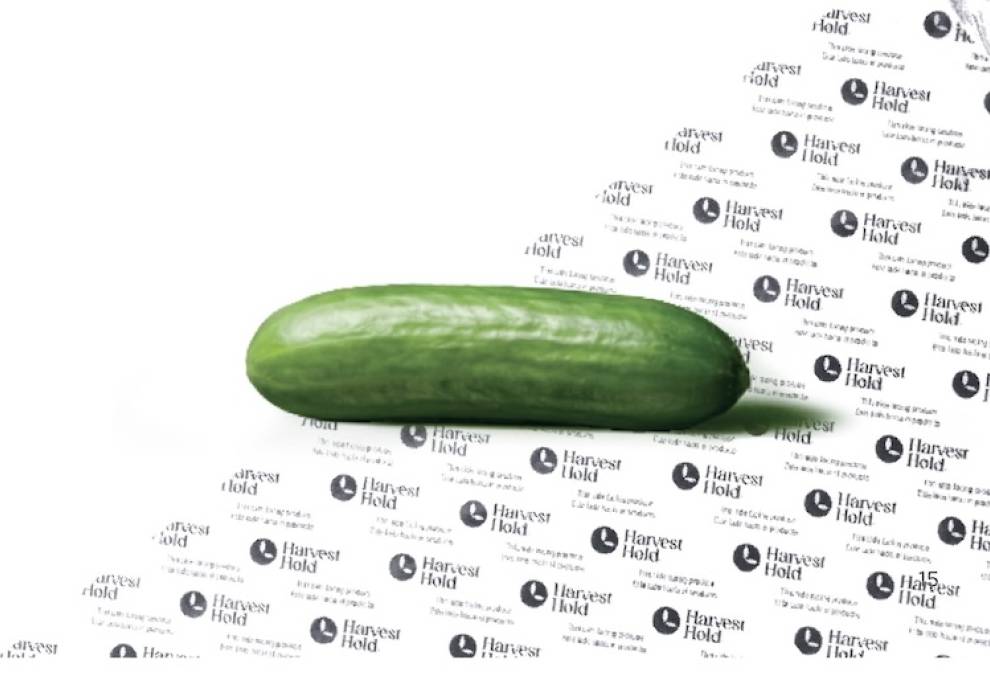
Technology launches are most successful with an understanding of the entire chain: grower to packer to retailer. That’s what Verdant Technologies has done, studying what happens with cocktail cucumbers. To date, their pilots show that HarvestHold Fresh sheets could help extend freshness by an extra four to six days.
HarvestHold Fresh is based on a humidity-activated delivery system to gradually release 1-methylcyclopropene (1-MCP), a proven technology that slows the aging process. It’s been successfully used in broccoli in Canada and the U.S., eliminating the need for ice. It’s also registered for peaches and limes. Now the company is looking at a novel use in the snacking cucumber category.
According to Verdant’s regional sales manager, Andrew Blume, the category is still looking for acceptance by consumers. The four-to-six inch cucumber has more surface area than regular English cucumbers, therefore it’s more sensitive to temperature changes and aging. The product is best merchandized in a smaller grab-and-go bag where taste and texture can be experienced at peak of freshness.
“Consumers want freshness, but providing it consistently is harder than it looks,” says Blume.
Cocktail cucumbers are highly sensitive to handling conditions. Mixed loads, temperature compromises and exposure to ethylene can shorten shelf life before the product reaches its destination. Greenhouse grower and marketer feedback suggests that virus pressure, crop susceptibility and geographical factors are making production less predictable which affects supply consistency, forecasting and cost control.
Blume points out that snacking cucumbers are grown under different production systems, and that’s where growers can tweak their shelf-life results by four to six days with HarvestHold sheets, a significant benefit to the entire chain.
Verdant Technologies is piloting its technology in Canadian greenhouses. The cucumber is picked into a bin containing one sheet. The bin is then shuttled into temperature-controlled storage where it may be held up to 24 hours or until the packer/marketer fulfills an order. The humidity is what prompts the sheet to release its 1-MCP. The sheet is removed once the bin goes to the packing line.
Verdant Technologies has discovered the last food mile determines the eating experience. Even when produce leaves the greenhouse in good condition, in-store handling can undo it. Produce team education is often limited. Display positioning matters. In a pilot project that placed cocktail cucumbers off cold, rather than in the cooler beside mini cucumbers, the results were shelf-life problems and eventual discontinuation.
Mini cucumbers, which already carry a high shrink rate, can be compared more to berries, herbs or cut fruit than traditional vegetables. Their thin skin leads to faster moisture loss. With standard English cucumbers, the typical shrink can be four to eight per cent. With mini, Persian and cocktail cucumbers, the typical shrink can range from eight to 15 per cent. With this market intelligence, Verdant Technologies is refining its understanding of the snacking cucumber category.
For more detail and to pick up a report, visit Verdant Technologies at Booth #1828 at the Canadian Produce Marketing Association trade show, April 29-30, 2026 at the Toronto Metro Convention Centre.
Standard (Image)
If latest news
Check if it is latest news (for "Latest News" page)
1 (Go to top of list)

