
01
.
It’s been a decade since Canadian farmers’ landmark mental health study quantified the undercurrent of anxiety and depression facing producers. So, over the past 10 years, has the situation improved? Become worse? That’s what new research aims to find out.
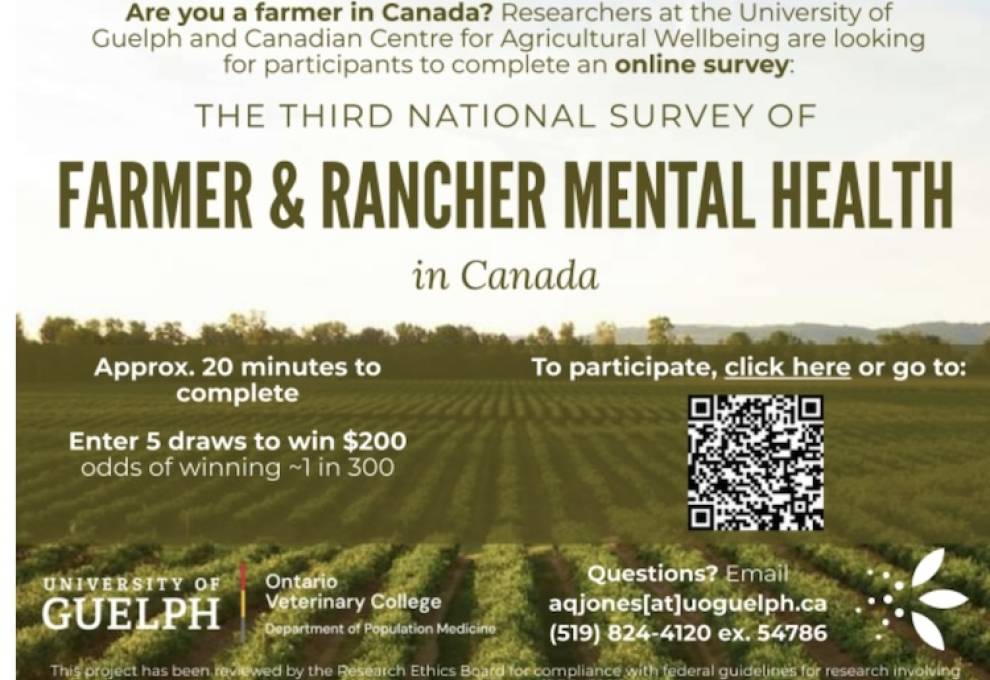
Prof. Andria Jones of the University of Guelph and her team are leading the study. This will be their third such survey; back in 2016, they surveyed 1,110 farmers across Canada, mostly from Ontario, to determine their mental wellbeing, then followed up in 2021.
The 2016 study revealed that stress, anxiety, depression, emotional exhaustion and burnout were all higher among farmers than among other populations. Inside and outside of agriculture, the findings were jolting and downright alarming. The very people that Canadians count on for food production, one of the country’s most essential services, were struggling mightily.
The research results prompted a flurry of discussions designed to figure out what was going wrong and how to address it. The follow-up study that took place in 2021 had a similar number of participants.
Again, the findings were alarming. This time, they were further accelerated by COVID: farmers with moderate to severe scores for any outcome before the pandemic reported worsening symptoms. As well, statistics for women were gathered for the first time. Results showed women fared significantly worse than men across all measures. More than twice as many women reported seeking mental health or substance use support during the pandemic than men.
The two studies succeeded in sparking momentum for change, and action. Most lately, that’s resulted in the Canadian Centre for Agricultural Wellbeing and the National Farmer Wellness Network Crisis Line 1-866-FARMS01) unfolding. These measures have direct ties to the research findings.
Now, with five more years having passed since the 2021 study, Jones and her team are again measuring farmers’ mental health status. They’ll be asking about depression, anxiety, burnout, suicidal thoughts, societal pressures and resilience, and more.
Results from this online study, which takes under 30 minutes to complete and runs until the end of March 2026, will reflect how the current state of world affairs is impacting Canadian producers. She’s anticipating a challenging situation.
“How do management decisions on the farm impact mental health, given specific sources of stress like extreme weather, emerging pests, politics, tariffs and upcoming trade negotiations and the pressure on supply management, among other realities that have piled on since our last survey?” she asks. “These are all on top of traditional stressors like workload, dealing with bureaucracy, finances and machinery challenges.”
New to this study is the mental health status of upcoming farmers, specifically Ontario Agricultural College students who are from a farm.
“They represent part of the next generation of farmers,” says Jones, “and we want to know their mental health status as they prepare for succession, and how issues like extreme weather are affecting their anxiety levels.”
This portion of the study is being conducted with support from the Students Federation of the Ontario Agricultural College, and its president Josephine Meyers. And as an example of how the topic itself is becoming more mainstream, under Jones’s supervision this portion of the survey is being conducted by six students from colleges outside of agriculture or veterinary science, including the colleges of biological sciences and computer science.
As always, Jones and her team will make the results of the study available to provincial and federal decision-makers, to prompt support for mental health programs for farmers.
“We’ve been hearing farmers talk about how the issues have grown, and how they’re having to make management decisions on the fly to accommodate change,” she says. “We’ve even heard fruit and vegetable producers say extreme weather has changed the nutrient content of their produce. That requires adaptation, that can cause stress, and we want to find out what’s going on.”
Visit https://ajresearch.ca/ to participate in this study.
Standard (Image)
If latest news
Check if it is latest news (for "Latest News" page)
1 (Go to top of list)

