
01
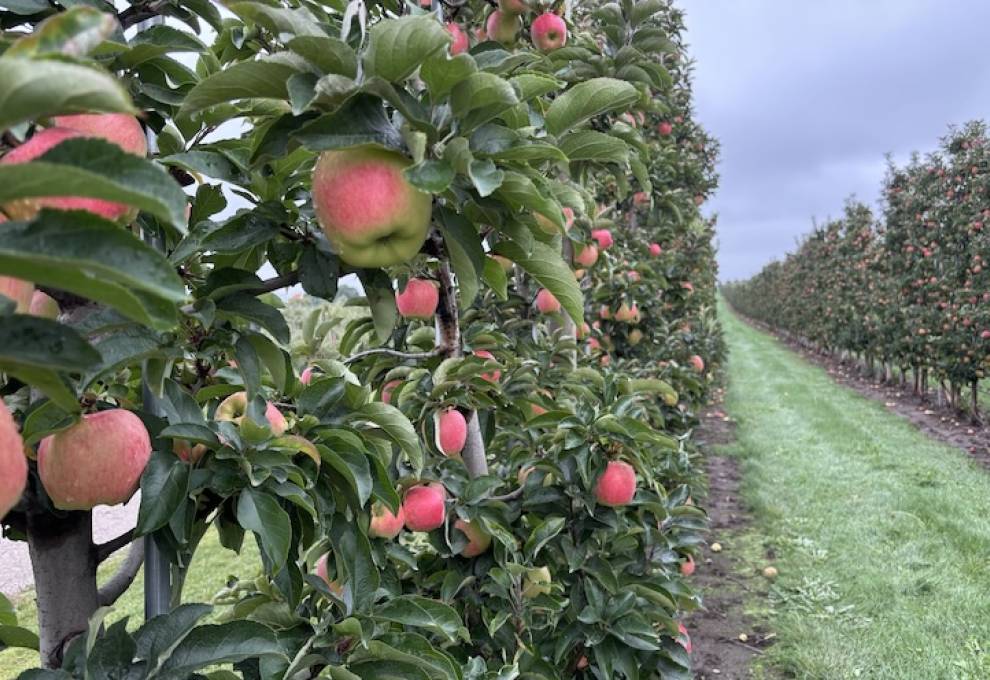
A newly registered post-bloom chemical thinner for apples is one example of the work conducted by the Pest Management Centre.
As discussions get underway in 2026 for the next federal-provincial agricultural policy framework, which will shape government agricultural programming from 2028-2033, a cheap and highly impactful policy option is available at the fingertips – enhanced support for the minor use program.
In the world of crop protection, one will encounter the term “minor use” crops. Crops that fit this definition span most fruits, vegetables, floriculture, nursery, ginseng, Christmas trees, forage, pulses, and less common field crops such as flax. Essentially, if it is not barley, canola, corn, soybean or wheat, it likely falls under the umbrella of a minor use.
Minor use crops are not given this term for their economic value, rather the smaller area of production they occupy compared to the major field crops. The consequence of the relatively smaller footprint is a lack of commercial interest from crop protection companies to develop solutions for these crops. Instead, crop protection companies, who sell products based on acres treated generally focus on major field crops where the big acres are.
However, minor use crops do generate major economic activity. In 2024, collectively these crops produced more than $17 billion in farm cash receipts nationally. Minor use crops represented a full third of the $51 billion in total crop receipts overall. While total crop receipts grew 23 per cent from the period of 2020 to 2024, some minor crop sectors grew at a much faster pace. Cash receipts over the same period for potatoes were up 54 per cent, greenhouse vegetables increased 49 per cent, while Christmas trees grew by 36 per cent. They represent some of the fastest growing components in the agriculture sector overall.
To sustain a thriving minor crop sector, Canadian farmers require effective solutions to manage crop health and reduce losses from insects, disease, and weeds which threaten crop yield, quality and value. While growers of major field crops can rely on the private sector to discover, commercialize, and complete regulatory submissions for crop protection tools on their crops, minor use crop growers have fewer tools resulting from the lack of private sector interest.
To fill the gap, the federal Minor Use Pesticides Program – typically referred to as the minor use program – assists growers with access to crop protection technology for minor use crops where manufacturers are reluctant to obtain registration themselves. The responsibility of undertaking the necessary scientific research is conducted by Agriculture and Agri-Food Canada’s (AAFC) Pest Management Centre (PMC) and the Pest Management Regulatory Agency (PMRA) completes the required regulatory reviews. It has been operational since 2003.
While small in scale, the program has an outsized impact. In 2016, AAFC completed a study of the economic impact of the minor use program. The study looked at potential crop losses that were likely to have been avoided by the availability of crop protection tools provided through minor use. It also compared the value of the benefits to society from government investment in the program and estimated impact to Canada’s GDP from minor use activities.
During the period of the study, access to crop protection tools through the minor use program were estimated to contribute to the prevention of $653 million to $998 million in crop losses annually. Looking further into economic analysis, the 2016 study also compared the level of government investment to the expected benefits and concluded that for every $1 of government cost into the program, $42 of benefit is accrued to society.
Following the original methodology, the Ontario Fruit & Vegetable Growers’ Association (OFVGA) recently updated the figures using data from the 2020-2024 timespan. We estimated during this period that the minor use program helped to prevent $1.6 billion in annual crop losses, contributed an additional $1.6 billion in GDP to the economy, and supported more than 12,000 jobs. Meanwhile, government investment during this period averaged $12.2 million, while the societal benefit ratio per dollar of government investment climbed to 111:1 – a strong signal this program is suffering from underinvestment.
Despite its tremendous impact, the minor use program has been quite simply neglected. Government funding hasn’t changed over the lifetime of the program, and thanks to two decades of inflation, the stagnant funding is now worth roughly 60 per cent of the value it had in 2003. Not surprisingly, declining purchasing power has led to reduced program outcomes over time. The average current output of the minor use program is now approximately half of what it was during the Growing Forward framework, which ran from 2008-2013, when the program had found its groove after the initial startup years.
With minor use crops worth more than ever, the effective support level from the minor use program has been contracting. With a slower pace of new crop protection tools hitting the market from companies, and the regulatory removal or voluntary withdrawal of older products from the marketplace, a robust minor use program is needed more than ever.
Negotiations are now beginning on the content of the next agricultural policy framework, which funds the minor use program. Government has a golden opportunity to support a strong future in crop protection tools for minor use crops by finally enhancing the support level for the minor use program. With an estimated benefit of more than $100 per public dollar, it is an opportunity that cannot be missed.
Standard (Image)
If latest news
Check if it is latest news (for "Latest News" page)
1 (Go to top of list)

