
01
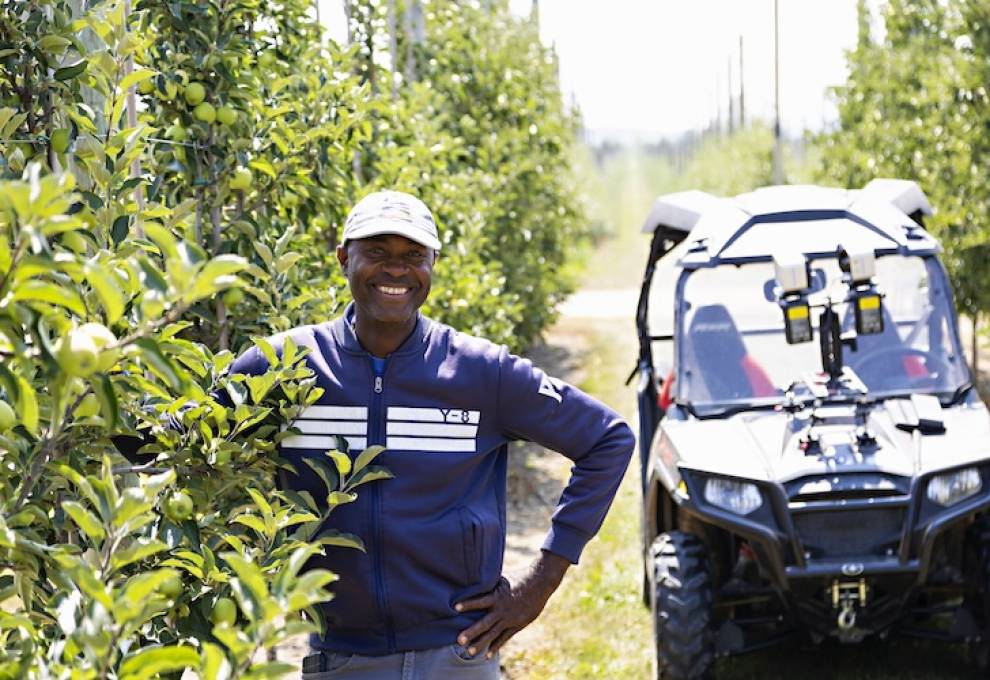
One of the participants of the Seasonal Agricultural worker Program is Q Simpson from Clarendon Parish, Jamaica. Since coming to Canada since 2007, he’s built a new house. During the growing season, he is based at Top Meadow Orchards in Clarksburg, Ontario. Photo by Nancy French.
As Ontario fruit and vegetable growers move into another busy growing season, the federal government's redesign of Canada's temporary foreign worker programs remains one of the most important policy files facing our sector.
The process has been underway for some time now, and while many details are still being worked through, one thing remains clear: growers need a reliable, experienced seasonal workforce if we are going to continue producing food here in Canada.
That message has been at the centre of the Ontario Fruit and Vegetable Growers’ Association’s (OFVGA) discussions with federal officials, and it will continue to guide our advocacy as the redesign process moves forward.
This year also marks the 60th anniversary of the Seasonal Agricultural Worker Program (SAWP), a milestone that offers an important reminder as governments consider future changes. The program has evolved considerably since the first group of Jamaican workers arrived in Ontario in 1966 to help harvest apples.
Today, it is one of Canada's longest-running international labour partnerships and a critical component of our food production system. More importantly, it is a program that has demonstrated its value over six decades.
Every year, thousands of workers from Jamaica, Mexico, Trinidad and Tobago, Barbados and the Eastern Caribbean travel to Canada through SAWP. Thousands more come through other agricultural streams of the Temporary Foreign Worker Program. Together, they help plant, grow, harvest, pack and ship the fruits and vegetables Canadians rely on.
For many farms, these workers are not simply seasonal employees. They are highly skilled members of the farm team who return year after year, bringing valuable experience and knowledge that cannot easily be replaced.
As the federal government examines how agricultural labour programs should operate in the future, OFVGA has been emphasizing the importance of preserving SAWP, and the features that have made it so successful.
One of those strengths is the government-to-government structure that brings together employers, workers and officials from workers' home countries. That framework creates clear accountability and provides mechanisms to address concerns when they arise.
Another key feature is worker mobility. The ability for workers to move between farms when circumstances change helps ensure workers remain employed while giving growers flexibility to respond to changing labour needs throughout the season.
Equally important is the annual review process that has allowed the program to evolve over time. Few labour programs have benefited from the same level of continuous collaboration among governments, employers and worker representatives.
That does not mean the program cannot be improved. Like any system, there are always opportunities to strengthen supports, improve administration and reduce unnecessary burden for both workers and employers.
But improvements should build on what works rather than discard it.
That principle is particularly important as governments consider broader labour market pressures and public debates around temporary foreign workers. Agricultural labour needs are fundamentally different from many other sectors. Crops cannot wait until workers become available. Planting, pruning, harvesting and packing must happen when the crop is ready.
Despite ongoing recruitment efforts, these remain positions that employers consistently struggle to fill domestically. The reality is that without seasonal international workers, much of Canada's fruit and vegetable production would simply not occur.
That has implications far beyond individual farms, and the federal government has just announced a national food security strategy that highlights how important it is that we have the ability to grow as much of our own food as possible here at home.
SAWP shows what success can look like and OFVGA will continue to engage closely with the federal government to advocate for the protection of such a longstanding and successful program.
Standard (Image)
If latest news
Check if it is latest news (for "Latest News" page)
1 (Go to top of list)

