
01
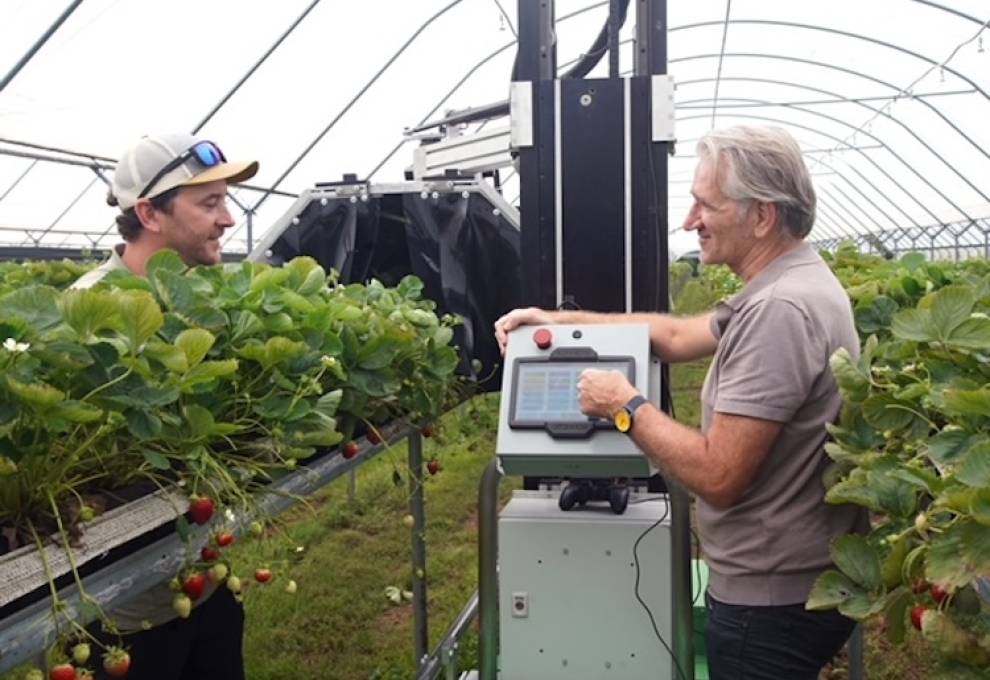
Berry grower Kevin Howe (left) discusses progress of field trials at his Aylmer, Ontario farm with Konrad Konnerth, CEO of KONNEXIO.
Pests and pestilence. They still keep growers up at night, despite years of treatment with precision chemistry and new biological tools.
Kevin Howe, an Aylmer, Ontario farmer, has a vision for a different approach. It’s his second growing season trialling the use of UV-C light disinfection to combat powdery mildew and botrytis on table-top strawberries. To protect his workers from potential health issues, the developmental agroTRAX robot machine works the midnight shift. And it appears that a good night’s rest is not far off.
“When I first got wind of this technology, it seemed to me that it supported the story of Berry Growers of Ontario – that we’re sustainable and reducing chemicals whenever possible,” recalls Howe. “The robot might not be producing immediate large savings, but in testing its fitness in rows and on sandy soil, I can see a future in attachments that can trim runners and blossoms, and perhaps one day, harvest berries.”
For Howe, the smart technology being developed by London, Ontario-based KONNEXIO Inc. could be an important step forward for his 10 acres of high-tunnel strawberries. His fruit is marketed to several Canadian retailers with tight specifications for size, colour and quality. These trial results matter, in terms of continuing to meet and exceed these standards.
Three separate trials were conducted during the 2025 growing season says Konrad Konnerth, KONNEXIO founder.Treatments were:
• 85 J/m² twice per week (no fungicides)
• 170 J/m² once per week (no fungicides)
• Conventional (fungicides only, no UV-C)
The AgroTRAX prototype features a three-foot hood that shrouds the table-top trough and restricts the spread of UV-C light as the machine travels at 1.5 km/hr along the rows. Designed for both greenhouse and tunnel row use, the hood attachment can be extended to a maximum height of 15 feet.
“Think of the machine as a mobile platform,” says Konnerth. “It’s built for adding more tools just like you would imagine a tractor. It’s upgradable over time as we develop more processes.”
Recognizing the benefit of expanding the robot’s functionality, the Canadian Agri-food Automation and Intelligence Network (CAAIN) recently awarded KONNEXIO $267,000. The intent is to develop the capability to thin strawberry canopies within an intra-row environment and to provide seamless integration with table-top systems. This next phase requires development of a vision-guided, AI-driven thinning module mountable onto KONNEXIO’s existing autonomous rover platform. Commencing 2027, the project will incorporate the use of RGB-D cameras and artificial intelligence to control servo-driven micro-cutters and lasers to precisely target removal of runners, excessive trusses, and dying foliage. Mirroring best agronomic practice, the goal is to improve fruit-load management and increase marketable yield through scheduled multi-pass, light-touch thinning. Additionally, best estimates suggest that switching to robotic thinning may reduce ongoing seasonal trimming labour expenses by 30 per cent or more annually.
Assisting in such pre-commercialization development is well suited to CAAIN’s goals says Darryl Petras, CEO.
“This activity directly supports CAAIN’s priorities in automation, robotics, and data-driven decision-making,” says Petras. “By delivering a validated autonomous thinning tool ready for pre-commercial deployment, the project strengthens the resilience and competitiveness of Canadian berry producers.”
All eyes are on the outcome here in Canada, as well as globally. With the 2026 Ontario growing season winding up, robotics aficionados will be following the Forum International de la Robotique Agricole (FIRA) being held in Yakima, Washington for the first time. The October 20-22 event will be closely watched for any technology that’s reaching the commercialization stage.
Luna is one such example. The robot uses UV-C light and bug vacuums to target not only pests but fungi as well, destroying their DNA so they can’t reproduce. TRIC Robotics, the manufacturer, partners with growers to deliver Robot-as-a-Service solutions that work night after night across California’s matted row, strawberry fields. The company says pesticide usage can be reduced by up to 70 per cent.
As tech start-ups all over the world roll out test products, it’s noteworthy that FIRA USA has launched its first Grower-Led Innovation of the Year award for 2026. The intent is to recognize an individual grower or a farming business that’s demonstrated outstanding engagement with agricultural innovation.
“The award celebrates growers who identify real-world farming challenges and take meaningful action to address them, whether by testing an emerging technology, contributing to its development, collaborating with research institutions or technology providers, or investing in and successfully adopting a solution on their farm. The technology does not need to be fully commercialized or already purchased, provided that the grower has made a significant contribution to its evaluation or advancement,” says FIRA.
The award is clearly meant to recognize and acknowledge the vital role growers play in the global agri-innovation process – tinker, deliberate, sweat details, then repeat. For growers such as Kevin Howe, he’s not participating in trials for the awards or the cheers at the finish line. What he really wants is a more efficient operation and the story-telling rights.
Standard (Image)
If latest news
Check if it is latest news (for "Latest News" page)
1 (Go to top of list)

