
01
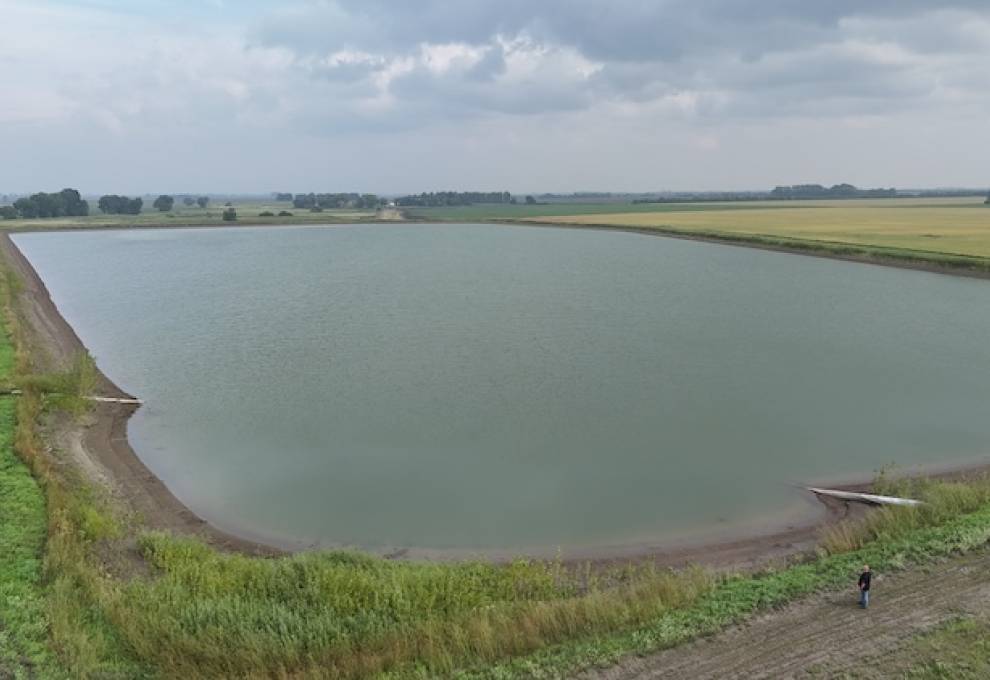
Southern Potato Company Inc. is managing drought risk with a massive water storage and irrigation system for 2,500 acres of fresh, chip and seed potatoes. The Kuhl family is committed to that conservation effort near Winkler, Manitoba. Marlon Kuhl can be spotted in the bottom right-hand corner of the photo taken by Steve Langston.
The Kuhl family of Winkler, Manitoba may not farm directly within the flood path of the mighty Red River but that doesn’t mean they don’t understand and respect the power of water.
“The Red River Valley has dark, fertile soil,” explains Marlon Kuhl, who shares management responsibilities with his brother Jeremy at Southern Potato Co Ltd. “The challenge is that there is a clay base underneath and more often than not, our crops would have wet feet if it weren’t for extensive tile drainage. In my entire career, I’ve only seen a couple bad droughts.”
Farming 11,000 acres of canola, corn, wheat, soybeans, edible beans and potatoes in rotation affords a yearly allocation of approximately 2,500 acres which produce fresh, chip and seed potatoes. They are sold under the Southern Potato Co banner.
Exploring ways to de-risk the farm’s exposure to occasional drought, an increasing worry in light of climate change pressures, they decided to build two water reservoirs, six miles apart, on farm property. A four-year project that started in 2015 was supervised by local engineer Bruce Shewfelt, PBS Water Engineering Ltd. He managed the permitting process with municipal and provincial authorities. At the same time, he partnered with other technical specialists to choose suitable sites for a combined total of 500 acre-feet of water storage.
As Shewfelt explains, portions of southern Manitoba were originally submerged beneath Lake Agassiz, an ancient glacial lake that produced a heavy clay base in the soil today. This type of geological formation is advantageous for building water storage, but requires diligent testing to determine the exact location where the clay core is closest to the surface. Once the two sites were identified, the reservoirs were built with a four-metre dike above ground to safely store the water.
“There are two pump stations -- one at each reservoir at different points in the pipe network,” says Shewfelt. “Jointly, the pumps deliver close to 5,000 gallons per minute.”
Water is syphoned from the reservoir through variable-speed electric pumps capable of drawing water at up to 90 psi pressure. Miles of pipe, ranging from 10-inch to 15-inch diameter, create an irrigation network that delivers water to above ground pivot and linear sprinkler systems. The entire network is fully automated, enabling the Kuhls to turn it on and off without having to enter the field.
Environmental permit considerations included setbacks from municipal roads and directional boring to install leak-proof pipe underneath rural roads and the creeks that intermittently flow during spring runoff. And of course, Manitoba’s minus 30°C weather in the winter requires proper draining of the pipeline network to prevent bursting, a job the farm contracts out to local service providers.
Southern Potato Co, like many farmers in the area, doesn’t have access to aquifer water to irrigate. Hence their decision to capture spring snowmelt into the reservoirs for just-in-time supplementary irrigation. Potatoes generally require one to two inches of water per week to maintain consistent soil moisture, particularly during the critical flowering and tuber-setting stages. Depending on soil type, total seasonal needs are typically about 18 inches. On average, Kuhl estimates that five to six inches of water are irrigated onto his potato crop during the growing season. That means irrigation is providing up to one-third of the potato crop’s water requirements.
“Yield results range by variety, but the reds, yellows and specialties such as fingerlings are showing improvements in overall quality,” says Kuhl.
Watershed initiatives
As a member of Winnipeg-based Peak of the Market, Southern Potato participates in the Potato Sustainability Alliance (PSA), a North American group that tracks metrics that range from soil health to biodiversity. Dr. Tracy Shinners-Carnelley, vice-president, research, quality and sustainability for Peak of the Market, is a leader in these efforts as chair of PSA.
“In my time working with growers in Manitoba, they have always invested in managing risk,” says Shinners-Carnelley. “In transitioning to irrigation capacity, they have recognized the need for reliable access to water.”
PSA’s 2024 reporting, the latest available, shows that 474 American and Canadian potato growers, representing 640,000 acres, were members of the Alliance. Impressively, that’s half of the total potato acres harvested in North America. From a water impact perspective, PSA data reveals that 99 per cent of growers utilize a crop production irrigation plan that, over time, has been optimized for long-term water availability challenges within their region. Of the participating growers, 58 per cent, up from a meagre six per cent in 2023, collaborate on watershed or aquifer initiatives with others in their community to improve water quality.
Water quantity and quality are too often viewed in a silo separate from soil health. But upon reflection, Kuhl says that the farm’s drainage efforts have played a large part in reducing soil compaction. When it’s go-time in spring, equipment can roll into the field having minimal impact on soil.
Micro-zone irrigation
Other Manitoba potato growers also participate in the Potato Sustainability Initiative. Under The Hill Farms and Over The Hill Farms in Cypress River, situated in the Central Assiniboine, Redboine, and Pembina Valley sub-watersheds, are part of the PSA’s Lake Winnipeg Basin Project.
Supporting 3,000 acres of processing potatoes, irrigated by drawing from groundwater, partner Chad Berry has recently adopted low-volume, pivot sprinkler nozzles to improve water uptake by the soil.
“We have no run-off of water,” reports Berry, who appreciates the environmental savings.
Berry also adopted the InteliRain system in 2025 to deliver micro-zone precision irrigation. The Calgary, Alberta company provides automated pivot irrigation sensing and control capabilities using soil sensors, robotics, machine learning and long-range wireless communication. The soil sensors measure air and soil temperature, electrical conductivity, pH, humidity and availability of nitrogen, phosphorus and potassium.
“We’re really happy with the technology,” says Berry.
He has further honed water management by irrigating cover crops for establishment. Once potatoes are harvested in early to mid-fall, he’s able to sow fall rye that then holds the soil in place over winter. The next season, that crop is harvested for either cattle feed or grain. This practice is the connector between water and building up soil tilth.
“As a grower, I see firsthand how water connects everything we do – our soils, our crops, and our communities,” said Berry.
Mega water project
In the neighbouring province, Saskatchewan plans to start on the Westside Irrigation Rehabilitation Project (WIRP) in late 2026 to expand irrigation near Lake Diefenbaker. Potato grower Harry Meyers, Barrich Farms Ltd., Outlook, SK is in favour. He irrigates 1,500 acres of seed and fresh potatoes, thanks to access to the South Saskatchewan River.
“Without that access, we wouldn’t be here,” says Meyers, located about 30 minutes north of Lake Diefenbaker. “The year before last, Lake Diefenbaker had worrying low water levels. It’s not OK to run out of water even once in 10 years.”
The Water Security Agency says the project will build a pump station and reservoir as well as restore a canal built in the 1970s. This proposed infrastructure would facilitate 100,000 acres of new irrigation. KPMG LLP did the final economic analysis and found the areas forecasted to see major economic impacts were the crops, livestock, land and food manufacturing sectors.
The study points out that Saskatchewan has 431,000 irrigated acres compared to Alberta’s 1.8 million acres. Just as southern Alberta has expanded its potato production, there’s opportunity to grow more specialty crops in Saskatchewan. The final economic analysis for WIRP shows a $12.9 billion gross domestic impact while creating 80,000 jobs.
As Canada pursues greater self-sufficiency amidst the looming threat of economic upheaval, political debate has intensified over major infrastructure priorities. What better time for agriculture to step up and shine a light on water access and sustainability needs. In the long history of politicians being commemorated across Canada with airports, highways, and bridges, only one, John Diefenbaker, left his legacy on water. Such an important natural resource deserves more.
Standard (Image)
If latest news
Check if it is latest news (for "Latest News" page)
1 (Go to top of list)

