
01
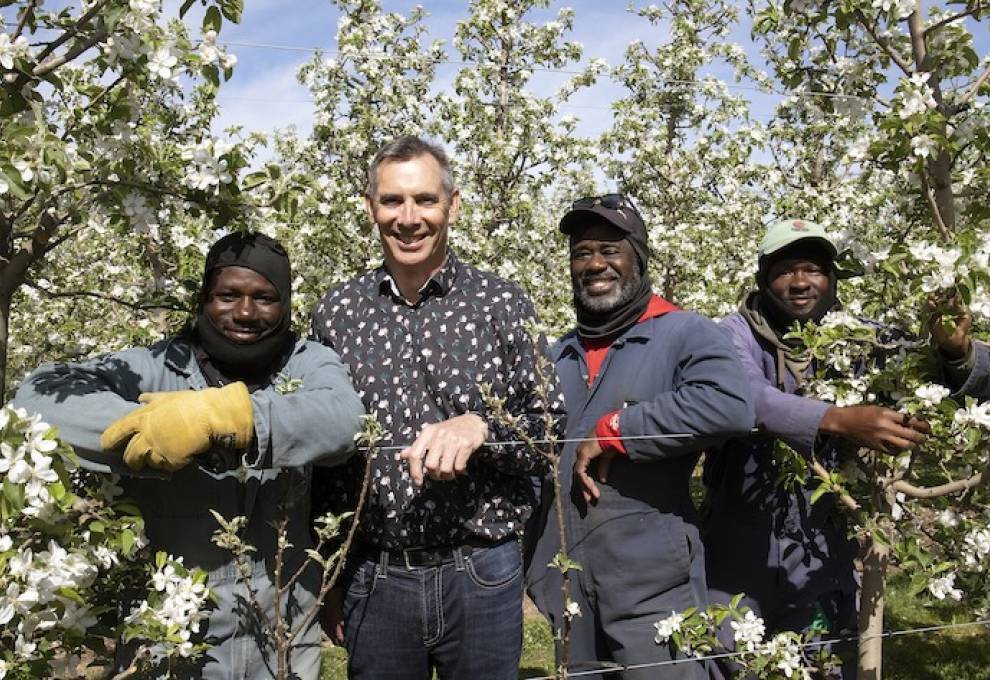
L-R: Orane Walters, Robert Shuh, Dave Brown and Maxroy Messam at Shuh Orchards near Elmira, Ontario.
“Get Up Stand Up” reggae spirit will be on full display this year as Jamaicans celebrate the 60th anniversary of their countrymen coming to Ontario farms. It’s an important milestone honouring growth in a relationship that’s delivered $1 billion in wages to date.
At the other end of the spectrum, Robert Shuh is just marking his first anniversary as president of the Foreign Agricultural Resource Management Services (FARMS). That’s the Ontario-based, non-profit agency responsible for managing 32,826 temporary foreign workers coming and going last year. In addition to Jamaica, FARMS has branched out to include workers from other Caribbean countries and Mexico under the Ag Stream, and Seasonal Agricultural Worker Program (SAWP). Although Shuh was appointed president after only a year as a director, he’s personally been hiring Jamaicans for his 50-acre, high-density apple farm near Elmira, Ontario through the agency since 2014.
Shuh has come to lead FARMs at a pivotal time. The organization has been under some pressure in recent years, dealing first with the COVID pandemic and then with negative media coverage about on-farm conditions for workers. Navigating past this maelstrom brings Shuh’s many skills to the fore. Central to his re-organization of the agency was adopting a co-leadership model with FARMS vice-president Andy Vergeer, a tobacco grower farming near Delaware, Ontario.
Quickly recognizing the depth and breadth of the file, they split the responsibilities. Together they present a united voice in dealings with the Ontario and federal governments. Vergeer leads on housing issues and negotiations with source countries while Shuh, working closely with the FARMS management team, represents the agency at the Canadian Federation of Agriculture and chairs FARMS board meetings.
Step one has been meeting with the executive directors and chairs of the various Ontario commodity groups to identify immediate needs and determine future goals.
“We were quick to listen and slow to speak,” Shuh quips. “We need to build an organization that can adapt.”
Highlighting his approach, Shuh shares a personal anecdote from time spent working on economic development in Honduras. The government at the time wanted a bridge over the Choluteca River that could withstand extreme weather and Japanese engineers were then hired to build it. When Hurricane Mitch landed in 1998, the architectural wonder survived the storm admirably but what wasn’t envisaged was the monumental flooding that followed. The rising water caused the river to change its course and it subsequently flowed well beyond the end of the bridge. Unfortunately, this bridge over troubled water became known locally as the bridge to nowhere.
FARMS will no doubt continue to face head winds in the days to come, but keeping the Choluteca Bridge lesson in mind, Shuh intends to build governance and infrastructure that will allow the agency to adapt as needed. One such need will be the imminent replacement of long-time executive director Sue Williams, due to retire in May 2027. Also on the 2027 horizon is the federal government’s expected announcement on new housing regulations and its impact on Ontario’s 1,136 farm employers, and those elsewhere in Canada. And unfortunately, ongoing scrutiny of the temporary foreign workers (TFWs) file by media is more than frustrating and troublesome when photos of farm workers are used to illustrate stories about problems in industries outside of agriculture.
Restructuring
While organizational restructuring is underway and to be fine-tuned by a consultant’s report expected in June 2026, it remains to be seen how the new org chart will flesh out, and what the final governance model will look like going forward. As Shuh points out, although FARMS itself is a non-profit agency, it works closely with its subsidiary CanAgTravel, the for-profit business with responsibility for fares and flights for TFW return travel between Canada and home countries: Barbados, eastern Caribbean, Jamaica, Mexico, Trinidad and Tobago.
Oversight of the logistics involved in brokering charter airline flights and consolidating TFW transfers through 2026 and beyond could perhaps experience some turbulence. Airlines may choose to assert the right to surcharge fares in view of skyrocketing fuel prices caused by the Israel/U.S. war on Iran. Although CanAgTravel airfare costs have been negotiated and are thought to be locked in for this year, there’s no guarantee the airlines won’t hijack the current budget.
FARMS’ drive for self-improvement has already fostered exchange with the two other Canadian agencies bringing TFWs for agricultural work: Québec-based FERME led by Fernando Borja, and British Columbia-based WALI led by Veronica Moreno. A case can be made that sharing best practices builds better bridges.
“On the topic of technology, we see tremendous value in the possibility of FARMS’ own software being able to communicate easily with each of the source countries along with FERME and WALI,” says Shuh.
Shuh notes that FARMS’ technology is also delivering improved communication and service to clients. A private and secure QR code can be obtained via the website’s client login portal that enables the status of a client’s Labour Market Impact Assessment (LMIA) application to be downloaded to a mobile device. The ability to provide up-to-the-minute worker transit information online is time saving for both growers in the field and telephone staff at FARMS.
“I’ve adopted the phrase of radical collaboration,” he continues, “not for the purpose of high-fives, but for candid conversations.” When an important Zoom meeting with Mexico yielded unsatisfactory answers, representatives from the three organizations flew to Mexico City for face-to-face meetings to recalibrate the business relationship.
Collaborating
On the ground here in Ontario, FARMS and organizations such as the Jamaican Liaison Service and the Mexican consulate, are developing a housing inspection template that will be available for use in Ontario and, ideally, beyond. As Andy Vergeer explains, Ontario’s various health units do not use a standardized template for housing inspections. Currently, a grower in one health region operates under different rules than a grower in a different region. Another hurdle will be the eventual outcome of ongoing discussions in Ontario regarding the ratio of workers to washrooms and laundry facilities.
“We recognize that housing is under a provincial mandate,” says Vergeer. “There’s nothing definitive at the national level, rather the discussion there is more about housing principles.”
That said, at the federal government level, Employment and Social Development Canada (ESDC) is working hard on housing standards with one eye fixed firmly on the larger picture: food security is national security.
“I forecast small increases in the number of temporary foreign workers that we’ll need,” says Vergeer. “I see a trend towards more employers favouring the Ag Stream program which has a two-year commitment. But then again, as much as innovation and automation are revolutionizing horticulture, there will always be the need for an experienced human hand.”
Significantly, these policy discussions are not taking place in silos, but instead are engaging broader, on-the-ground perspectives. An example is Bill George, chair of the labour committee for the Ontario Fruit and Vegetable Growers’ Association (OFVGA) who is an invited observer to FARMS’ negotiation meetings with Caribbean source countries. This presents George an opportunity to hear about concerns before they turn into grievances. In turn, Andy Vergeer attends OFVGA labour committee meetings and gets grower feedback firsthand. Such dialogue helps to inform, at a granular level, ongoing industry conversations with local politicians and stakeholders.
Forecasting
As FARMS adapts to meet future challenges head on, the central aspect of its mandate is undeniable – temporary foreign workers are an indispensable part of growing produce in Ontario. Often overlooked in media coverage is the fact that farmers invest heavily in this relationship. Bill George has been involved on the front line of farm politics for decades so when he states that improved modular housing for workers is estimated to cost $40,000 per worker, that’s an informed number.
With so much mutual gain, and potentially so much at risk, when FARMS and OFVGA partner with Jamaican farm workers to celebrate their 60th anniversary on July 26 in Simcoe, Ontario, it’s not only good business, it’s being a good friend.
Future growth is anticipated in the Ag Stream in Ontario
# of Ontario workers
Program | 2024 | 2025 |
Seasonal Agricultural Worker Program | 21,769 | 21,401 |
Ag Stream | 10,557 | 11,460 |
Total | 32,326 | 32,861 |
Source: FARMS, April 2026.
Standard (Image)
If latest news
Check if it is latest news (for "Latest News" page)
1 (Go to top of list)

