
01
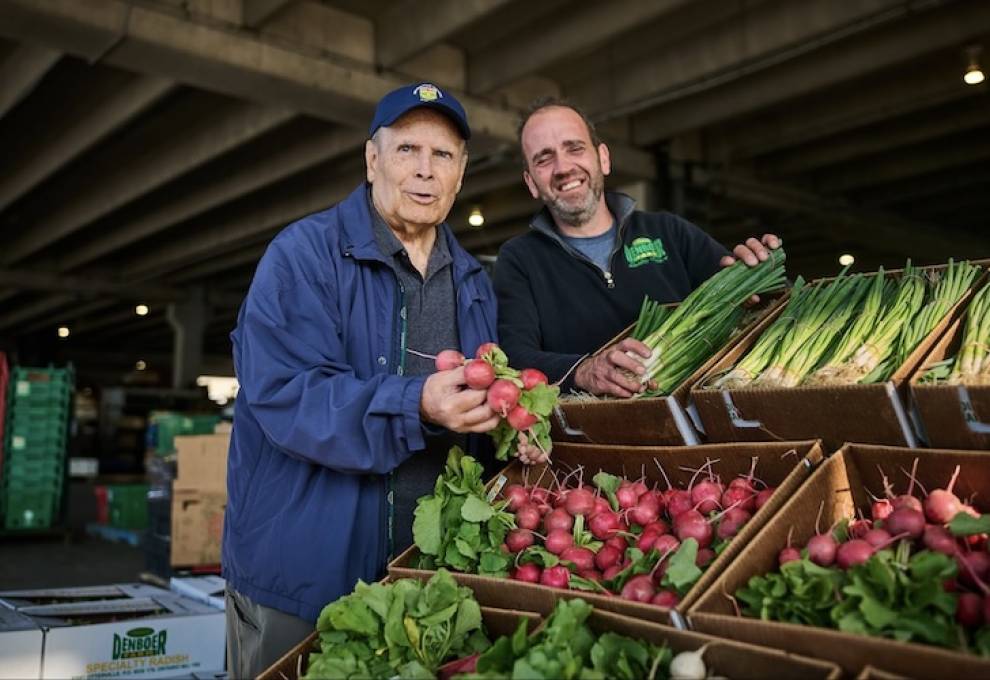
Bruce Nicholas, (L), marking 25 years as the Ontario Food Terminal general manager, is in planning mode as he admires the fresh vegetables of Raymond den Boer, Otterville, Ontario.Photo by Sammy Kogan.
Take a ramble through the Ontario Food Terminal in mid-summer and it’s all here in abundance: Niagara peaches, Québec lettuce, Leamington greenhouse-grown tomatoes, peppers and cucumbers. In the outdoor farmers’ market, local growers present a mindboggling array of produce. Even with the breeze, there’s a distinctive waft of dill in the air.
The facility is also a destination for fruits and vegetables from around the world, offering vendors 100,000 square feet of cold storage. By volume, this produce hub is one of the biggest in North America, handling 2.1 billion pounds annually. Only New York, Los Angeles and Philadelphia are bigger.
A produce wholesalers’ mecca, the Toronto terminal was the backdrop for Prime Minister Mark Carney’s historic June 11, 2026 announcement of $3 billion government funding for a 10-year national food security strategy. It wasn’t entirely a surprise to Ron Lemaire, president of the Canadian Produce Marketing Association (CPMA) who introduced key stakeholders to the Prime Minister’s Office while the policy was under draft.
“Many elements of the strategy are interconnected,” says Lemaire. “A modern food system depends not only on what we produce, but also on our ability to move food efficiently and reliably from farm to consumer, and from Canada to the world. As discussions continue, it’s important to evaluate the potential benefits, impacts and long-term value such investments could bring to Canada’s food system and trade competitiveness.”
A major pillar of the announcement is $1 billion directed at creating food hubs which is why Bruce Nicholas, marking 25 years as general manager of the Ontario Food Terminal (OFT), is upbeat about building a permanent, year-round structure for the farmers’ market. His team will be drafting initial plans for a new building for about 350 farm vendors currently trucking their produce to 165 The Queensway. But he needs a partnership with the Ontario government to seal the deal. The OFT Board is the owner and operator, and although it’s under the guidance of the Ontario agriculture ministry, Nicholas is quick to point out that the facility is already fully self-funded, requiring zero public money to operate.
Raymond den Boer is one of OFT’s farm market vendors with 250 acres of carrots, beets, parsnips, green onions, leeks, turnips, radishes, sunchokes and cabbage grown near Otterville, Ontario. He is thumbs-up for a climate-controlled building for farmers.
“I’m approved for CanadaGAP food safety and to get technical, the cold chain is broken when I’m selling produce from my truck at the market,” he says. “It’s not fun being in my truck at 3:30 am in the winter and opening up the reefer truck to sell two bags of beets.”
Build infrastructure
Den Boer agrees with the prime minister’s comment that farmers need more places to sell their products. The strategy highlights that to compete with big retailers, smaller independent grocers need more places to source product for their stores. Critics may say the food hub announcement is the government’s admission that it can’t do much about retail consolidation in Canada by five major grocers that control 75 to 80 per cent of food sales. But perhaps it can do something to give the independents a leg up.
From den Boer’s perspective, the large chains have become too powerful, controlling what consumers can buy on store shelves. He points to his specialty item of watermelon radishes, as an example. Granted, radishes won’t feed the world but they highlight the type of choice that green grocers and restaurateurs can offer their clients.
“I think if we had more hubs and better facilities that more farmers would produce for those hubs where independent grocers could source their produce,” he says. He suggests Ontario cities such as Windsor, London, Ottawa and Thunder Bay.
He’s also vocal about the Québec-grown produce that receives a subsidy if it’s marketed outside the province. He offers the example of spring onions being sold at $7 per case under the OFT going price. “I’m not here as a fundraiser,” he complains. “These lower prices are often not passed through to the consumer.”
Patchwork provincial subsidies are an underbelly of the market that most outsiders don’t fully appreciate, maybe even the Canadian government. But as Lemaire readily points out, “The strategy is a platform to build out the details and exactly how this might work.”
Link to the east coast
The scope of OFT’s role is expanded when talking to Frank Pingatore, Super Select Produce Buyers. They are a wholesale aggregator that trucks fresh produce not only to nearby communities such as FoodShare Toronto, but also to clients in the Maritimes and on to Newfoundland. At the height of the growing season, he’s sending a transport once a day to North Sydney, Nova Scotia where the five-to-seven-hour ferry heads to Port aux Basques, Newfoundland. From there, it’s a nine-hour haul to St. John’s, home to half of Newfoundland’s population. Canada is a vast country. No wonder food distribution is a laborious and expensive endeavor.
What’s in a typical Super Select mid-summer load? Sweet corn, strawberries and rhubarb, seen out in the farmers’ market, are now piled high on a pallet on the loading dock, steady ready for the long road trip.
Whether or not a food hub on the east coast would have a positive impact is a question best directed at Maritime farmers. Its answer lies in growing enough local produce to make the venture profitable. What’s not in doubt, though, is that costs climb the more times food is handled up the chain.
The government’s national food security strategy is attracting interest from all quarters, including New Brunswick’s agriculture minister Pat Finnegan. “I also think that the east coast is ready to play a greater part in opening the world to our vast food basket,” he stated on LinkedIn. “The ports (ice-free year-round) of Saint John, Belledune and Halifax are ramping up investments to do just that.”
Food for thought
For almost a century, Canadian geneticists have distinguished themselves for breeding expertise, whether in wheat, canola, apples, tree fruit or dairy. To leverage that legacy, agriculture today demands that Canadian engineers meet the challenge of designing new infrastructure to store and move food, safely and securely. And that depends on innovative post-harvest storage, inventory control, optical sorting and grading, and food waste systems. There’s little to be gained by improving access to food that’s not in pristine condition.
Recent statistics point to Canadian farmers growing more, and better food. If Canadians invest in a domestic framework that distributes food more efficiently and sustainably, then opportunities will open to the rest of the world.
Sidebar: How J.E. Russell Produce Ltd reduces food waste
The discussion about food hubs should also consider how to best handle inevitable food waste. J.E. Russell Produce Ltd is a tenant at the Ontario Food Terminal (OFT) whose family-owned wholesale business is to supply premium produce to independent retailers, grocery chains, specialty retailers and foodservice customers across Ontario and east to the Maritimes. Because highly perishable products move through the business every day, reducing food loss and waste is directly connected in inventory management, forecasting and customer service. One of its most time-sensitive product categories is packaged salads.
Rather than continuing to move short-dated packaged salads though progressively lower-value commercial channels, the company established a clear operational decision point. Once packaged salads reach six days of remaining shelf life, they are removed from commercial sale and redirected to Second Harvest while they still have usable life for families and community organizations.
This approach, says Hutch Morton, senior vice-president, delivers benefits well beyond food recovery. By creating a consistent operating process, category managers gain greater visibility into shrink, inventory decisions become more disciplined and forecasting improves over time.
The case study can be accessed at the Canadian Produce Marketing Association under https://cpma.ca/sustainability/food-loss-waste/food-loss-and-waste-use-cases/
Standard (Image)
If latest news
Check if it is latest news (for "Latest News" page)
1 (Go to top of list)

