
01
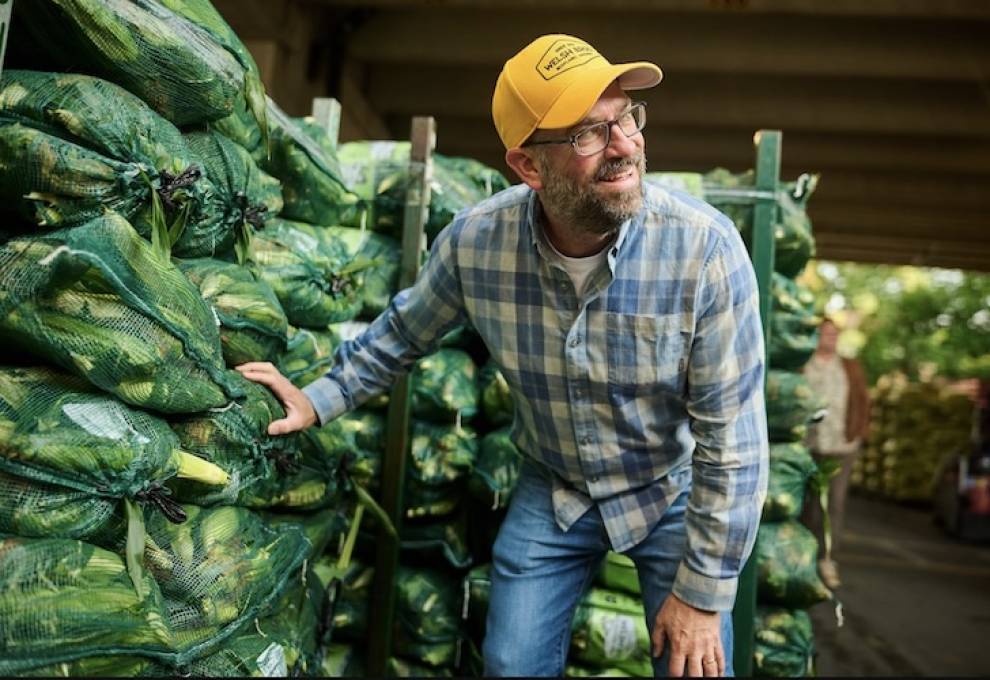
Bi-colour sweet corn is on the market from as early as July 13 to mid-October if Charlie Welsh aligns all the weather stars at his Scotland, Ontario farm. Here, Welsh Bros corn is on offer at the Ontario Food Terminal. Photo by Sammy Kogan.
Bolt, Stamina and Autograph. One might rightly mistake these as champions of thoroughbred horse breeding, reminiscent of Canada’s iconic Northern Dancer. But no. These are the names of recently released sweet corn hybrids. Bred to the highest standards, the seed holds traits that help the corn thrive through frosty mornings and drought-baked afternoons.
No one is more pleased with their performance than Charlie Welsh who farms 600 acres of bi-colour sweet corn near Scotland, Ontario. Thanks to row covers and constantly improving genetics, his farm typically has the first sweet corn of the season on offer at the Ontario Food Terminal.
In Canada, local sweet corn is a summer staple and a food sovereignty touchstone. It’s widely viewed as a standout against imports, signaling the independence of Canada’s food production system. But as Welsh points out, sweet corn seed relies on a cross-border supply chain that all starts with a global breeding network.
For several years, his farm along with others in Europe and the U.S., have trialled numbered hybrids developed byTolono-based Illinois Foundation Seed Inc. (IFSI). That’s where Charlie Thompson, vice-president and director of research, leads the quest for environmental resilience, season extension and longer shelf life. Testing thousands of plants annually, the company recently began breeding carrots and beets in addition to its sweet corn hybrids.
“We test for 25 different characteristics in sweet corn,” Thompson explains. “Tenderness, sweetness and flavour are the consumer-facing traits. But in the last decade, we’re using better predictive models to identify agronomic traits such as environmental stability.”
In other words, stress tolerance is a priority. Sweet corn must stand up to a changing climate, from severe windstorms to drought, and still mature with complete grain fill come harvest. Optimally, cobs should be at least eight and a half inches in length, have big, green flag leaves with a husk cover, and have 18 straight rows of kernels.
Outside of North America, IFSI makes use of a global field-trial network to stress test sweet corn across temperateclimates in Hungary, Spain and France to New Zealand and Chile. For these trials, IFSI deliberately sows at 10 to 20 per cent higher than growers would, which can be 27,000-33,000 plants per acre depending on the environment.
“By stressing the plants, we have confidence these hybrids will work for growers,” says Thompson. “Who knows what climate conditions we’ll have in 10 years?”
When evaluating other desirable agronomic traits, seed breeders have season extension as top of mind. Growers place high value on having access to early-maturing, mid-season and late-maturing varieties. By example, over the last four years, Bolt has given growers the opportunity to be first to market but still offers a product that has the eating qualities expected in mid-season corn.
As Charlie Welsh points out, “Texture is important in flavour, the kernels should pop.”
A global model for seed development has identifiable merit, considering that a latitude of 43 degrees north runs through both Scotland, Ontario– having a warm-summer humid continental climate – and southern France where scorching dry summers have increasingly been the norm. IFSI’s ability to freely and efficiently test its hybrids across far-flunggeographies plays a key role in seed development and a supply chain that extends to distributors such as Stokes Seeds, Seedway, and Rupp Seeds.
A perennial optimist
Charlie Welsh is unique because he grows both sweet corn, an annual crop, and asparagus, a perennial crop.
Like sweet corn, asparagus seed breeding is a global effort but it’s different in that Canada has a starring role. Fox Seeds, based in Simcoe, Ontario, is one of the few North American-based breeders of asparagus. In 2023, Fox acquired the University of Guelph’s asparagus germplasm and took over its seed breeding program.
“Crops are cyclical in nature. At Fox Seeds, we require some resiliency,” says Colin VanParys, general manager, “Our mission is to provide seed to our growers so that we’re not beholden to others.”
Esteban Diaz Castro is Fox Seeds’ research and breeding lead directing the company’s field trials and tissue culture laboratory located near Simcoe, Ontario. His current focus is on developing new asparagus varieties that will deliver higher marketable yields compared to Millennium and Equinox.
Diaz Castro’s research is funded through Fox Seeds’ sales of hybrid asparagus to growers in Canada, Michigan and Washington states, and Europe. With only two or three new varieties coming to market in a breeder’s lifetime, success demands dedication and persistence. For example, Millennium, now the standard cold-hardy variety, was launched in 2000. Newer genetics such as Equinox support stable production throughout seasonal temperature fluctuations.
Paul Banks, consultant to Fox Seeds, explains that asparagus is unusual in the plant world because it typically produces both male and female progeny. In the 1980s, rare super male plants that produce only male progeny were identified.
Seed breeders all look for traits to increase yields but as Banks points out “What matters most in all horticultural crops is marketable yield.” He goes on to explain, “We want uniform spears that require less sorting and easier bundling. Because labour costs are so high, we need to make life easier for the pickers so that there’s longer shelf life.”
A shorter chain
Within the context of current international geopolitics, ongoing dialogue regarding Canada’s Next Agricultural Policy Framework will likely touch on the twin issues of food production resiliency and sovereignty. To not consider the seed and rootstock supply chain in such discussions could prove a serious oversight.
That all plants come from seed is a basic fact of agriculture. It is also a fact that unfettered global collaboration has been critical to commercialize new seed varieties. And while seed breeders continue to thrive without borders today, it’s worth remembering that, as with any IP, rights reside with the owner.
Sidebar: A primer on new breeding techniques
These days, any discussion about plant breeding will inevitably mention one or more of the following techniques. In the case of the non-browning Arctic apple, gene silencing was used through RNA interference.
To date, these examples are rare in horticulture. Conventional breeding techniques are still relied upon for most crop improvement.
- - CRISPR-Cas9 genome editing: Uses molecular "scissors" to make targeted changes, deletions, or swaps inside a plant's existing DNA. This shortens development timelines from seven to 15 years down to a few months. For example, it has been used to engineer drought-resistant rice that uses up to 40 per cent less water.
- - Marker-assisted selection (MAS): Uses DNA-level molecular markers to test very young seedlings for desirable traits (such as disease resistance). This cuts breeding cycle times in half by avoiding the need to grow entire crops to maturity before testing.
- - RNA interference (RNAi) & cisgenics: Regulates or silences specific gene expressions to block pests, viruses, or fungal infections without introducing foreign genetic material from unrelated species.
- - High-throughput phenotyping and Al platforms: Combines automated field scanning, genomics, and artificial intelligence (such as university tools guiding dry bean or staple crop breeding) to rapidly screen thousands of genetic crosses for climate resilience and yield stability.
- - Pan-genomics & wild relatives’ integration: Maps the entire genetic variation of a crop species and its wild or "orphan" relatives to reintroduce lost traits such as extreme cold tolerance or disease resistance.
Standard (Image)
If latest news
Check if it is latest news (for "Latest News" page)

