
01
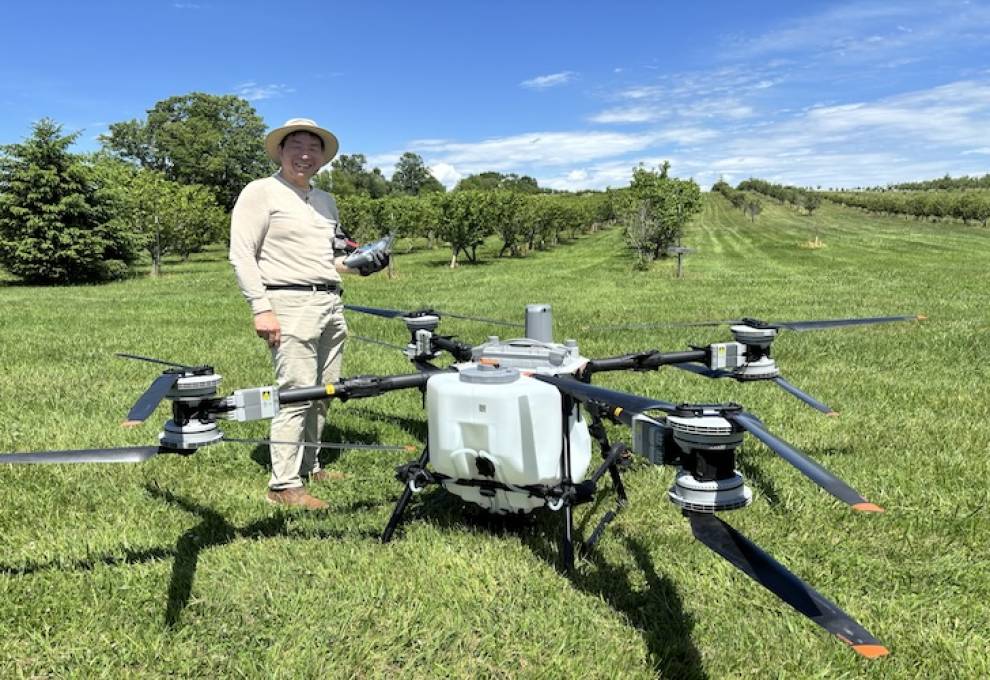
This drone was demonstrated at an Ontario Hazelnut Association field day near Uxbridge, Ontario.
Canadian farmers finally have joined their colleagues in Australia, Japan, and the United States in having access to aerial drones to apply crop protection products. After several years of scientific deliberation, Health Canada’s Pesticides Regulatory Directorate (PRD) introduced the new policy at the end of June 2026. The update brings Canada into alignment with many other global jurisdictions which already allow crop protection application by drone.
Remotely piloted aircraft systems (RPAS), commonly known as drones, offer access to an aerial application system at a fraction of the cost of a plane or helicopter. Controlled by remote, and largely computer guided, these aircraft are also far simpler to operate compared to those with a human pilot on board. These two factors make the barrier to entry far lower to consider aerial application with drones on many farms.
Health Canada’s updated science policy outlines how labels with existing approved aerial use are sufficient for allowing application by drones. For aerial application to be allowed, crop protection products must include specific instructions for those uses on the label. By following the existing aerial label directions for application with drones, the “value” or effectiveness of the product is expected to behave no differently than if it was applied by plane or helicopter. If the applicator wanted to apply with different parameters than the existing aerial instructions, such as a lower minimum water volume, a different application rate, or an increased frequency of applications, this would require a review from PRD prior to approval.
For environmental protection, the PRD regularly applies buffer zones for terrestrial and aquatic habitats on product labels. The updated science policy requires drone operators to follow the buffer zones established for rotary aircraft application (i.e. helicopter). However, new studies are suggesting spray drift from drones is more restricted – higher than field sprayers and somewhat similar to airblast sprayers but less than piloted aircraft. The current use of the rotary aircraft buffer zone is therefore conservative and a drone-specific (and smaller) buffer zone is expected to be developed in the near future.
To protect against exposure of the drone operator and supporting crew, the PRD has similarly implemented conservative approaches. Applicators wishing to use drones under the new policy will need to have two individuals, a pilot and a separate individual for mixing and loading of products, as per the current aerial application guidelines in Canada. Yet the personal protective equipment (PPE) required for drone operators is to be the same as the label PPE required for ground application. The ground application PPE would come from the directions for ground boom or airblast sprayer depending on the crop being treated, which already factors in the same individual mixing and loading and doing the application. In the future, PRD acknowledges that separating these roles may not be required.
Drone pilots will also have to comply with Transport Canada regulations. Drones are considered aircraft in Canada and therefore fall under the Canadian Aviation Regulations. Any drones weighing more than 250 g need to be registered to fly in Canada. The pilot will also need to have a valid drone pilot certificate to fly any drones for the purposes of crop protection.
For a spray drone with a takeoff weight from 25 kg up to 150 kg, which would comprise the newer rotary drones on the market, an advanced operations certificate is required. In order to become certified in this category of operations, one must pass an online exam and then pass a practical flight review from a drone flight school to assess the individual’s ability to operate the drone safely. A drone pilot certificate does not expire once obtained but there are requirements for continued training to remain current.
Although crop protection registration and safety reviews are handled federally in Canada, provincial legislation regulates the sale, purchase, storage, transportation, use and disposal of registered products, along with any requirements for training and certification for applicators. As a result, provincial licensing requirements vary across the country.
Saskatchewan has already created a specific provincial licence category for commercial applicators using drones – but farmers applying crop protection products for their own crops are still exempt from obtaining mandatory licensing in Saskatchewan. In Ontario, commercial applicators for agriculture need to be licensed as an exterminator.
However, farms using crop protection products for their own operations can have individual(s) certified under the Grower Pesticide Safety Course instead. However, this certification does not currently extend to aerial applications, so Ontario farmers wishing to apply crop protection products by drone, even to their own crops, need to obtain a provincial exterminator license with the aerial application category.
It has been a long process to achieve legalized use of drones for crop spraying in Canada. Though now approved, the responsibilities of the operator remain crucial. That includes following all label directions, obtaining proper certifications, calibrating the equipment correctly and verifying its output, ensuring appropriate conditions during product application, and maintaining required safety precautions for the pilot and crew.
The current policy addresses drone use for labels that already have an approved aerial registration. It is expected that the process for the addition of drone use to product labels that do not currently include aerial uses will be addressed in the near future.
Standard (Image)
If latest news
Check if it is latest news (for "Latest News" page)
1 (Go to top of list)

