01
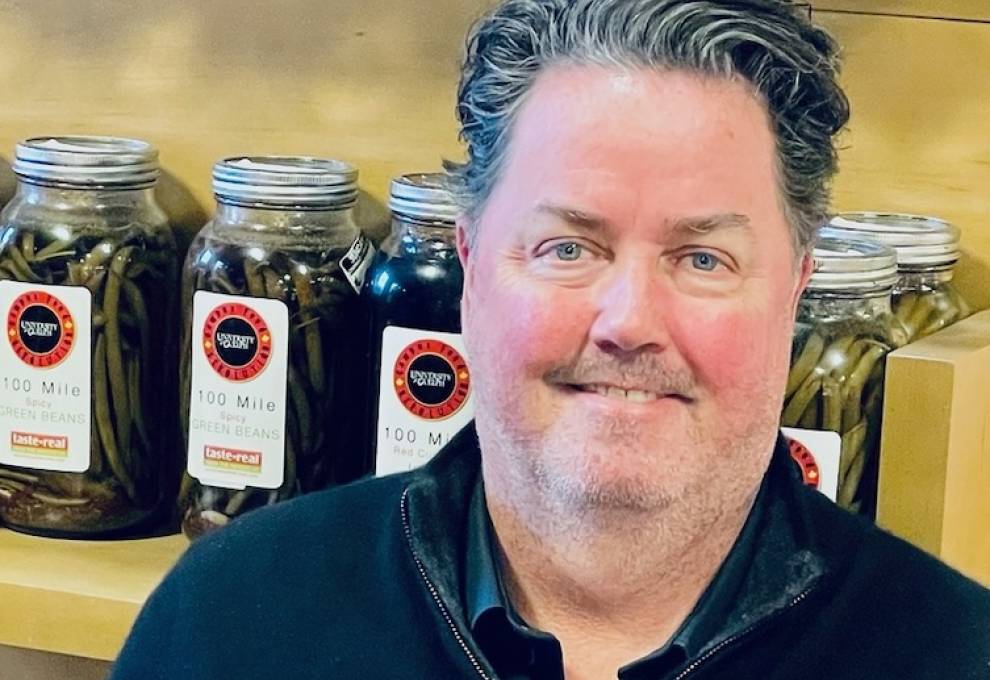
University of Guelph food procurement manager Mark Kenny shows off some of the locally sourced items in his giant pantry.
Regardless of what side of the bed U.S. President Donald Trump wakes up on, people still have to eat. Trump’s tantrums and dalliances have made for a troubled trade environment overall. But nevertheless, at the University of Guelph, food service professionals such as food procurement manager Mark Kenny and his team must carry on – after all, they’re called on to serve 25,000 meals every day to hungry students and staff at the institution.
The university clientele has high expectations of Kenny and the 15 Red Seal chefs, 30 cooks and hundreds of support staff in the Hospitality Services department. Guelph has a rich tradition of leadership, teaching and research in the agri-food sector, and a reputation as one of the top food universities in the country.
And Kenny knows that to those who purchase meals at the university, local food matters. About 93 per cent of Guelph’s enrolment consists of domestic students, primarily from Ontario, to whom local food has become a cultural affair thanks to programs such as Foodland Ontario. They arrive at the University of Guelph expecting to find the best local food on their plates. To them, a fractured trade environment is no excuse for hiccups in food services.
That might be enough to keep some procurement managers up at night. But not Kenny. In fact, he seems downright unfazed by the challenge.
Kenny views the current trade culture as an opportunity for the procurement supply chain to find new efficiencies so growers participating in the Canada Strong movement have reliable avenues to market their fruit and vegetables locally.
Kenny, an early advocate of local Ontario food, says success in local food procurement has three main ingredients: producers’ passion for quality, their interest in promoting local food, and a network of local food champions such as chefs, business owners and procurement managers like himself who put local food in front of a clientele.
“These elements are in abundance in Ontario and elsewhere in Canada,” he says. “There should be no reason that I can think of for any organization to not support local food procurement in Ontario.”
Kenny’s biggest challenge is storing fresh, local, quality food. In 2012, the university purpose-built a fresh food processing facility, adjacent to its biggest food outlet, Creelman Hall. The facility opened the door for more local food offerings.
But post-COVID, enrolment at the university has soared to record numbers, along with the volume of food the university food services teams procure to meet their guests’ needs. Today, the processing facility that was adequate a dozen or so years ago now only has room to store two days’ worth of fresh produce.
So, Kenny’s on his phone or on his computer more than ever, sourcing food for upcoming menus.
“Although we have limited storage, we still must have ample supply to serve thousands of meals every day,” he says. “Our chefs plan two weeks out and we’re placing orders five or six days a week, needing a quick turnaround.”
And while it’s busy now, the demand for local fruit and vegetables is bound to intensify. The university is building a huge $275-million student residence that will house more than 1,200 students and feature a 500-seat dining hall. The facility will be ready for residents in September 2029.
Kenny calls this a huge opportunity for local food producers who are connected to an effective distribution network that serves the university. Such networks have become imperative for dealing with him.
“A producer may want to sell us six cases of produce, which is fine, but we need 60 cases a week,” he says. “I want and need the product but it’s difficult to deal with small volumes, and we can’t have so much delivery traffic coming and going. So, it’s in both of our interests for producers to work with a distributor who supplies product to us. We are definitely open to working with new vendors who meet the high standards that our customers expect.”
And those customers show no sign of abating.
Standard (Image)
If latest news
Check if it is latest news (for "Latest News" page)
1 (Go to top of list)