
01
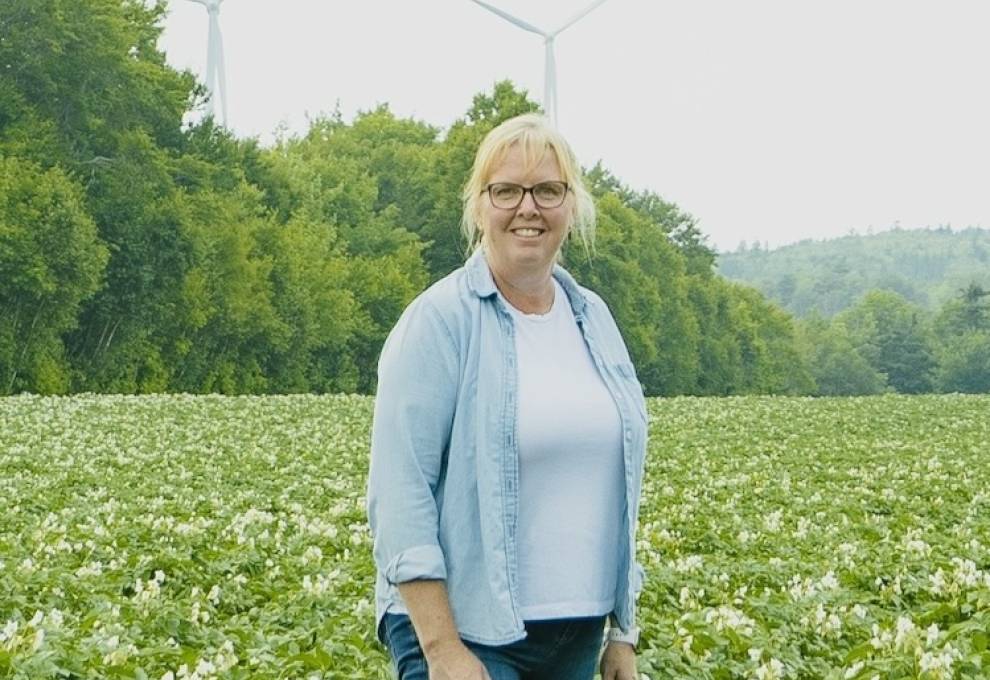
Katie MacLennan, chair Prince Edward Island Potato Board.
Women farmers have always been a force in agriculture, but now their numbers are formalized in the Statistics Canada census of agriculture. At last count in 2021 – and soon to be updated – the numbers stand at a hair under 80,000.
To put a face on those statistics, meet Katie MacLennan, the first female chair of the Prince Edward Island Potato Board. She’s been farming for 27 years with her husband Jonathan near West Cape, PEI. As a seed and processing potato grower of 725 acres plus more acreage for rotation crops, she’s lived through a roller-coaster in the last five years: COVID, the potato wart crisis that closed the border for exports to the U.S., then drought.
Elected in November 2025, she and her board are now dealing with provincial permitting to set up irrigation systems for potato growers. Other issues include improving access to labour, reducing the regulatory burden, strengthening the management of phytosanitary risks and addressing climate-related risks. Agronomy initiatives seek to increase farm production and improve efficiency. The board is continuing to push for new and expanded market access for Canadian potatoes. All of this work comes back to one goal: strengthening the long-term profitability and sustainability of Island growers.
“I’m interested in what it takes to work together as a province and a country,” she attests. “We come from a small area but we’re a tough group. Let’s see how far we can advance together.”
The United Nations has declared 2026 as the Year of the Woman Farmer to spotlight the essential, yet often unrecognized, roles women play in global agrifood systems. By any measure, Canadian women have moved forward in spades in terms of access to agricultural resources, technology and financing.
“Ten years ago, my husband and I changed banks and it was made very clear that we were partners in the business,” MacLennan recalls. “Most times, the bank calls me.”
Ontario greenhouse grower
Twenty years younger, Sydneigh Wilson is in the first decade of her career, after graduating with a science degree and working as a research assistant at Agriculture Canada’s Harrow, Ontario station. Since her first visit to the Kingsville, Ontario area in 2018, she’s been gobsmacked by the growth of the greenhouse vegetable sector. During COVID, she and husband Emilio Mastronardi operated Ridge Farms, working morning to night on every task imaginable: stringing, clipping, J-hooking, planting and packing tomatoes. Two years ago, her 360-degree view of greenhouse growing made her an attractive hire for a vegetable seed company that rents part of the farm for a demonstration house.
“More women are becoming involved in the very male-dominated greenhouse industry,” says Wilson. “In the past, these have been technical roles as integrated pest management specialists, but now we’re seeing more women in roles such as growers and labour managers/supervisors. On behalf of De Ruiter, I have a sales territory in Ontario that stretches to Ohio.”
By nature, women are collaborators, and that’s one area that’s mystified Wilson. “I come from a rural background where, in the case of a night emergency, the first person you call is your neighbour. They usually arrive in their pajamas and rubber boots. That’s not been the case in the greenhouse sector where your neighbours are your competitors.”
She’s been trying to change that attitude, so that growers aren’t repeating mistakes. A good example is the 2019 arrival of tomato rugose virus, a wake-up call that this was a community emergency deserving of a shared-responsibility response. As a result of her prodding, her husband has become more of an open-door farmer.
Ridge Acres is undergoing a growth spurt in more ways than one. The farm is expanding from 18 acres to 29 acres. Now in her late ‘20s, she has an 18-month-old son and twins on the way.
“My perspective is to focus on what we can handle as a family,” she says. “My husband tends to load his plate heavy. Farming is our life, but life must also be cherished.”
British Columbia grape grower
This is an approach shared by Heidi Lorch, voted viticulturist of the year in 2021 by the BC Grape Growers’ Association. Her peers have respected how she’s restored a vineyard near Okanagan Falls, British Columbia.
“I was raised on a dairy farm in Southwestern Ontario, so agriculture has always been in my blood,” says Lorch. “I went on to farm for 27 years myself, growing cash crops and running a commercial poultry operation with 35,000 birds. In 2019 I made the move to BC, wanting to try something new in horticulture. I enrolled in the viticulture program at Okanagan College right here in Penticton, and from there I just jumped right into growing grapes — and I haven't looked back!”
Unlike third-world women farmers who face challenges in accessing land and financing, Lorch has not had that experience. “I have never encountered any challenges when it comes to purchasing land or equipment or sitting down with lenders. I have always been treated fairly and with respect as a business person. My experience has been a positive one from the start.”
Like many female farmers, Lorch has an agricultural degree majoring in field crops and livestock production from the University of Guelph. In British Columbia, she is a registered agrologist with the BC Institute of Agrologists. Decades of hands-on farming experience translated very well into viticulture. However there is no risk-free day.
“The challenges I face are really the challenges that farmers everywhere are dealing with — rising input costs for fuel, parts, and maintenance continue to put pressure on margins,” she says. “And finding reliable farm labour is an ongoing concern.”
The large percentage of women operators reflect trends in related agricultural sectors. Lorch points to representatives in equipment sales, crop input recommendations, agronomy, and more.
“In my own experience, I have always felt respected and treated as a farmer and a business person, full stop,” says Lorch.
Canadian senator
There has never been a glass ceiling for PEI farmer Mary Robinson. Now 56, she has her own Wikipedia listing with provincial, national and international accomplishments. She’s been managing partner of her family’s sixth-generation farm for three decades, held the role of first female president of the Canadian Federation of Agriculture, was elected vice-president of the World Farmers’ Organization in May 2023 and was appointed to the Canadian senate in January 2024. She is an ardent advocate for the agricultural sector, rural development and environmental sustainability.
All of these role models display a healthy respect for time. They balance competing duties, take stock and advance their goals. With boots on the ground, no weight training is required.
Standard (Image)
If latest news
Check if it is latest news (for "Latest News" page)
1 (Go to top of list)

