
01
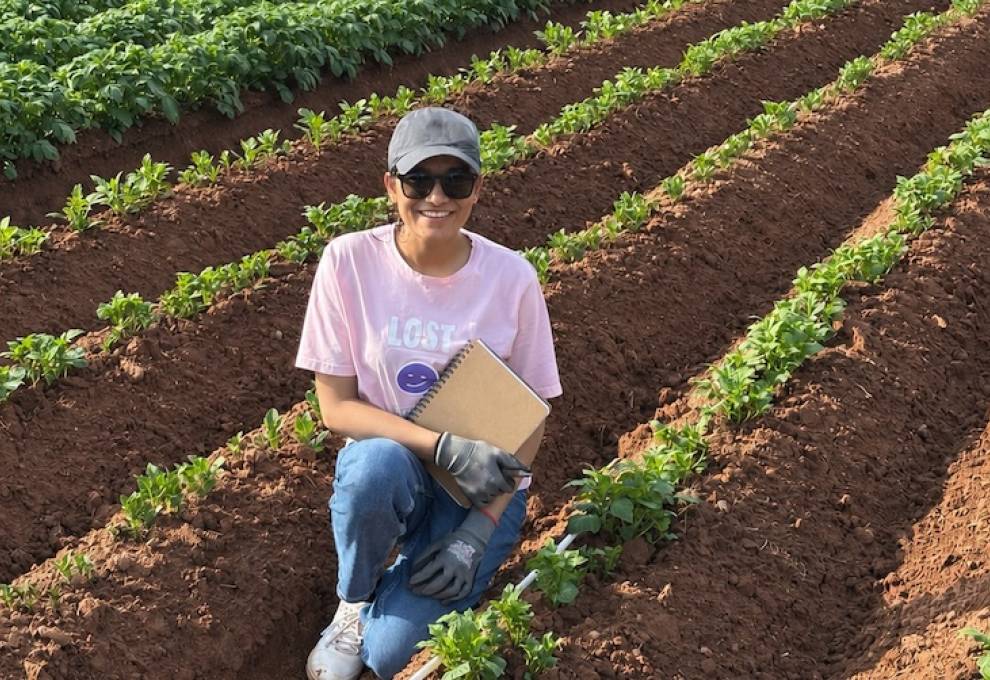
Ritu Patel, pictured here on a PEI potato operation, welcomes new chemistries that will help the horticultural sector and small-acre crops. Photo courtesy of Ritu Patel
Regardless of the size of your farm, the pain of waiting years – maybe even decades -- for new chemistry development is real.
But potato producer and articling agrologist Ritu Patel says specialty crop and smaller-acre growers everywhere feel particularly helpless.
“For us, the wait for new chemistry is personal,” she says, based on experiences on her family’s multi-generational potato farm in India and on her field work with growers in Canada. “Registrations naturally flow to the big-acre crops first, and horticulture can be last in line. Meanwhile, re-evaluations keep retiring the older products we've relied on for years.”
The crop protection development industry is risk adverse because of the millions of dollars of costs and years of research involved in creating a new chemistry. Science had advanced exponentially since early chemistry development, but there’s still a hit-and-miss element to the process that can eat up to 10-15 years of time.
Tony Klemm, CEO of Connecticut-based Enko, says better, earlier scientific decisions in chemical development are vital. Researchers need help screening: identifying stronger, safer, more effective candidates sooner and eliminating weaker ones faster, he says.
And that’s where AI and other advanced tools come in.
Enko has two advanced herbicide programs, a cell membrane-disrupting herbicide and a novel graminicide, discovered through its trademarked ENKOMPASS platform. The platform combines machine learning, DNA-Encoded Library technology, and computational chemistry.
Klemm says by using the platform, the time to discovery is 75 per cent faster than traditional approaches, and 90 per cent less expensive because of the time saving.
“A set period of time is still required to go through the regulatory process, and we can’t change that,” he says, “but we can reduce the early discovery timeframe appreciably and get the chemistry to regulatory review faster.”
Enko’s two herbicide programs have generated more than four years of field data across 200-plus trials on four continents including North America.
The company is initially focused on major row crops, including cereals, corn and soybeans, where resistant weeds create a significant need for new tools. But Klemm says the underlying chemistry may also have potential across additional crops and geographies. Broader use, including horticultural crops, will depend on continued testing, crop selectivity, regulatory approvals, and future commercialization decisions, he says.
Separately, Klemm says Enko is also advancing a novel insecticide program targeting sucking pests, which has potential applications in horticultural crops where these pests are a significant challenge.
Enko's discovery efforts span all three major areas of crop protection: herbicides, insecticides, and fungicides. Klemm says a key focus across the company’s portfolio is addressing the growing challenge of resistance, including herbicide-resistant weeds, insecticide-resistant pests and fungicide-resistant pathogens.
“By discovering novel modes of action and differentiated small molecules, we aim to provide growers with new tools to manage resistance while improving the performance and sustainability of crop protection,” he says.
It’s still too early to predict when these new chemistries take shape as crop protection products to be launched commercially, according to Klemm. That depends on continued technical success, regulatory approvals and commercialization decisions by Enko and any future partners.
But the commitment appears to be there. Enko employs a team of 40-plus PhD scientists – including computer scientists, crop scientists, chemists and molecular biologists -- working in a cross-disciplinary capacity, at the company’s 89,000-square-foot headquarters in Mystic, Connecticut.
Growers are anxiously awaiting the results of their efforts. Patel says that being asked to fight new disease and resistance pressures with an older, smaller toolbox is frustrating.
“No grower is against rigorous safety review — we want products we can trust,” she says. “The frustration is the gap between losing a tool and getting its replacement, because that gap is where the grower carries all the risk. That's why anything that shortens discovery time responsibly matters most in horticulture. We simply have the least room to wait."
Standard (Image)
If latest news
Check if it is latest news (for "Latest News" page)
1 (Go to top of list)