
01
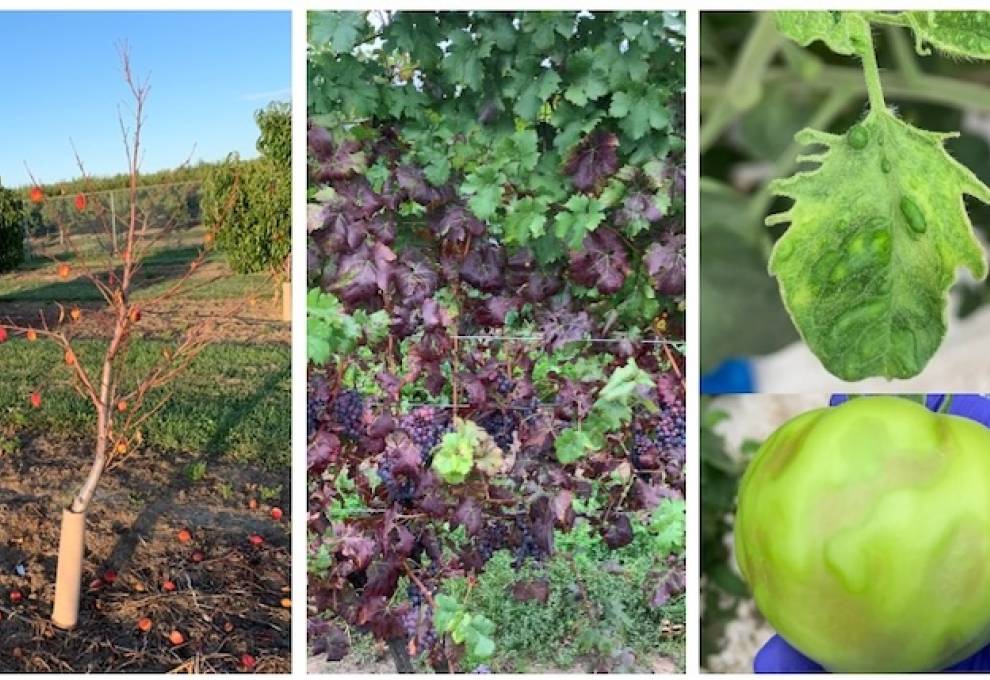
L-R: Declining nectarine tree, grapevines infected with GRBV, and a tomato leaf and fruit infected with ToBRFV.
JONATHAN GRIFFITHS & AIMING WANG
The study of plant viruses is a relatively new field. The first description of a pathogen smaller than a bacterium, Tobacco mosaic virus, was only reported ~125 years ago. The study of plant viruses is usually focused on obvious cases of disease and severe symptoms that can result in major crop losses.
The field of plant virology has advanced rapidly in the last decade, and virologists have moved from studying one virus infecting one plant to trying to understand all the viruses that can infect all plants within a field or a greenhouse. This is a vast amount of information, and the sum of all viruses within a plant or ecosystem is known as the virome. The advent of genomic sequencing has recently helped to identify hundreds of new plant-infecting viruses. Given these rapid changes in our knowledge and understanding of plant viruses, this article is intended to be a broad overview of viruses found in major horticultural crops in Canadian agricultural production systems and highlight areas for improved management.
Viruses can cause many symptoms that result in reduced production. Major symptoms in crops include dieback, stunting, reduced vigour, decline, issues with graft compatibility, and myriad leaf symptoms including bleaching or chlorosis, wrinkling or distortions, shot holes, and more. Viruses can reduce fruit production through smaller fruit size, blemished or unmarketable fruit, ringspots or line patterns, aborted fruit and even crumbly fruit for certain berries.
Viruses can accumulate over time, resulting in virus complexes (or co-infections) further exacerbating symptoms. Improved knowledge of viruses in agricultural ecosystems can inform growers’ choices for clean plant stocks and help to direct management and mitigation approaches, including targeting pathways of virus transmission, and targeted destruction of virus infected plants (i.e., rogueing).
Some viruses have broad host ranges and can infect multiple different plant species, while others have more restrictive host ranges. Nepoviruses, such as Tomato ringspot virus and Tobacco ringspot virus can cause issues in blueberries, grapes, apples, berries, and stone fruits. Pollen-spread Ilarviruses such as Prunus necrotic ringspot virus (PNRSV) and Solanum nigrum ilarvirus (SNIV) are surprisingly widespread in multiple crops including berries, stone fruits, and apples.
Many new Luteovirus species have recently been described infecting apples, blueberries, and stone fruits. In many cases, the host range extends beyond the species stated in the virus name. Understanding the whole horticultural virome could help identify emerging threats and promote mitigation efforts that could impact multiple crop species. Here, we briefly discuss major viruses in different plant species.
Key viruses of different crops
Apples, comprising nearly one quarter of all Canadian fruit farmgate values, are popular fruits nationwide that can be infected with many different viruses. Many viruses that infect apples are described as latent (hidden, inactive or not causing obvious infection), including Apple chlorotic leaf spot virus, Apple stem pitting virus, and Apple stem grooving virus. While labelled “latent” many of these viruses can cause symptoms in certain cultivars or ornamental varieties and can still cause reduction in growth that is difficult to measure.
Apples have been affected by “Rapid Apple Decline” which is characterized by sudden unexplained collapse and death of a tree, even with a full fruit set. While recent research has linked apple decline to extreme weather events, viruses could be contributing to this issue in complex ways. Recently, two new apple viruses have been described including Apple ilarvirus 2 (AIV2) described by Dr. Helene Sanfacon, a researcher at AAFC Summerland, BC, and Apple luteovirus 1 (ALV1). ALV-1 has been detected in most provinces while AIV2 appears to be restricted to certain regions in British Columbia. Another study published in the U.S.from 2020 described 17 potential new viruses infecting only six apple trees, emphasizing the wide range of viruses that can cause issues in apple production.
Blueberries have long suffered from virus infection, and Blueberry scorch virus (BlScV) was first detected in British Columbia in 2000, the severity of economic impact for the industry increasing substantially ever since. BlScV infection can cause vegetative and blossom necrosis and progressive loss of yield, and it may ultimately result in plant death. It is spread by aphids, and management consists of using virus-free planting stock, strictly controlling aphids, and rogueing infected plants when detected.
Currently, there have been no major reports of BlScV in Eastern Canadian production regions. Vigilance to prevent introduction of this virus to other regions could help prevent disaster. Blueberry shock virus (BlShV) is an unrelated virus that can cause similar symptoms, but plants typically recover the following years. BlShV is spread through pollen, making it more difficult to control aside from planting varieties that are slow to become infected. Recently a novel Luteovirus,named Blueberry virus N, was described by a research group led by Professor Jim Mattsson at Simon Fraser University, adding to several other novel blueberry viruses described by researchers in the U.S.
Tomato producers have had major issues with the newly emerged Tomato brown rugose fruit virus (ToBRFV), which is estimated to have caused losses of nearly $100 million a year in Ontario alone. One of our recent studies suggests that multiple resistance-breaking mutations are present in Canadian isolates of ToBRFV and that this virus will continue to be a major issue in tomato production. Pepino mosaic virus is another ongoing issue. Although losses associated with this virus are not as severe, co-infection can exacerbate ToBRFV symptoms.
Other berries. Strawberry decline, caused by multiple virus infections, can result in severe losses to growers. Aphid control has helped reduce virus transmission and promote plant health. Raspberry bushy dwarf virus causes crumbly fruit and reduced fruit firmness and yield in some raspberry varieties, and co-infection with other aphid- or pollen- transmitted viruses (e.g., Raspberry leaf mottle virus, Blackberry chlorotic ringspot virus) can exacerbate the impacts on production.
Stone fruits. Tender fruits such as peaches, cherries, apricots, nectarines, and plums, all closely related Prunus species, are long-lived woody trees that can accumulate multiple viruses. Many viruses infecting cherries are regulated; for example the ongoing Plum pox virus quarantine and monitoring effort in Niagara, Ontario. Cherry leaf roll virus is another regulated pathogen with sporadic reports in British Columbia and Ontario. Ilarviruses such as PNRSV, SNIV, and Prune dwarf virus are ongoing issues that are difficult to control.
Grapes are somewhat notorious for having the highest number of potential viral pathogens, with more than 100 different viruses associated with this crop. Major viruses include Grapevine red blotch virus and Grapevine leaf roll associated virus 3. These viruses and more are being managed through clean plant programs and efforts to identify and control insect vectors.
Conclusions
This is not an exhaustive list of all virus challenges faced by the Canadian horticulture sector, but a brief overview of some of the many viruses impacting producers. Each of our horticultural crops can be affected by one or more devastating pathogens, and virus complexes often result in more symptoms and economic losses than single infections. The use of virus-free planting material is a critical starting point. Once a plant is infected with a virus it cannot be eliminated, and the risk of spread to other plants can be high. Vector control can be important for some viruses such as BlScV, while genetic resistance offers the best hope for combatting other viruses such as ToBRFV.
Standard (Image)

