
01
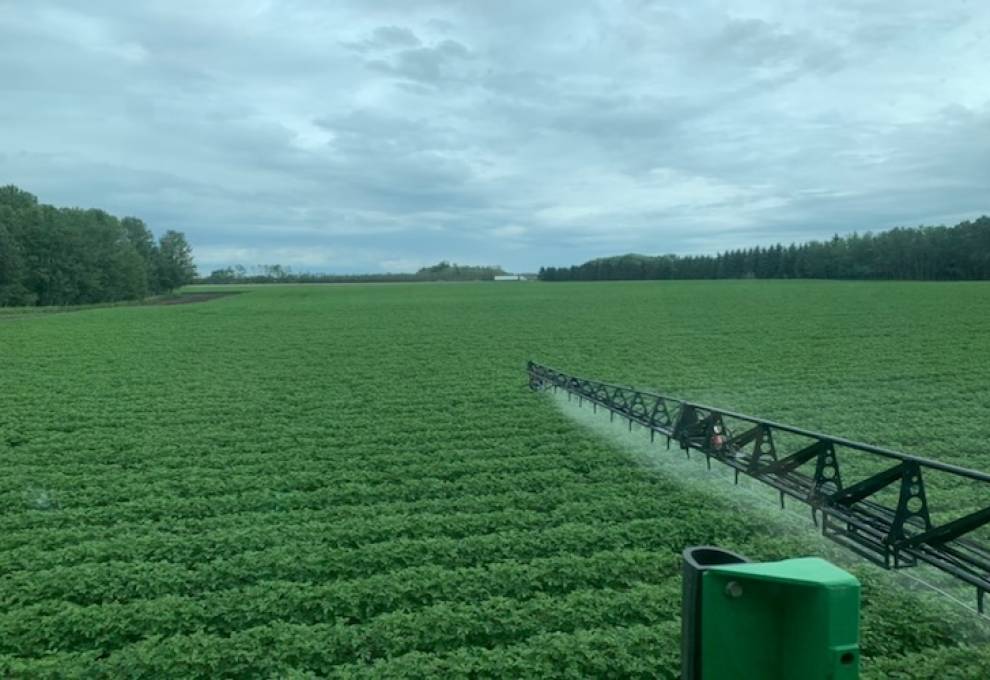
Spraying potatoes in Alberta
BY MATT SHEPPARD & CHRIS DUYVELSHOFF
Ongoing concerns continue regarding the funding and capacity of the Pest Management Centre (PMC) of Agriculture and Agri-Food Canada (AAFC) while several policy initiatives were the focus of engagement with the Pest Management Regulatory Agency (PMRA). Advocacy activities in 2025 focused on funding enhancement for PMC and pursuing a mandate change for PMRA.
OFVGA – advocacy
Securing additional funding for the Minor Use Pesticides Program of PMC remains a top priority. Many new crop protection registrations would not happen for fruit and vegetables without the work of the PMC. The program remains under limited capacity with half the average output from a decade ago, reducing the ability of PMC to conduct its critical work facilitating minor use label expansions. Ultimately, fewer projects at PMC means a smaller crop protection toolbox for growers. In support of seeking restored capacity at PMC, OFVGA along with FVGC met with elected officials, engaged with provincial and federal agriculture Minister’s offices, senior AAFC staff, and shared advocacy materials. We will continue working towards a funding enhancement for this critical program.
Expanding the mandate of the PMRA beyond human health and environment to include considerations for impacts to domestic food production and competitiveness has also been a major objective. Similarly, OFVGA along with FVGC engaged at several points throughout the year on this topic with some degree of success. Firstly, this vision was reflected as a campaign commitment in the 2025 federal Liberal platform. Secondly, OFVGA and FVGC along with some member organizations were witnesses for a fall study of the parliamentary Standing Committee on Agriculture and Agri-Food on regulatory reform in the agri-food sector. In December, a report from the committee outlined several recommendations to government, including to change the mandate of PMRA to include economics, food security and the cost of food in their decisions. We will utilize this initial support to seek meaningful change in 2026.
OFVGA – supporting activities
The annual Canadian Pest Management Priority Setting Workshops held in March are a critical venue to bring together growers, consultants, extension specialists, registrants, regulators, and government to discuss pest management issues and identify potential solutions for minor use crops. Starting with the 2024 meeting, OFVGA and the Fruit & Vegetable Growers of Canada (FVGC) have been cohosting the event with PMC so it can remain in person. Strong sponsor support – including from grower associations – and registration fees enabled the 2025 workshop to be held successfully. Continued funding by grower organizations helps to send a clear message to government that the workshop is an important collaboration to us. We are pleased to be working together again with PMC for the 2026 meeting scheduled for March 23-25th in Gatineau, Quebec.
The OFVGA also began efforts to increase public-facing communications on crop protection topics in 2025, kicking off with an initial series of three sponsored media articles in the fall. These articles promoted the importance of crop protection and the robust systems in place to ensure safety. Further activity is expected in 2026 to continue spreading this message.
PMRA – policy
After a one-year extension, the new tank mixing policy took effect in December 2025. In essence, the policy requires the label of each product in the tank mix to have instructions related to tank mixing for it to be permitted. It is expected this will be subject to compliance in 2026.
The OFVGA and FVGC continue to work towards achieving approval of remotely piloted aircraft systems (i.e. drones) for crop protection use. All indications have been positive for supporting this application method with appropriate requirements. A policy update is expected in early 2026.
The PMRA consulted on revised procedures for the registration of pesticides for emergency use in 2025 which OFVGA and FVGC provided recommendations to expand the scope of scenarios which qualify and extend the default duration to three years from one. The OFVGA board also approved some dedicated funding to cover Ontario emergency use fees for 2026 on behalf of the membership.
In initial consultations, PMRA also suggested changes to the Pest Control Products Regulations for exemptions and pest control devices. In response, OFVGA and FVGC provided recommendations to expand the scope of exemptions for common substances such as essential oils, along with providing for broader authorization of pest control devices without needing PMRA registration such as UV devices and laser bird control tools.
Finally, PMRA also undertook a pre-consultation of its policy covering label change implementation timelines following re-evaluation and special reviews. The OFVGA and FVGC provided recommendations to extend phaseout timelines for uses with no identified alternatives beyond the current three- to four-year maximum to allow for replacement tools to be developed. Furthermore, we sought to increase industry engagement on determining suitability of alternatives, along with extending a similar policy to registrant-initiated label amendments that cancel uses and products, as seen in 2025 with Matador insecticide and Betamix B herbicide.
Two notable proposals from 2024 did not advance in 2025. First, the proposed regulatory amendments to add additional criteria to the environmental risk assessments on cumulative effects were abandoned. Second, proposed increases to annual fees charged to registrants to maintain product registrations have been paused. Both proposals were not favourable for increased product availability in Canada.
PMRA – re-evaluations and special reviews
Three final re-evaluation/special review decisions were completed by PMRA in 2025 related to edible horticulture crops in Ontario (Table 1). All remain registered for use with label updates required.
Table 1: Final re-evaluation/special reviews completed by PMRA for edible horticulture crops in 2025.
Type | Active Ingredient | Product | Outcome |
Conventional | |||
Re-Evaluation | Abamectin | Agri-Mek/Avid Minecto Pro Insecticide | Continued registration acceptable – updated buffer zones and vegetative filter strip now required. |
Special Review | Pydiflumetofen | Miravis Fungicides | Continued registration acceptable. |
Biological | |||
Re-Evaluation | Streptomyces lydicus strain WYEC 108 | Actinovate Fungicide | Continued registration acceptable. |
PMRA – new crop protection active ingredients
Only two new active ingredients to Canada were registered by PMRA on edible horticulture crops with their first label in 2025 (Table 2). Both were new conventional active ingredients. In addition, numerous label expansions were completed on existing active ingredients by registrants, or through the User Requested Minor Use Label Expansion (URMULE) program by submissions from the PMC, by OMAFA, or by other provinces.
Table 2: New active ingredients registered on edible horticulture crops with their first label in 2025.
Active Ingredient | Product | Crop(s) / Target Pests |
Conventional | ||
Metamitron | Brevis | Apple and pear fruit thinning |
Cyclobutrifluram | Victrato | Lettuce for root-knot nematode (suppression) |
Biological | ||
- | - | - |
OFVGA crop protection committee
The Crop Protection Committee had three meetings in 2025, including a lunch-and-learn on crop protection use data, along with two regular meetings in July and November. The OFVGA would like to thank committee members who contributed to crop protection efforts this past year.
Collaboration
The OFVGA collaborates with numerous organizations to advocate for crop protection on behalf of edible horticulture in Ontario. We wish to thank our member organizations, FVGC, PMRA, AAFC, OMAFA, and CropLife Canada who continue to work towards making crop protection in Canada better for growers and ensure safe and abundant food for consumers.
Matt Sheppard is chair, OFVGA crop protection committee. Chris Duyvelshoff is OFVGA crop protection advisor.
Standard (Image)
If latest news
Check if it is latest news (for "Latest News" page)
1 (Go to top of list)

