
01
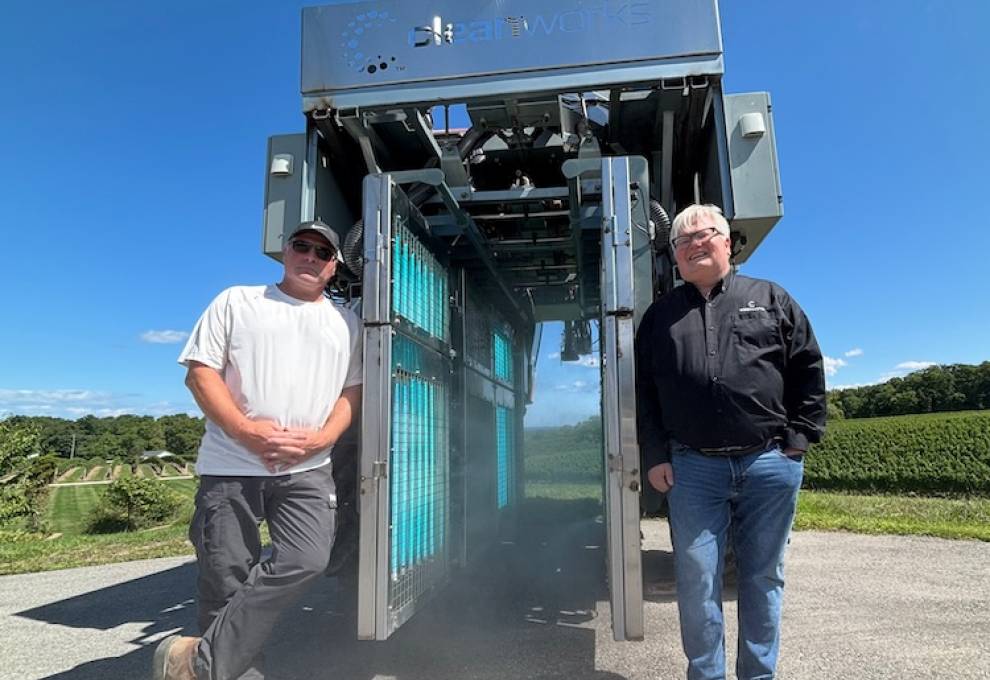
Brian Schmidt, (L) Vineland Estates Winery and Paul Moyer, Clean Works.
Imagine you could sanitize your crops against disease the same way apples are sanitized before being shipped to your local grocer. And that the entire process is sustainable, with water being the treatment’s sole residue. Third-generation winegrower Brian Schmidt thinks it’s more than possible.
Bringing expertise acquired over 36 harvests, he’s collaborated with Clean Works of St. Catharines, Ontario, to do field trials for the past two seasons on his 100-acre vineyard near Vineland, Ontario. The Clean Works equipment passes over the vines, bathing them with a hydrogen peroxide and ozone fog in the presence of UV light.
These three treatments have a history of being used successfully as individual sanitizers in many other industries. The key element for each of these treatments is the sanitizing effect of hydroxy radicals, and research shows that when combined into one application, the efficacy increases almost a hundredfold. For Brian Schmidt’s grape vines, the gain has been a significant reduction in powdery and downy mildew during trials.
Although the chemistry of this treatment has been well established and broadly used, innovation was needed to take the technology out of the warehouse and into the field. That is, to make it transportable.
Denise VanderVeen, director of business development for Clean Works, explains how their fogging machine works. Hydrogen peroxide is atomized into a clean flow chamber while ozone is being released into the chamber. As the machine moves along the vine row, the fog envelops the entire plant while being irradiated by ultra-violet light, which in turn exponentially accelerates hydroxy radical production on the plant’s surfaces. Since these radicals only have a half-life of about one nanosecond and can’t travel far, maximum surface saturation is required to ensure optimal effectiveness in killing the mildew fungus. And voilà, within seconds of application, the fungus is dead, depositing water as the end by-product.
The treatment is an attractive solution from several perspectives. Fog or vapour diffusion throughout the vine achieves instant mildew eradication on most of the plant’s surface, not just the surfaces reached by typical spraying. It costs less than a comparable fungicide application. And it can be applied right up to harvest since there are no re-entry interval limitations. But most significantly from a sustainability perspective, there are no negative impacts on pollinators, water sources, or soil.
“Not to sound simplistic, but this reminds me of making bread,” says Paul Moyer, an apple grower and entrepreneur who has partnered with Court Holdings to commercialize the technology. “You need flour, yeast and water in the right ratios under the right conditions.”
In 2015, the team at Clean Works perfected the use of applying hydrogen peroxide, ozone, and UV-light in a single treatment out of a need to sanitize his candy apples. Several deaths in the U.S. and Canada were identified by authorities as having been caused by presence of Listeria monocytogenes in candy apples. There was an urgent need to figure out a waterless solution that would work for candy apples. Working with food safety expert Dr. Keith Warriner, University of Guelph, Clean Works went on to commercialize the three- component treatment process under the Clean Works brand. When COVID hit in 2020, the process gained additional credibility when Health Canada approved the equipment to sanitize N95 masks for reuse.
Adding to the tool box
Fast forward to 2023 when Schmidt and Clean Works explored the potential of its technology to tackle the scourge of powdery and downy mildew on grape vines. With the loss or reduction in the number of applications of broad-spectrum fungicides, growers are relying more on fungicides with site-specific activity that are more prone to resistance. The Clean Works technology is non-specific, therefore not prone to resistance.
“We’ve been at the tip of the spear in innovation in several regards,” says Schmidt. “We were the first to buy novel optical-sorting harvest systems. We were the first to adopt new wine-making concepts. We’re comfortable pushing the envelope.”
Despite field trial successes, he doesn’t see crop protection products being entirely eliminated by Clean Works. In fact, he sees a place for the fogging machine alongside a regular rotation of fungicides, as an aid to reduce resistance to active ingredients. If the machine is commercialized, he predicts fungicide cost savings of 50 per cent in years when disease is prevalent. For his vineyard, that could represent a savings of $75,000 annually.
Apart from input cost reduction, there are other long-term sustainability considerations: “I don’t like dragging a sprayer with 2,000 pounds of liquid product,” says Schmidt. “That’s compacting the soil.”
Dr. Wendy McFadden-Smith, tender fruit and grape IPM specialist, for the Ontario Ministry of Agriculture, Food and Agribusiness, has been on the front lines of vineyard management for many years. Since 2024, she and her team have performed weekly assessments for powdery and downy mildew at the Vineland test site. At each date, they examine 50 leaves and 50 clusters and evaluate for disease. In 2025, McFadden-Smith trained the person from Clean Works to do the assessments.
Treatment frequency
Given the limited number of rows used for the trial, McFadden-Smith designed the assessment to include as much replication as possible. The hot 2025 season reduced disease pressure, which in turn resulted in very low infection levels. One question left unanswered was the issue of treatment frequency.
“As for weekly applications, I don’t know that this will be necessary once we get past the period of fruit susceptibility at six weeks post-bloom, although we are also looking at this method for botrytis management as well,” says McFadden-Smith. “If you consider organic viticulture, weekly sprays are the norm. The thought is not to rely on the Clean Works technology exclusively but to alternate with conventional fungicides to reduce selection pressure for resistance and also extend the interval between fungicide sprays.”
McFadden-Smith is looking forward to more trials in 2026. “My reservations are primarily because we’ve never had the system functional in the vineyard earlier than the end of July and in both years, the trial ended the beginning of September because the harvester had to go back to the original owner. We haven’t had a trial for the full season.”
She adds that no tests have been done on black rot. The vineyard block where the team worked in 2024 was severely infected with black rot and the machine wasn’t available to control early-season infections.
Future applications
Interestingly, Dr. Malkie Spodek, Cool Climate Oenology Viticulture Institute, is determining whether this technology can help manage insect and mite pests. Dr. Justin Renkema has been looking at ultra-violet light and how Clean Works technology could control leafhoppers. In another potential application, Spodek is wondering if Clean Works could repel multi-coloured Asian lady beetle, if applied just before harvest.
What was demonstrated in summer 2025 is a prototype system mounted on a harvester. Clean Works is now building a tow-behind unit that would be affordable for anyone with a 75 hp tractor. This will make the unit lighter so there’s less soil compaction and it will be more nimble with a smaller turning radius. The hope is to have this field-ready for 2027.
In the meantime, Clean Works has extended its pathogen-killing technology to other crops including a frozen raspberry plant in Serbia and frozen wild blueberries in Canadian plants. Trials are underway in field crops such as spinach and arugula.
Trial results at Vineland Estates have shown the trifecta of hydrogen peroxide, ozone, and UV-light to be effective in combatting fungi. With other crops poised to become potential beneficiaries of this technology, it seems waiting for the fog to clear isn’t in the forecast.
Standard (Image)

