
01
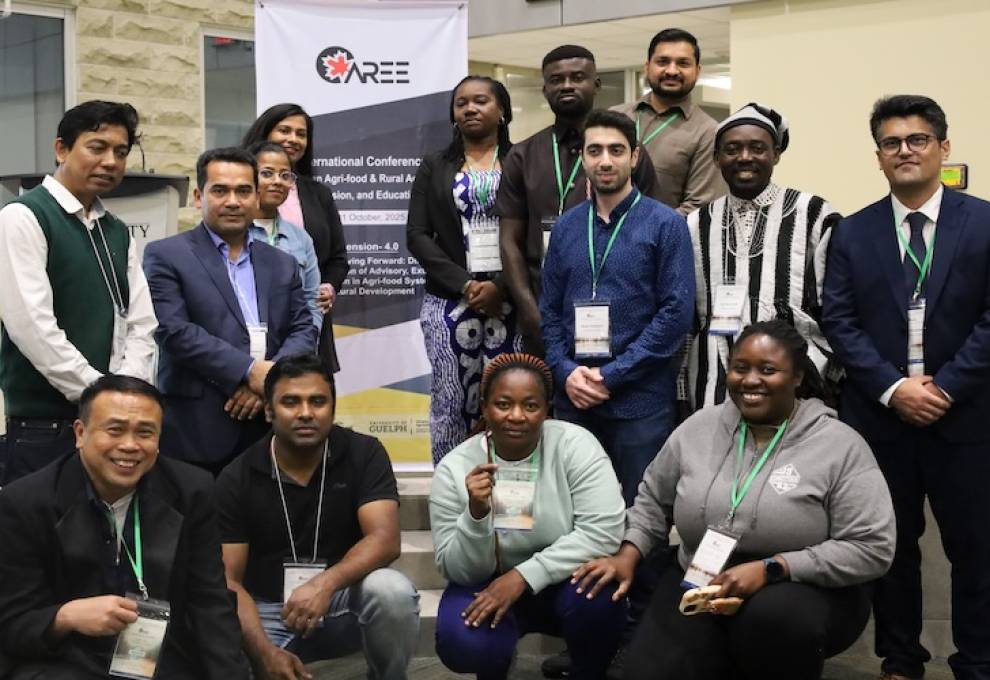
University of Guelph professor Ataharul Chowdhury (middle row, second from left) joined his students for this photo during the first Canadian Conference on Agri-food, Rural Advisory, Extension and Education at the university last fall. Photo courtesy of Ataharul Chowdhury.
A University of Guelph researcher is calling for a national agricultural extension strategy, to address what he calls the “$150-billion blind spot” holding back sustainability and progress.
Prof. Ataharul Chowdhury, School of Environmental Design and Rural Development, describes himself as a believer in sustainable change. “Through research, teaching and service, I strive for enhancing or creating capacity that supports social and technological innovation,” he says.
And over the next five years, one change he’d like to see is the way extension in Canada is coordinated. Chowdhury believes extension – that is, applying research and knowledge to agricultural practices, through farmer education -- is an essential element of change.
“It’s all about guiding farmers towards better results,” he says. In practice, when researchers learn something new and helpful through their studies, they extend or disseminate this new knowledge to farmers through traditional avenues such as meetings and reports, or through virtual means including social media and websites.
Ideally, this approach results in farmers trying to implement the researchers’ suggestions, then provide feedback with their perspectives. In that way, impact can be measured.
Today, pockets of agricultural extension are active and popular across the country. Provincial governments, universities, colleges, private industry and private individuals hold grower days and conferences, and engage in e-communication to pass on their latest findings and discuss them with growers.
But a formal, national coordination effort does not exist, like it does in other countries – most notably, the U.S. Studies show that farmers who use advisory services see their profits typically grow 10-20 per cent, and the return on public investment is $9 for every $1 spent on extension.
Here though, research dissemination is fragmented, disconnected and unequally accessible. A landmark article in 2010, published in the Journal of Extension, argued that Canadian extension was already on life support. At that point, publicly funded extension had been chipped away for 20 years or so, they said, to the point where it had become moribund. Without a complete overhaul, the researchers believed extension was sunk.
Now, 16 years later, Chowdhury says not much has changed. Fortunately, extension didn’t sink, but he thinks it’s teetering. A national strategy could change that, he says, and take better advantage of the knowledge percolating in research communities and connect it with growers.
Chowdhury believes improved extension coordination is especially important now that Canada is taking a fresh look at markets, sustainability and support for agriculture. It could also help agriculture join together with AI increasingly taking hold as an information – or disinformation – tool. Canada’s fledgling AI strategy is still wet behind the ears; how it will affect agriculture is a huge question.
Then there’s the matter of succession. Training for the next generation of agricultural extensionists is almost non-existent. Guelph has one of the few academic programs in the country dedicated to extension. The consequences seem obvious, but for a $150-billion sector such as agriculture that’s so consumed with numbers and research, direction is strangely lacking.
At what was billed as the first Canadian Conference on Agri-food, Rural Advisory, Extension and Education, a conference he and his team led last fall at the university, Chowdhury got the ball rolling by introducing a new academic journal. Its goal is to help enhance awareness, visibility, and collaboration among the various research, education, advisory, and community engagement activities happening across Canada.
“Farmers are isolated from each other, but they don’t work in isolation from the environment, community development, health and wellbeing and technology,” he says. “System change begins when we invest not only in activities, but in the people, organizations, partnerships, education, research and policies that allow extension and advisory systems to adapt, collaborate, and create lasting impact.”
Standard (Image)
If latest news
Check if it is latest news (for "Latest News" page)
1 (Go to top of list)

