01
.
A highly effective way to address questions such as “so what?” and “who cares?” is to show impact. Just ask the University of Guelph.
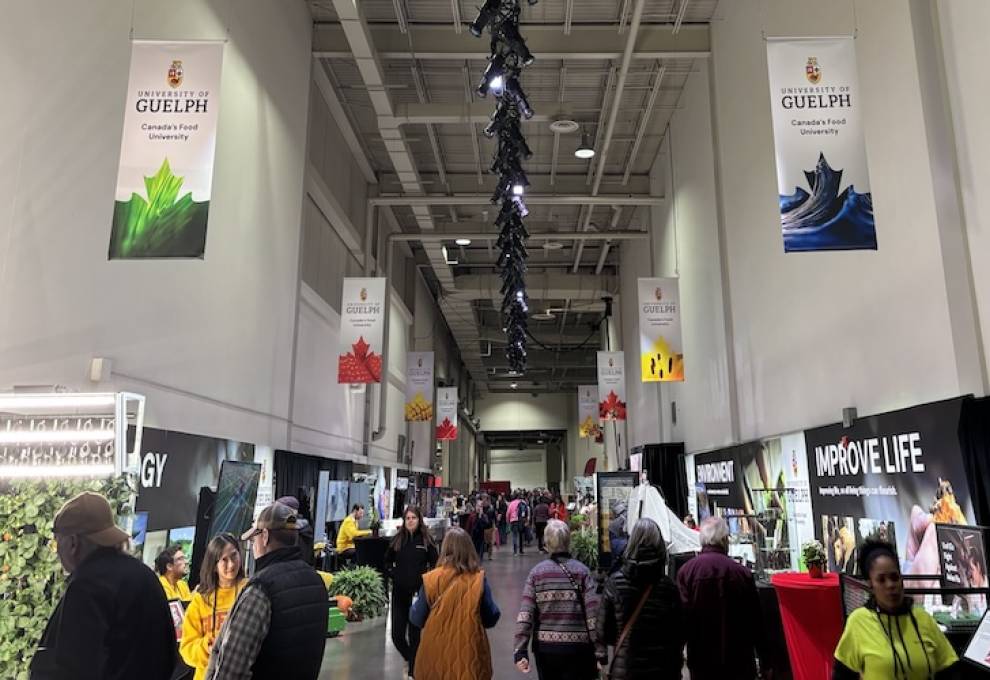
The institution, which has dubbed itself Canada’s Food University for the past 20 years or so, focused specifically on highlighting the impact of its unique, multi-faceted research enterprise at its 2025 Royal Agricultural Winter Fair exhibit. This year’s theme was “Nourishing Ideas, Cultivating Innovation and Growing Solutions.”
Impact has long been a cornerstone of the university’s research communications. But the stars particularly aligned for the Royal exhibit, making it a standout among the 2,500 exhibitors who greeted 300,000 visitors to the annual event. Reaction to the 2,700-square-foot exhibit, staffed by a dozen student ambassadors, recruitment officers, graduate students and researchers, could be summed up in one word: wow!
“What stood out for me was the focus on education and the application of research towards the production of healthful foods within a healthy environment,” says Prof. Brian McBride, a retired University of Guelph dairy researcher who attended the Royal with his family. “The exhibit felt alive. Even my grandchildren were drawn into its positive energy.”
So, what was it that gave the 2025 impact message such, er, impact?
Claire Alexander, U of G’s assistant director for ceremonies and events, says at least three factors played into it.
First, timing was key. Elbows-up Canadian patriotism may have cooled off slightly in some camps since its emergence last year, but it was on full display at the Royal. After all, the event, which organizers dub “the largest indoor agricultural and equestrian event in the world,” has been a Canadian institution since 1922. That’s when a collective of influential farmers and horse owners gathered to plan an exhibition of Canada’s finest agricultural wares. The Royal has built-in nationalism.
“We’re proud Canadians and we had many Canadian flags at our exhibit,” says Alexander. “So did others. The displays made a statement like ‘Canada is OK, and we’ve always been. There’s a lot of brilliance in this country and if something happens at the border and food is a question, we’re here for you.”
Another factor was teaming up with government and industry partners, who wanted to highlight their strategic research liaisons with the university. Such partnerships often bring huge applicability and practicality to research activities and outcomes. Impact is front and centre.
Alexander also notes the exhibit’s impact was influenced by the real estate mantra: location, location, location. The exhibit consumes what’s called the “swing space” or breezeway between Heritage Court and Hall B. It’s like having a captive audience.
“Having the U of G exhibit in a breezeway gave the exhibit ‘flow’,” says attendee McBride. “My grandsons were racing up and down the breezeway...then froze, as they spotted the entomology display and circled back to look at the beetles.”
The breezeway is indeed a highly travelled thoroughfare and represents a golden opportunity for stopping power, provided you have the right story to tell. And to Alexander, story telling is what resonated the most with the crowd.
“It’s all in the story, and this year’s story was impact,” she says. “We showed how research, education and collaboration are shaping the future of food and agriculture in Canada. It was a reminder of what’s possible when ideas connect with purpose and when people work together to improve life.”
Research is a working-together affair. Guelph was an early adopter of what’s called One Health, described by the United Nations as “an integrated, unifying approach to balance and optimize the health of people, animals and the environment.” That approach propelled the Royal exhibit, including horticultural initiatives such as integrated pest management research in vegetable crops by Prof. Mary Ruth McDonald, new apple varieties by Prof. John Cline and an extensive display by the always-popular Guelph Honeybee Research Centre.
“People realize this kind of research has real impact on their lives,“ Alexander says.
As for next year, watch for even more interactive activities, still more stories…and still more impact.
Standard (Image)
If latest news
Check if it is latest news (for "Latest News" page)
1 (Go to top of list)