
01
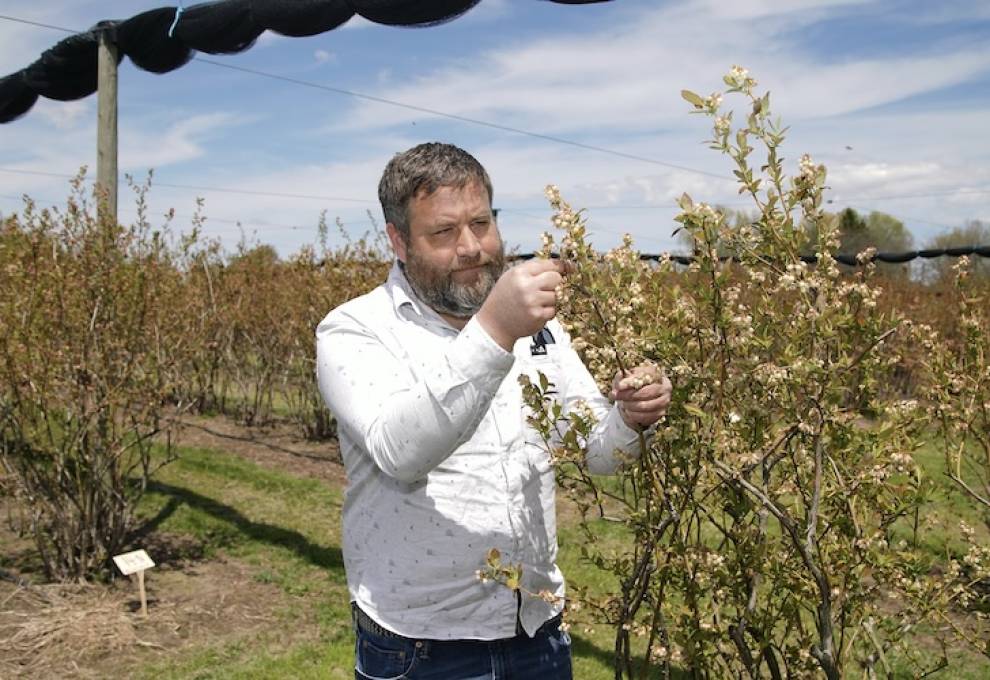
Agriculture and Agri-Food Canada research scientist, Dr. Jonathan Griffiths inspects bee pollination activity at Blueberry Knoll Berry Farm near Lowbanks, Ontario. Photo by Jeff Tribe.
Dr. Jonathan Griffiths, a molecular plant virologist, uses an unusual source of labour to assist his research: the enigmatic honeybee. A respected contributor to berry, tree fruit, grape, and tomato research, he is using bees as sentinels for the early detection of plant-based viruses.
As an Agriculture and Agri-Food Canada (AAFC) researcher, Dr. Griffiths has discovered that as honeybees pollinate fruit trees and berry crops, they can gather plant viruses along with the pollen that’s carried back to the hive. Members of his team working at Vineland and London then analyze the pollen by extracting the ribonucleic acid (RNA) to identify any viruses that may be present. Their research also includes analyzing how flowering timelines and bee pollination behaviour affect virus transmission within and between various crops.
Seconding bees as an early warning network to identify plant viruses is an ingenious, effective way to advance crop protection. Blueberry Knoll Berry Farm near Lowbanks, Ontario serves as Griffith’s field laboratory where farmer Brian Young welcomes the research and is excited by its many potential applications. His berry farm has proved to be helpful in analyzing the links between pollinators and transmission of plant viruses. Beyond that site, Dr. Griffiths’ work includes monitoring peach, cherry, apples, strawberry, and raspberry viruses. This research also has the potential to help greenhouse growers manage the devastating effects of tomato brown rugose fruit virus.
The apparent success of this innovative work aside, big questions hang over the effectiveness of research priority setting and funding for the broader horticultural industry. It’s a perennially thorny issue for growers that’s even more problematic as dwindling government and private sector budgets become the norm. Prioritizing research to target the biggest pay back for 120-plus horticultural crops requires the wisdom of a modern-day Solomon. Questions such as who is funding, who controls spending, who gets money, and when do growers get a say all deserve to be answered up front.
The Sustainable Canadian Agricultural Partnership (SCAP), in place since 2023, is up for renewal in 2028. The sustainable CAP program matches industry-prioritized research spending with federal funding to promote grower-focused research. But matching cutting-edge research with grower needs, and producing on-farm improvements, can still be a challenging prospect.
In Ontario, Dave Hope, chair of the Ontario Processing Vegetable Growers (OPVG), is advocating for more research dedicated to the $162 million sector that produces the raw ingredients for canning, freezing and pickling.
“What we would like to see is a Centre of Excellence for Vegetable Research at Ridgetown,” explains Hope. “Ridgetown has been a major contributor to the agriculture and food economic powerhouse in southwestern Ontario. Future success depends on innovation. To cut to the chase, farmers depend on having researchers who are focused on solving problems on the farm. A commitment by government to partner with the industry and the research community is key to be competitive. Farmers are willing to do their share and they are actively partnering with the processor community.”
OPVG has pledged $278,000 for specific projects in 2026. Examples include phytophthora research in processing tomatoes and downy mildew control and monitoring in cucumbers.
Right now, Hope is acutely aware of negotiations between the Ontario Ministry of Agriculture, Food and Agribusiness (OMAFA) and the University of Guelph to renew an alliance that is funding and executing $343 million of research under a five-year agreement ending March 31, 2028. It’s Hope’s view that creating a new Centre of Excellence would refocus “crystal ball research planning” toward a more producer-facing horizon. At present, he says that Ridgetown is an academic-facing component of the University of Guelph satellite ecosystem.
Some agricultural sectors, such as grains or dairy, can laser-focus their research by anteing up a million dollars for a research chair at the university. But for horticulture, it’s entirely different given that funding streams become scattered when serving many interests. The result: from apples to asparagus, hops to hazelnuts, all groups go begging, much like Oliver in the Dickens novel: “Please, sir, I need some more.”
Research in Alberta
In 2020, the Alberta government established a different funding model, Results-Driven Agricultural Research (RDAR), along with its commitment of $380 million over 10 years. At first glance, this is an impressive amount but less so when compared to the province’s $25B farm receipts in 2024. RDAR is an arm’s length, non-profit agency that works with industry advisory groups to evaluate research proposals and then administer funding.
“Without profits, we're not sustainable,” writes Dr. Mark Redmond, CEO for RDAR. “We challenge each project to show economic benefit for the agri-food value chain before we invest…We collaborate with various stakeholders and encourage collaboration within projects. Ideally, each project will include a producer or processor, so that results are realistic and may be adopted.”
Five years on, at its annual roundup conference in June 2026, RDAR reported that of the $355 million portfolio and 610 projects, 55 per cent of the research results were reaching the farm within three years. And that $130 million in funding was being leveraged 3.2 times by public and private partners. The transparency in reporting such funding matters.
He goes on to say, “In Canada, we don’t have an innovation problem but rather an adoption and scaling problem. Research needs to be more closely aligned with producer feedback loops.”
The Manitoba model
Two provinces over in Manitoba, Leanne Koroscil sings from the same page. She’s the Innovation Farms manager for EMILI, a memorable acronym for Enterprise Machine Intelligence Learning Initiative. Since 2016, EMILI’s founders have been guided by three strategic priorities: enable farmer-centric innovation, advance sustainable technologies and techniques, and increase digital agricultural skills and knowledge. Their exemplary vision holds true today with AI-powered BioScout in trials to detect early blight spores in potatoes, and with Cellar Insights in trials to extend long-term, post-harvest storage of potatoes.
As Koroscil explains, Innovation Farms operates at two Manitoba locations: Rutherford Farms, a 5,500+ acre seed farm in Grosse Isle, and J.P. Wiebe Ltd., a 10,000-acre farm with approximately 3,000 acres dedicated to potatoes in MacGregor. Working alongside these farmers, EMILI creates a closed feedback loop with the ability to quickly evaluate ROI on new agriculture technology in real-world commercial farm settings.
In 2025, Sheldon Wiebe signed on to become part of EMILI’s Innovation Farms for his family’s processing potato operation.
“Quality is always top of mind,” he explains. “If we can use technology to replace people who are constantly checking the crop and the storages, then I’m on board.”
Wiebe is currently pumped about using Autonomous Pivot, an irrigation company based in Kansas that provides more than just irrigation. Their equipment integrates on-board cameras and sensors to measure soil moisture and crop health within the pivot’s coverage area. The system optimizes irrigation real time and occasionally assists with early identification of pest infestations.
He’s also anticipating benefits from the first chair in potato sustainability at University of Manitoba. Between the university, the Manitoba Horticulture Productivity Enhancement Centre (MHPEC) and support from Keystone Potato Producers, a series of inter-related research projects have been started. These include projects with food processors – J.R. Simplot and McCain Foods – who give immediate feedback on research to solve storage issues.
“We’re trying to be more forward-looking in the research process,” says Wiebe. “With soil-borne diseases such as potato mop-top virus, we need to change the research trajectory much faster. The biggest challenge is to find the researchers who will live and work in our rural communities.”
Last mile
The notion of national collaboration has been repeated often by Prime Minister Mark Carney. That agricultural research is the cornerstone of food production innovation in Canada should not be forgotten as the country unites to “Build Strong.”
Simply put, growers need a research ecosystem that is nimbler in providing rapid responses to emerging threats such as fungi, insects, weeds…and viruses. One that is faster in delivering workable commercialization support. One that is flexible in collaborating across federal, provincial, and industry research stakeholders.
Yes, the need is cumbersome: basic research, applied research, last-mile research. And the question is complicated: continuous needs, many players, not enough money. But whatever the eventual answer, one thing is certain. Growers need to be at the table right from the get-go.
Standard (Image)
If latest news
Check if it is latest news (for "Latest News" page)
1 (Go to top of list)

