
01
.
Advanced technology can help farmers get to the root of a growing problem -- overwatering in an era of increasing drought and water scarcity. A new UC Riverside system can map soil moisture tree by tree, so growers water only where and when it's needed.
This system, detailed in the journal Computer and Electronics in Agriculture, was led by the research group of Elia Scudiero, associate professor of precision agriculture and the Director of UCR's Center for Agriculture, Food, and the Environment (CAFE).
Water management is one of the biggest challenges facing agriculture in California and other dry regions. Currently, some growers rely on soil moisture sensors buried in the ground to determine when to irrigate. These sensors are expensive and typically installed in only a few locations, leaving growers to guess how conditions vary across hundreds or thousands of trees.
"The information those sensors provide is very limited," Scudiero said. "It really only tells you what's happening in the immediate areas where they're placed."
Even when sprinkler systems deliver the same amount of water throughout an orchard, the soil moisture and its availability to trees can vary greatly from spot to spot within a single field.
One reason is soil texture. Fine soils packed with tiny particles hold water tightly because they have more surface area where water can cling. Sandy soils contain larger particles and fewer small ones, which allows water to drain more quickly. These differences can leave neighbouring trees experiencing very different conditions.
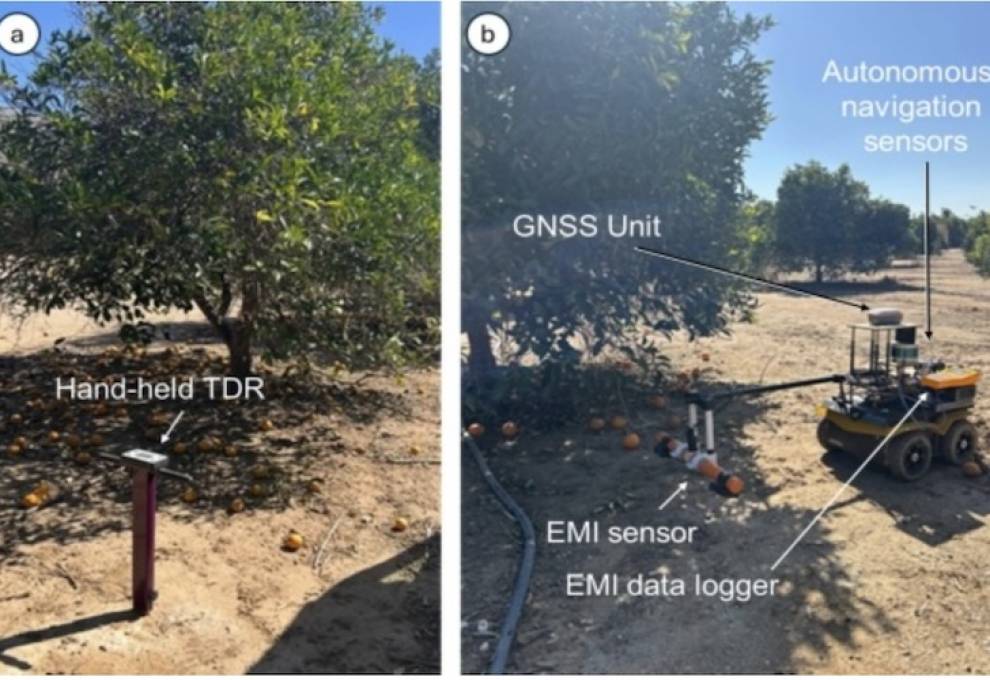
The new system replaces limited sensor data and guesswork with detailed maps. A robot moves through an orchard measuring a property of the soil called electrical conductivity. These readings, combined with data from the fixed moisture sensors already in the ground, allow researchers to build a statistical model that predicts water content across the entire field.
Electrical conductivity indicates how easily electricity moves through the soil and is influenced by factors including moisture as well as salt and clay content. By pairing those measurements with direct water readings from buried sensors, the system can translate conductivity into accurate estimates of soil moisture.
The result is a tree-by-tree picture of water distribution. "Using this method, growers will finally know how much water they have, and how much they need, and can water specific trees if they're dry," Scudiero said.
The team has already filed a patent related to how the robot interacts with sensors without disturbing their measurements. This research was conducted at the UCR Citrus Research Center & Agricultural Experiment Station. Future work will focus on testing the system with commercial growers beyond the university's research orchards.
Source: University of California-Davis June 15, 2026 news release
Standard (Image)
If latest news
Check if it is latest news (for "Latest News" page)
1 (Go to top of list)

