
01
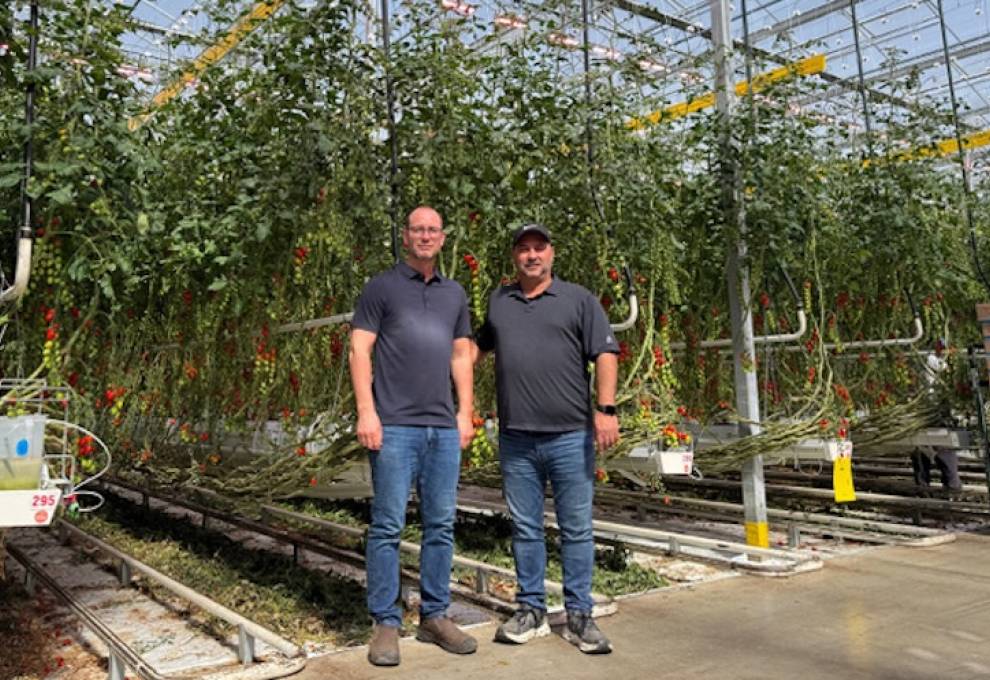
Brothers Rudy (left) and Albert Mastronardi, are relieved to have a tomato crop ready to harvest in mid-March near Kingsville, ON
Frigid temperatures outside. Sizzling hydro rates inside.
That’s what caused some Ontario greenhouse growers to dim their lights this past winter. They were forced to stall plant growth deliberately as hydro rates skyrocketed from five cents per kWh up to peak rates of 64 cents per kWh!
Albert Mastronardi is a grower who experienced this crisis firsthand. He and his brother Rudy operate H&A Mastronardi Farms Ltd near Kingsville, Ontario, managing 12 acres of red grape tomatoes and another dozen acres of mini cucumbers.
“The volatility of pricing was unimaginable,” recalls Mastronardi, who says the situation lasted from January through early March 2026. “We were managing hour to hour, not only with LED lighting but the spectrum as well. Far-red light, for example, requires higher consumption of power. So we experimented with the mix to manage costs.”
The irony of this situation is that they invested in new dynamic LED lighting over the last couple years with the goal of improved sustainability, finetuning greenhouse lighting during the day and at night to optimize fruit load and quality. Their in-house computer system connects directly into the Independent Electricity System Operator (IESO) network to track price changes in real time. During periods of soaring spot pricing, the Mastronardi brothers micro-managed greenhouse operations, not only adjusting lighting but irrigation as well. Watering must be balanced to lighting conditions to ensure healthy root development. Absent integration of supplemental lighting and controlled irrigation, plants are weakened and yields diminished.
As Mastronardi describes, rising electricity prices put H&A in a tight squeeze: dim the lights to manage costs or risk underdelivering contracted product to clients.
Once a plant is in production, it is no longer a simple “flip the switch” decision.
Historically, Ontario has had abundant electricity, but increasing industrial and consumer demand coupled with a stagnant and unreliable supply have considerably altered the economics of the province’s electricity generation. For the greenhouse industry, this has resulted in an operational dilemma where, in some cases, electricity costs exceed labour costs.
“If we had perfect alignment with the stars, we would have reliable and affordable access to natural gas, hydro, water and wastewater facilities,” says Richard Lee, executive director, Ontario Greenhouse Vegetable Growers (OGVG). “Our sector needs good policies at municipal, provincial and federal levels to reach sustainable and competitive goals.”
At risk are 4,487 acres of vegetable greenhouse production in Ontario. OGVG statistics break this down as 1,689 acres of tomatoes, 1,484 acres of peppers and 1,314 acres of cucumbers. While the sector recorded 6.5 per cent growth in 2025, business case analyses have trimmed expected growth this year to three per cent.
Tackling these challenges head on, the Ontario Greenhouse Vegetable Growers highlighted their concerns at the annual general meeting of the Ontario Fruit & Vegetable Growers’ Association (OFVGA) held in February 2026. Three motions were brought forward at the meeting, then subsequently passed by delegates:
- - That OFVGA advocate for continued investment in natural gas infrastructure to ensure affordable, accessible and reliable fuel for agriculture, thereby enhancing competitiveness, supporting long-term investments and strengthening food production in Ontario.
- - That OFVGA urge the Ontario government to investigate, develop and implement predictable, affordable agricultural electricity rates, including mechanisms to cap, stabilize or mitigate energy costs.
- - That OFVGA endorse and advocate for wider adoption of cogeneration technologies for on-farm generation opportunities, that provide regulatory certainty, fair grid access and appropriate compensation mechanisms that recognize the value of on-farm electricity generation and optimize the use of co-generation products.
Co-generation is adopted by some Ontario greenhouse growers, but also in other jurisdictions. One example is Big Marble Farms, located in Medicine Hat, Alberta, which installed co-generation facilities six years ago. The farm uses 37 megawatts of power of which 12 megawatts is produced through their own co-generation facilities for 71 lit acres and nine unlit acres of tomatoes and mini cucumbers. As of February 2026, they can now sell back excess power to the City of Medicine Hat.
“This is not about making money at market rates of two to three cents per kilowatt,” explains Albert Cramer, Big Marble Farms. “Rather, with a contract with the city, it’s an assurance that we can manage our energy costs and co-generation costs.”
Contrary to some assumptions, hydro power is not cheap in Alberta. It’s natural gas that’s cheap at $2/gigajoule and that’s what Medicine Hat uses to produce its own electricity for the municipality. Big Marble Farms is paying 11 cents/kWh for hydro, including delivery costs.
Back in Ontario, electricity costs are but one item in a basket of concerns, all of which share a common theme: a new, much needed underground infrastructure network to deliver services. In the case of natural gas, for example, a delivery bottleneck exists that will only be solved by laying new pipe. Similarly, improved water access requires installation of additional watermains to unblock growth. Even though the fresh waters of Lake Erie lie within easy sight of many greenhouse growers, accessing it remains a dream on the horizon.
Oddly, given grower anxiety over unaffordable hydro, the greenhouse industry was surprised by the January 26, 2026 federal announcement that owners would be granted a 100 per cent capital cost deduction against income during the first operating year of new greenhouse builds.
The prime minister’s text read: “To lower the cost of food production, we are introducing immediate expensing for greenhouse buildings. This allows producers to fully write off greenhouses acquired on or after November 4, 2025, and that become available for use before 2030. This measure supports increased domestic supply and investment in food production over the medium-term.”
Although any additional federal support for the greenhouse industry is welcome, electricity pricing volatility and stretched natural gas and water infrastructure hamper the viability of any new construction. Alleviating risk for Ontario’s $2 billion a year greenhouse sector depends on support alignment between all three levels of government. To achieve less undermines both long-term economic prosperity and year-long food security in a world already in turmoil.
Standard (Image)
If latest news
Check if it is latest news (for "Latest News" page)
1 (Go to top of list)

