
01
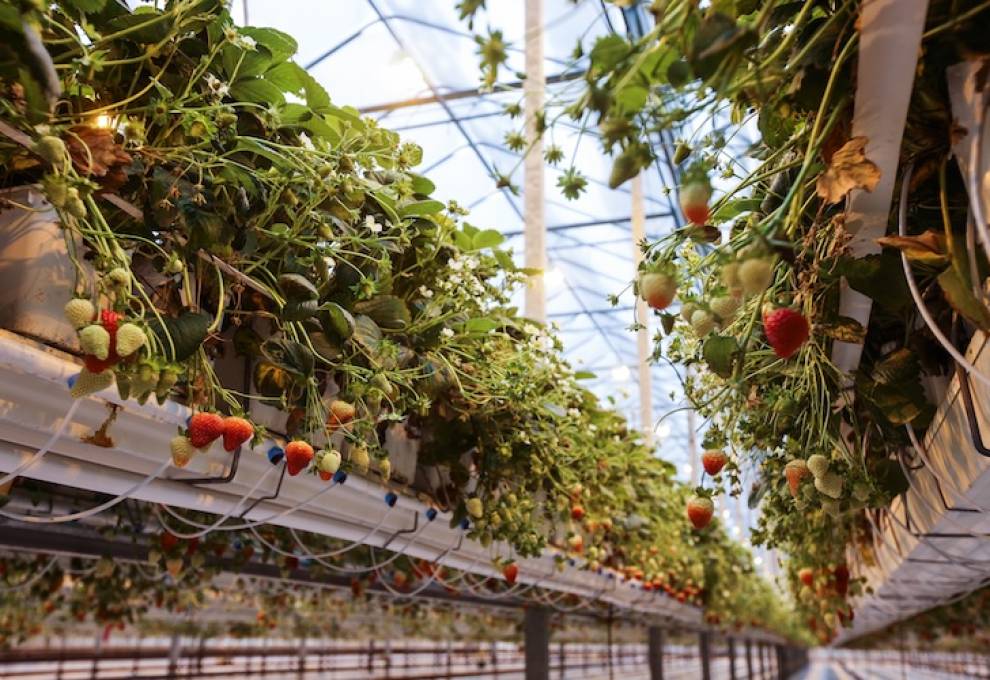
Greenhouse strawberries have been selected as a priority without a solution for Neopestalotiopsis sp.
Under continued joint collaboration between the Fruit and Vegetable Growers of Canada (FVGC), Ontario Fruit and Vegetable Growers’ Association (OFVGA), and Agriculture and Agri-Food Canada’s Pest Management Centre (AAFC-PMC), the 24th Annual National Pest Management Priority Setting Workshop was held in Gatineau, Québec on March 24 – 25, 2026. Continuing this year, the two-day workshop was first introduced in 2024 as opposed to the historical three-day format, which saw entomology, pathology, and weed science priorities elevated over the course of both workshop days. The goal of the workshops was to nominate ‘B’ priorities in all disciplines on Day 1, and to nominate ‘A’ priorities from the ‘B’ list for all disciplines on Day 2.
The meetings brought together a wide range of participants from across North America. Participants included, but were not limited to university and federal researchers, crop extension specialists, private consultants, provincial specialists, provincial minor use coordinators (PMUCs), registrant representatives, Pesticides Regulatory Directorate (PRD) formerly known as the Pest Management Regulatory Agency (PMRA) and AAFC-PMC staff, growers, grower organization representatives, and delegates from the US IR-4 project, Brazilian Health Regulatory Agency, and Global Minor Use Foundation (Costa Rica).
The meetings were held to review the top priorities identified by each of the provinces’ horticultural and ornamental crop industries to establish the top national priorities for the minor and specialty crops sectors. Project priorities resulting from the workshop will guide AAFC-PMC’s field research program for the 2027 season and beyond which will support future minor use label expansion submissions to the PRD. Continued into the 2026 workshops from 2025 was the re-introduction of capacity for an ‘A’ Priority Without Solution (APWS) project; projects which screen several potential product solutions prior to selection of one final solution for further supporting data generation. Thus, the goal of this year’s workshop was to nominate 47 ‘A’ priorities for capacity analysis consideration, including 10 mainstream and two organic projects per discipline, two APWS projects per discipline, plus five regional selections. Ultimately, a total of 37 projects were elevated to an ‘A’ priority after three of six organic priorities, and one of six APWS priorities were nominated.
The first day of the workshop was focused on ‘B’ nominations, and began with participant introductions, opening remarks from AAFC-PMC’s executive director Marcos Alvarez as well as from Chris Duyvelshoff on behalf of FVGC and OFVGA. Jean-François Dubuc of PRD provided an overview of how the PRD determines the suitability of alternative products in situations where pesticide uses are removed during post-market reviews (Special Reviews or cyclical re-evaluations) followed by Alice Axtell and Josh Kindel from the US IR-4 program delivering an update to attendees. After a brief break, Veronica Picado from the Global Minor Use Foundation provided an update before selection of the 2026 ‘B’ nominations began. By midafternoon, ‘B’ nominations were completed within the targeted range of approximately 100 nominations per discipline and the day’s agenda completed ahead of schedule.
Day two focused on ‘A’ nominations and began with AAFC-PMC’s associate director of research, development and technology, Jennifer Ballantine providing an overview of the PMC resource allocation process and PRD’s David Courcelles presented an overview of Emergency Use Registrations to the Directorate in recent years with statistics, policy changes, and recent trends. Officials from Brazil’s Health Regulatory Agency (Agência Nacional de Vigilância Sanitária – ANVISA) provided an update on Brazil’s Regulatory Framework for Pesticides in Minor Crops. Prior to a health break, British Columbia’s longstanding outgoing provincial minor use coordinator, Caroline Bédard and Ontario’s horticultural entomologist, Hannah Fraser, were both recognized for their years of service and successful careers prior to their respective retirements later this spring.
The ‘A’ project nominations began shortly thereafter. As the workshop progressed through the day, 30 mainstream, three organic, five regional selections, and one APWS nomination were selected as ‘A’ priorities shortly after 3:00 p.m. The next workshop will be held at the same venue for March 23 – 24, 2027.
Continuing from previous years, the capacity analysis process first introduced by PMC in the 2022 Priority Setting Workshop occurred over the course of April-early May. This process was implemented to ensure projects can be completed in an efficient, and timely manner in the coming years according to several factors including: staffing and site resources, the number of ongoing projects already underway for a particular crop, crop availability in residue crop zones across Canada, whether a selection would support a crop group registration, selected solution product availability, selected pest pressure, registrant support conditions, new, invasive, or emerging pest status, whether or not the priority was selected as an ‘A’ priority but not taken on in previous years, re-occurring emergency use requests and ‘category A’ new product submission status(es).
Following this capacity analysis process, a total of 21 projects were selected as final 2026 projects to move forward into the 2027 field research season, broken into 13 mainstream projects, two organic projects, one APWS and five regional selections. A further six to seven food use projects are expected to be selected as joint projects between the U.S. IR-4 project and AAFC-PMC following the IR-4 Food Use Workshop currently planned for September 15–17 2026 in Austin, Texas. Projects which were not initially selected through capacity analysis as a final project this spring may still become selected as a joint project this fall should selections align between both organizations, or if the target number of joint projects is unattainable. In total, it is anticipated that 26-30 projects will be undertaken for 2026. Project capacity for the 2026 workshop is expected to be confirmed in late fall 2026.
The following table summarizes the projects agreed upon as ‘A’ priorities for the 2026 workshop. Lines which are bolded indicate projects which will move forward as AAFC-PMC projects in 2027. Lines which are italicized were not selected as part of the capacity analysis process.
Ideally, the projects selected this year will have their data requirements completed and submitted to the PRD with a target submission timeline of about 2031. Subsequent registration decisions for these submissions are expected from PRD one to two years following submittal.
Table 1: Selected ‘A’ priorities from the 2026 National Priority Setting workshop. Lines that are bolded will move forward as PMC projects in 2026 while italicized lines were chosen as an ‘A’ priority but will not move forward at this time.
CROP | PEST(S) | PRODUCT SOLUTION | ACTIVE INGREDIENT SOLUTION | REGISTRANT | |||
ENTOMOLOGY PRIORITIES (10 of 10 selected, 4 final) | |||||||
Lettuce, head | Tarnished plant bug | Up-Cyde (reduction in PHI) | cypermethrin | UPL Agrosolutions | |||
Lettuce, leaf | Tarnished plant bug | Up-Cyde (reduction in PHI) | cypermethrin | UPL Agrosolutions | |||
Mustard greens | Tarnished plant bug | Up-Cyde | cypermethrin | UPL Agrosolutions | |||
Spinach | Tarnished plant bug | Up-Cyde | cypermethrin | UPL Agrosolutions | |||
Greenhouse Tomato | Nesidiocoris tenuis | Pyganic | pyrethrins | MGK | |||
Cherry, sweet | Leafhoppers | TBD | tiapyrachlor | Corteva | |||
Leek | Two Spotted Spider Mite | Nealta | cyflumetofen | BASF | |||
Fescue | Cutworms | Pounce | permethrin | FMC | |||
Outdoor Ornamentals | Strawberry Blossom Weevil | Harvanta | cyclaniliprole | ISK Biosciences | |||
Ornamentals, greenhouse | Aphids | TBD | tiapyrachlor | Corteva | |||
PATHOLOGY PROJECTS (10 of 10 selected, 4 final) | |||||||
Rutabaga | Downy mildew | Allegro | fluazinam | ISK Biosciences | |||
Lettuce, greenhouse | Phytophthora | Orondis Ultra | oxthiapiprolin + mandipropamid | Syngenta | |||
Sugarbeet | Cercospora | Captan 480 SC | captan | ADAMA | |||
Potato | Common Scab | Enlist 1 | 2,4-D | Corteva | |||
Strawberry | Powdery Mildew | Vivando | metrafenone | BASF | |||
Hazelnut | Eastern filbert blight | Captan 480 SC | captan | ADAMA | |||
Camelina | Downy Mildew | Xivana Prime | fluoxapiprolin | Bayer | |||
Asparagus | Purple Spot | Allegro | fluazinam | ISK Biosciences | |||
Celery | Celery Leaf Curl | Aprovia | benzovindiflupyr | Syngenta | |||
Mint | Fungal Leaf Blights (Alternaria sp.) | Cevya | mefentrifluconazole | BASF | |||
WEED SCIENCE PROJECTS (10 of 10 selected, 5 final) | |||||||
Garden (table) beets | Broadleaf Weeds | Command | clomazone | FMC | |||
Broccoli | Broadleaf Weeds | Command | clomazone | FMC | |||
Brussels Sprouts | Broadleaf Weeds | Command | clomazone | FMC | |||
Plum | Yellow Nutsedge | Sandea | halosulfuron | Gowan | |||
Summer Squash | Broadleaf weeds | Prowl H2O | pendimethalin | BASF | |||
Quinoa | Desiccant | Insight | tiafenacil | Gowan | |||
Blueberry, highbush | Broadleaf weeds | Enlist 1 | 2,4-D choline | Corteva | |||
Cranberry | Grassy weeds | Kerb | propyzamide | Corteva | |||
Clover, alsike, red (established) for seed and forage (and hay) | Broadleaf weeds | Valtera EZ | flumioxazin | Valent | |||
Fenugreek, seeds | Broadleaf weeds | MCPA | MCPA | NuFarm | |||
REGIONAL UPGRADE PROJECTS – listed by region. (5 of 5 selected, 5 final) | |||||||
Apples (ATLANTIC) | Labelled Weeds | Chikara | flazasulfuron | ISK Biosciences | |||
Raspberry (QUÉBEC) | Two Spotted Spider Mite | Nealta | cyflumetofen | BASF | |||
Peanuts (ONTARIO) | Rhizoctonia (seed treatment) | Vayantis IV RFC | various | Syngenta | |||
Hemp, industrial (PRAIRIES) | White mould, stem rot | Allegro 500F | fluazinam | ISK Biosciences | |||
Greenhouse Peppers (BRITISH COLUMBIA) | Aphids | Pyganic | pyrethrins | MGK | |||
ORGANIC PRIORITIES (3 of 6 selected, 2 final) | |||||||
Greenhouse Cucumber (Entomology) | Nesidiocoris tenuis | Pyganic | pyrethrins | MGK
| |||
Coriander, Seeds (Pathology) | Seed and soil borne diseases | Rootshield HC | Trichoderma harzianum rifai | Bioworks Inc. | |||
Caraway, Seeds (Pathology) | Seed and soil borne diseases | Rootshield HC | Trichoderma harzianum rifai | Bioworks Inc. | |||
A PRIORITY WITHOUT SOLUTION (APWS) (1 of 6 selected, 1 final) | |||||||
Greenhouse Strawberry | Neopestalotiopsis sp. | ||||||
Standard (Image)
If latest news
Check if it is latest news (for "Latest News" page)
1 (Go to top of list)

