
01
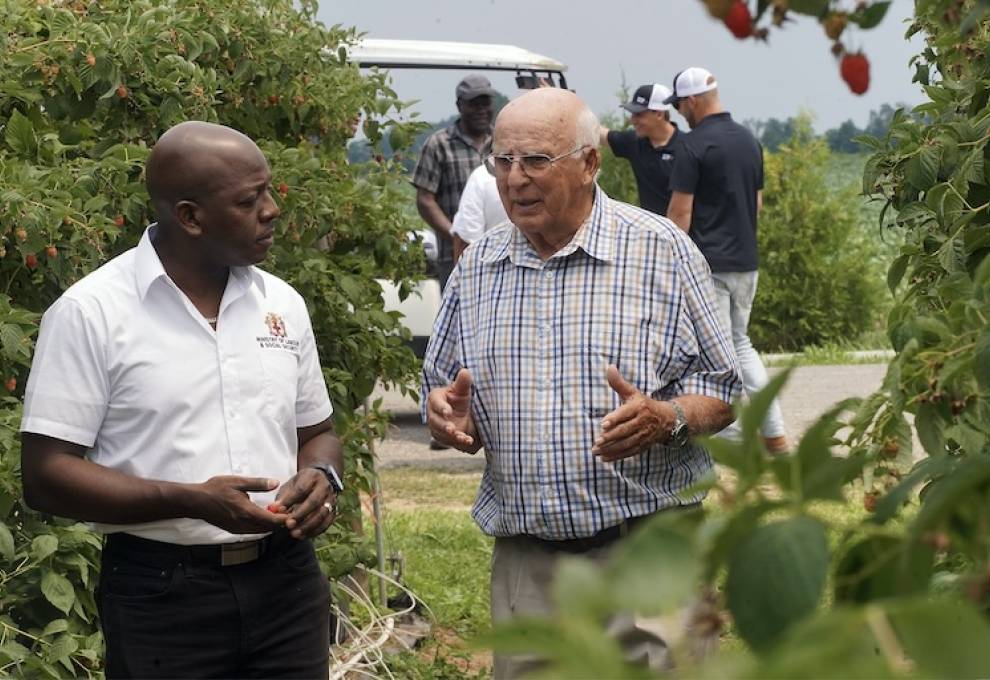
Pearnel Charles Jr., the Jamaican minister of labour, is engaging with Strawberry Tyme grower Gary Cooper in high-tunnel raspberries. In the background are Cooper’s grandsons Mason and Dalton who are chatting with temporary foreign worker Rodrick Williams. Photo by Jeff Tribe taken near Simcoe, Ontario.
Delroy Daley spends his summers a long way from home. Like a migrating bird, he’s been flying north to Canada for 42 years under the Seasonal Agricultural Worker Program (SAWP). His roots may be in Manchester, Jamaica, but every spring, his wings take him to Simcoe, Ontario.
He’s picked strawberries and raspberries for Gary Cooper, then son John, and now grandsons Dalton and Mason. And with deft hands, he’s managed to finance his daughter’s university education. His is a frequently repeated story, at the heart of the 60th anniversary celebrations of Jamaicans coming to work in Canadian agriculture. During the summer of 2026, Pearnel Charles Jr., Jamaica’s minister of labour, visited both Ontario and British Columbia to mark the milestone. His earnestness is palpable.
"Every day our workers continue to earn a reputation for excellence wherever they serve; they are our country's greatest ambassadors carrying with them the values of hard work and integrity,” said Charles Jr.
For Ontario, the numbers are significant. For the 2026 season, there were 6,071 seasonal agricultural workers from Jamaica, up slightly from a year ago as reported by Berenice Vega Rauda, executive director, Foreign Agricultural Resource Management Services (FARMS).
In mid-November, Jamaica hosted the 2027 contract negotiations for Caribbean workers. The consensus coming out of those meetings is that a Working Group on National Housing Standards will be struck.
Bill George, chair of the labour committee for the Ontario Fruit & Vegetable Growers’ Association (OFVGA) foresees a standard that is not only aspirational, but economically achievable.
“We want Canada to be the number one choice for international agricultural workers,” George says. “One item to discuss is how to implement an indoor cooling standard for summertime.” The goal is for the national housing standard to be included as an addendum to the employment contract.
Strengthening Canada’s reputation as a preferred destination for employment is an important competitive move given that the U.S. agricultural sector welcomed almost 400,000 H-2A workers in 2026, a program record. The states of Florida, Georgia, California, Washington and North Carolina account for nearly half of all approvals. Like Canada, the U.S. notes the increasing median age of workers.
Harmonized rules
Establishing a Working Group on National Housing Standards is welcome news. OFVGA and FARMS have been active in the last year with a joint housing committee, coordinating various stakeholders that include municipal health units and the various liaison services. The committee aims to solve the problem of each health unit operating a different housing inspection process. For farm employers who may have workers straddling two county lines, varying rules often create compliance issues.
“What we’re trying to accomplish is a harmonized guide that has the blessing of all the groups, that has the endorsement of the Ontario Ministry of Agriculture, Food and Agribusiness,” says Andy Vergeer, vice-chair, FARMS. “We want to be transparent so that employers know what’s expected and yet without increased administrative burden.”
If there’s an opportunity for this template to be approved by Employment and Social Development Canada (ESDC), so much the better. A federal guide would strengthen the reputation of the program in attracting international seasonal agricultural workers. That said, housing remains the purview of provincial governments.
“For too long, policies have been initiated by external voices,” says Vergeer. “It’s a noble desire for the protection of workers, but there’s a disconnect for farmers who pay for the program. They want more inclusion in the process.”
From the perspective of the Jamaican Liaison Service (JLS) housing improvements have been made since COVID. “We have seen where employers are more cognizant of the workers’ need for privacy, more space, more updated and practical accommodations, as well as the need to provide them with amenities such as internet access, washing machines and dryers,” says Althea Riley, JLS chief liaison officer.
She goes on to say that privacy and internet access are the number one needs followed closely by bathrooms, kitchen facilities, washers and dryers and air conditioning on hot days.
“In addition, we would like the phasing out of bunk beds, which would be an adjustment to the current housing standards which I am happy to say there is a multi-stakeholders group working on new housing inspection requirements. We’re hoping for implementation in the near future.”
Year-round search for seasonal labour
British Columbia’s housing issues are similar, but different in that private certified inspectors have the mandate to do on-site housing inspections. Berry grower David Mutz, president of the Western Agricultural Labour Initiative (WALI) explains that 1,200 to 1,400 Caribbean workers come to British Columbia every year, primarily to work in the tree fruit sector. Another 6,000 Mexicans come to work in the greenhouse, nursery, berry, fruit and veg sectors through SAWP.
December is a stressful month for BC farm employers looking to have Labour Market Impact Assessments (LMIAs) processed in time for early January arrivals. There’s a tight window for cleaning, sanitizing and readying greenhouses for new transplants for the next growing season. As farm employers know, LMIAs require background proof that advertising in the Job Bank for Canadian workers has gleaned no takers, necessitating offshore workers.
“The Job Bank is a mess for advertising,” says Mutz. “Ads need to run for at least 15 days. Sometimes the ads are rejected or delayed in being approved. Big employers need to advertise for more than 100 workers. And that number exceeds the Job Bank cap of 100. Sometimes LMIAs are being rejected because of the Job Bank ads, all leading to major delays. In my own case, my LMIA was rejected three times because of the wording, then I had to phone ESDC, as officers seem to be rejecting rather than contacting employers to clarify. The Job Bank is meant for truck drivers, accountants, other professions, not for agricultural workers. In my opinion, 99 per cent of the Job Bank applicants are foreigners from other countries who can’t legally work in Canada.”
Another irritant is the Recognized Employer Pilot under Canada’s Temporary Foreign Worker program. It’s closed to new entrants and terminates December 31, 2026. The original objective was to streamline the administration but pioneering employers who participated in the program are now being penalized when reapplying for LMIAs. So instead of saving time, they are back to square one, with officials asking, in some instances, for them to resubmit financial viability records. Says Mutz, “Employment and Social Development Canada (ESDC) really needs to rectify this.”
For British Columbia growers, access to seasonal labour continues to be a key issue. With Ian Paton, a new Conservative agriculture minister in place as of November 20, the farm sector will be looking for leadership on the file.
As the year draws to a close, the foreign worker program remains in the media spotlight. On November 5, the 2026 federal budget set aside $151.5 million over five years to support SAWP with a stated objective of “aligning labour needs, improving processing times and strengthening employer compliance.”
After 60 years of effort, there is consensus on at least one point: Canadian access to international seasonal agricultural workers is very much a work in progress.
Standard (Image)
If latest news
Check if it is latest news (for "Latest News" page)
1 (Go to top of list)

